
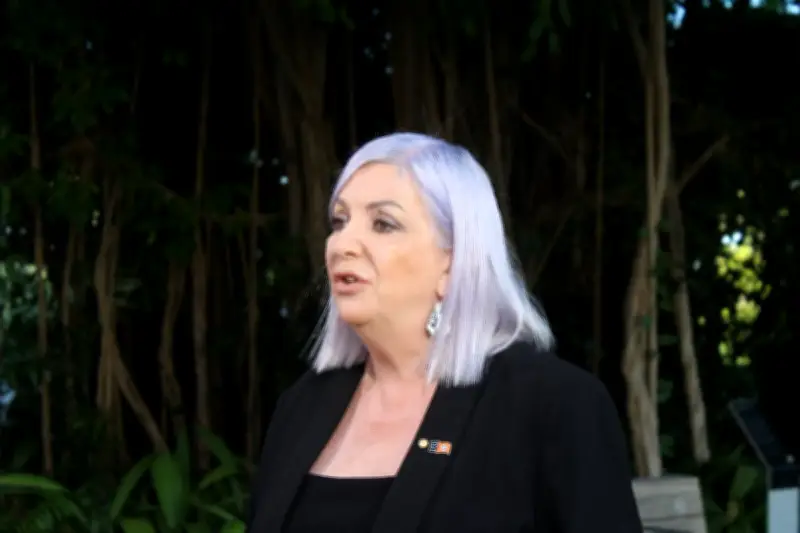
The Northern Territory minister for trade and business, Robyn Cahill, has faced criticism for claiming that groundwater in the NT needs to be used to prevent the Earth's magnetic poles from flipping. The scientifically inaccurate remarks were made while promoting the territory as a global datacentre hub.
Minister's claim draws expert rebuke
Speaking in Darwin last week, Cahill said: 'For datacentres, the water supply is already in existence. It’s mainly subterranean. The water supply that Darwin has is extraordinary.' She added: 'There’s scientific evidence to suggest that we have so much water underground in the Northern Territory that it actually impacts the axis of the Earth when we have a really bad wet season, so we need to use some of it otherwise we might find ourselves flipping the poles again.'
Kirsty Howey, executive director of the Environment Centre NT, described the claim as 'completely cooked'. 'The minister appears to believe that the Northern Territory’s wet season can alter Earth’s axis, which has no scientific basis,' Howey said. 'It’s frightening that the people in charge of regulating dangerous industries like fracking and datacentres seem to lack even a high-school understanding of water science.'
Scientific context on geomagnetic reversals
Dr Dylan Irvine, a groundwater hydrology expert at Charles Darwin University, told ABC Darwin: 'We’re not at risk of the poles flipping … I’m not concerned about the Earth tipping or flipping of poles.' The Earth’s most recent major geomagnetic reversal, the Brunhes-Matuyama reversal, occurred about 780,000 years ago. Reversals take an average of 7,000 years to occur. A temporary excursion 42,000 years ago lasted about 1,000 years. 'This is driven by processes that happen in the deep Earth … that happen in the Earth’s core … not so much groundwater systems,' Irvine said.
Datacentre plans and water concerns
Experts have warned about the impact of massive datacentre projects on strained water resources, especially in hotter climates. The ECNT is calling for a public ban on fracking and datacentres to assess their impacts on climate and water supplies. 'We don’t want to see our precious aquifers drained for AI while we get nothing in return,' Howey said. 'We don’t want to be the datacentre capital of the globe – we want safe drinking water and a livable future for our kids.'
According to the NT government, as many as a dozen datacentre developers are interested in the region. 'We will be the place all the hyperscalers come to have their datacentres here,' Cahill said last week. On Wednesday, NT chief minister Lia Finocchiaro announced the government granted Beetaloo Digital – a subsidiary of gas company Beetaloo Energy – an exclusive commitment over 185 hectares near Darwin for 'a massive project involving an integrated AI datacentre and on-site gas-fired power generation'. The project would be 'powered by up to 2GW of on-site power generation fuelled by Beetaloo gas', equivalent to the annual electricity consumption of approximately 2 million households. This follows Energy North’s Project Ares, a 1GW project proposed for Murranji station in the Barkly region.




