
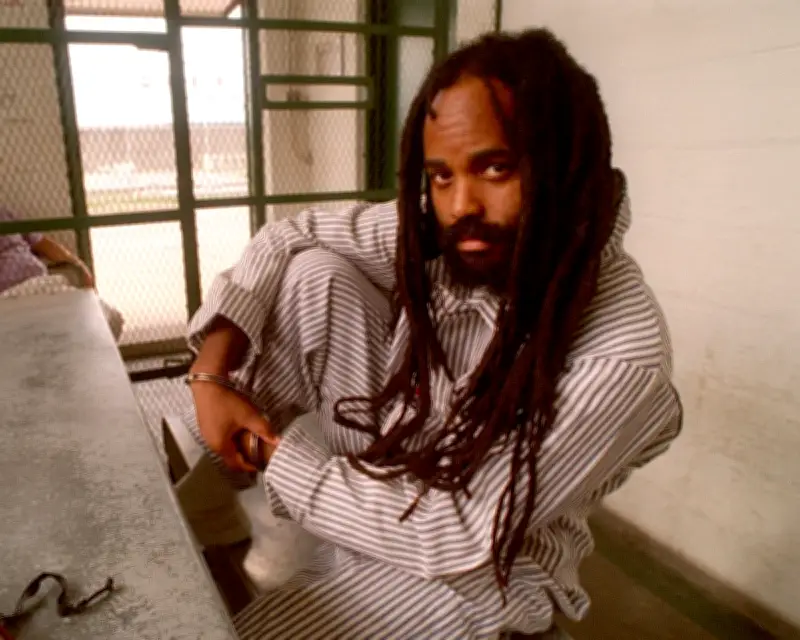
As he approaches the 45th anniversary of his incarceration in December, Black radical writer and prisoner Mumia Abu-Jamal has taken his claim of arbitrary imprisonment to the United Nations in Geneva. On Tuesday, Abu-Jamal, 72, lodged a petition with the UN’s working group on arbitrary detention, a body within the Human Rights Council. This marks the latest attempt by the internationally renowned prisoner and author of 15 books to seek relief after exhausting all domestic channels through state and federal courts.
Abu-Jamal speaks from prison
In a telephone interview from Mahanoy correctional institution in Pennsylvania, where he is serving a life sentence without parole, Abu-Jamal said the appeal to the UN was part of his personal and legal efforts to keep hope alive. “Hope is an element of struggle, is it not,” he said. “As we used to say in the old days, ‘La luta continua’.” The hope that this former Black Panther might one day walk free is slim, as Pennsylvania’s life without parole sentence means no accounting for rehabilitation, age, or health.
Abu-Jamal was convicted in 1982 of first-degree murder of police officer Daniel Faulkner in Philadelphia, a crime he has always protested his innocence of. Since then, he has become a lightning rod for both left and right. For progressives, he is arguably the most celebrated political prisoner in America today. For the law and order crowd, led by the Fraternal Order of Police, he is a cop killer.
Petition details injustices
Tuesday’s newly lodged petition calls on the UN to take a stance over what it says are many injustices during Abu-Jamal’s original trial and decades of unsuccessful appeals. His legal team—led by Bret Grote of the Abolitionist Law Center, joined by the ACLU and the Center for Constitutional Rights—argues that he endured multiple violations of international law. The document describes how the prosecutor excluded almost all Black jurors from his 1982 trial. During jury selection, the prosecutor scrawled “B” and “W” over jurors’ names to denote Black and white, then threw out 71% of all potential Black jurors and just 20% of non-Black candidates. The result was a jury of 12 with only two Black members in a county that was almost 40% African American.
The trial judge, Albert Sabo, was perhaps the most prolific death penalty judge in the country, presiding over 31 capital cases ending with death row, all but two of the defendants from minorities. Shortly before trial, he was overheard saying: “I’m going to help them fry the nigger.” The UN’s rapporteur on arbitrary detention is also asked to consider new evidence disclosed in 2018 that raises doubts about the credibility of the state’s main eyewitness, Robert Chobert, who wrote to the chief prosecutor weeks after trial inquiring about “the money own to me”.
Life without parole as arbitrary detention
One main thrust of the petition is that Abu-Jamal’s current sentence—life without parole—is itself a form of arbitrary detention in breach of international rules. He calls it “slow death row”. “It is death row without a specific date of execution. Or execution through time,” he said. He contrasted America’s fondness for life sentences—more than 200,000 people are on them, about one in seven of all prisoners—with Norway’s approach. When Anders Breivik committed the deadliest mass shooting by a single person in modern times in 2011, killing 77 people, he was sentenced to the country’s maximum penalty of 21 years, extendable on review every five years. “Such a response would be impossible, unthinkable in any of our 50 states,” Abu-Jamal said.
The UN working party has no direct enforcement powers within the US, but his legal team calculates that a strong condemnation from the world body would support the push for a retrial or commutation. Abu-Jamal welcomes the chance to present his case to experts not under political pressure faced by elected judges (all Pennsylvania judges are elected). He remembers being “flabbergasted” in 1995 when he learned that four out of seven justices on the state supreme court had been endorsed by the Fraternal Order of Police. “Presenting my claims to the UN will be one of the first times that judges will be hearing them without a vested interest,” he said.
Background and toll of incarceration
Abu-Jamal was 14 when he was booted into the Black liberation struggle in 1968 at a protest against segregationist candidate George Wallace, where a Philadelphia police officer kicked him in the face. A year later, he co-founded the Philadelphia chapter of the Black Panther Party and became a regular contributor to its newspaper. He built a successful career as a writer and broadcaster, serving as president of Philadelphia’s Association of Black Journalists. That came crashing down when he was arrested on 9 December 1981, supplementing his income by cab driving and passing the corner of 13th and Locust Streets when his brother William Cook was detained in a traffic stop by Officer Faulkner. A shootout ensued; Abu-Jamal was shot in the chest, Faulkner died hours later.
At trial, the state accused Abu-Jamal of murder, presenting his Black Panther writings to suggest antipathy toward police. He was convicted and sentenced to death, remaining on death row for 28 years until 2011 when his sentence was commuted to life without parole. He did not discuss the specifics of the charges with the Guardian, but talked about the toll on him and his family, including separation from four generations. “The state creates a system of solitary confinement for people on death row to dehumanize them to the people who love them,” he said. In his book Live From Death Row, he recounts a prison visit from his young daughter Samiya: “She rushed in, her eyes lit up, and she looked at me, and she was confused because of the glass between us. She ran to the glass, this little girl, and began hitting it, shouting: ‘Break it! Break it!’ It tore my heart.”
Global support and health struggles
Abu-Jamal received an avalanche of global support over the years. When facing execution, the New York Times reported he was the “world’s best known death-row inmate”, with support from celebrities like Maya Angelou, Spike Lee, and Paul Newman. He routinely received 50 or more letters per week, now dwindled to 10 or 12 due to restrictive mail systems and the shift from death penalty to life without parole taking him out of the limelight. “Some people seem to believe that because I’m off death row, now I’m home. They don’t know. They don’t get it,” he said.
Last month, he was made an honorary citizen of the Paris suburb Saint-Denis, where a road was named after him in 2006. If released, he would like to walk on that street, visit Ghana, and teach somewhere. He would also visit the graves of his mother Edith and wife Wadiya, who died during his imprisonment. Books have been his prime survival tool. “Books have been my closest friends for decades,” he said. “Most of what I’ve done in prison is read, and you have to read in order to write.” Even that became a struggle; for most of last year he was functionally blind due to deteriorating eyesight over the past eight years, resulting from health crises including a severe skin rash, diabetes from steroids, and a diabetic coma. He fought a two-year court battle to get medication for hepatitis C, withheld on grounds he was “not sick enough”. It took most of last year to get cataract surgery; during hospitalizations for congestive heart failure, he was shackled for days to his medical bed.
“When you cannot read, that is extremely painful,” he said. Despite impaired vision, he is compelled to finish his latest book for a PhD, exploring writings of Algerian revolutionary Frantz Fanon. “I must finish it. I am determined to finish it. And I am closing in.” He conceded it is difficult, but “difficult is not impossible. You do what you must do.”




