
Minnesota Unrest Echoes Academic Predictions of Civil War Scenario
Recent events in Minnesota are unfolding with alarming similarity to a high-level US civil war simulation conducted earlier this year. The exercise, run by the Center for Ethics and the Rule of Law at the University of Pennsylvania, explored scenarios where federal and state forces clash violently in American cities. Current developments suggest this theoretical danger is becoming a tangible reality.
Escalating Federal Actions and Local Response
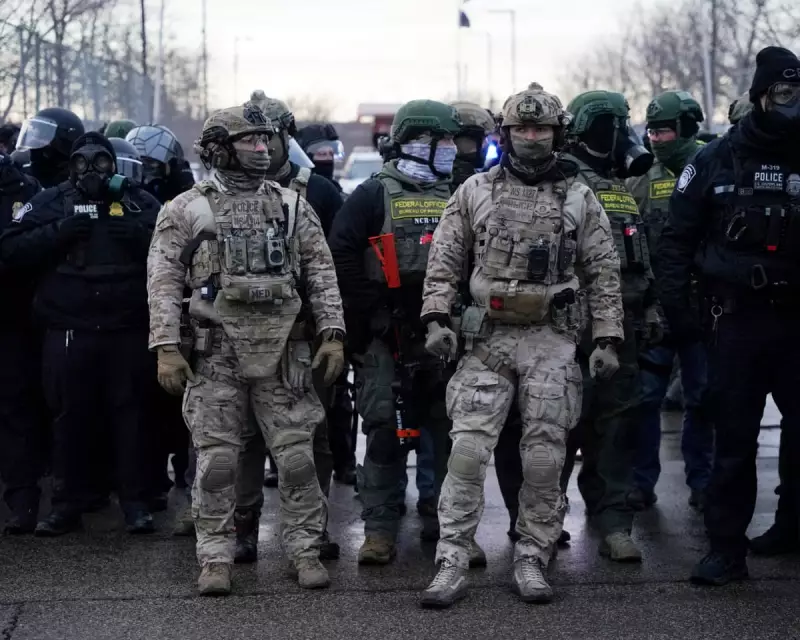
Since January, approximately 2,000 Immigration and Customs Enforcement agents have been deployed to Minnesota under the guise of a fraud investigation. In practice, these federal agents have been accused of terrorising Minneapolis residents through excessive force, often targeting US citizens rather than focusing on immigration matters. A federal judge has attempted to impose limits on ICE's activities, but the Trump administration's declaration of "absolute immunity" for agents appears to encourage continued lawlessness.
The situation deteriorated dramatically in recent weeks with several disturbing incidents:
- ICE agents shot and killed Renee Good, a 37-year-old mother of three, shortly after she dropped her child at school
- Protesters were blinded by so-called "less deadly" weapons fired at their faces
- A family car containing six children was targeted with teargas, sending one child to emergency care with breathing difficulties
- A woman was violently dragged from her vehicle and onto the ground
- Thousands have been forcibly detained in facilities, often without proper legal process
Political and Legal Ramifications Intensify
Rather than investigating these incidents, the Justice Department has opened criminal investigations against Minnesota Governor Tim Walz and Minneapolis Mayor Jacob Frey, accusing them of conspiring to impede federal agents. Remarkably, Renee Good's widow is also under investigation, prompting six US attorneys in Minnesota to resign in protest against what they perceive as unjust targeting.
As public outrage mounts, ICE has escalated its operations, engaging in what appear to be random acts of violence regardless of immigration status. Governor Walz has placed the Minnesota National Guard on standby to support local law enforcement, while President Trump has threatened to invoke the Insurrection Act. This extraordinary measure would grant sweeping domestic military powers and potentially bypass recent Supreme Court limitations on federal troop deployment for law enforcement.
Military Deployment and Constitutional Concerns
The Pentagon has readied the Army's 11th Airborne Division – approximately 1,500 active-duty soldiers – to support presidential threats, while an additional 1,000 ICE agents have been dispatched to Minnesota. This suggests the administration is effectively using ICE as a specialised paramilitary force to target protesters and suppress dissent.
The University of Pennsylvania's October 2024 tabletop exercise predicted precisely this type of escalation. In the simulation, a president conducted an unpopular law-enforcement operation in Philadelphia and attempted to federalise Pennsylvania's national guard. When the governor resisted and the guard remained loyal to the state, the president deployed active-duty troops, resulting in armed conflict between state and federal forces.
Critical Conclusions from Civil War Simulation
The exercise participants – including senior former military and government officials – reached several crucial conclusions that directly apply to Minnesota's current crisis:
- None considered the scenario unrealistic, particularly following the Supreme Court's decision in Trump v United States granting presidential immunity for official acts
- Courts would likely be unable or unwilling to intervene quickly enough during such fast-moving emergencies, leaving state officials without meaningful judicial relief
- Military leaders could face orders to use force against both state national guard units and unarmed civilians, requiring careful assessment of order legality
- Federal troops cannot lawfully back up ICE agents engaged in illegal behaviour
Every US military member has sworn an oath to defend the constitution, carrying legal obligations to refuse patently illegal orders. This principle faces unprecedented pressure as Senator Mark Kelly faces Pentagon investigation for publicly reminding service members of their right and duty to refuse unlawful commands.
A Nation at Constitutional Crossroads
For members of the 11th Airborne Division, these questions may soon move from theoretical to practical. Minnesota represents what could be the first genuine test of whether constitutional limits on domestic military force still hold authority in contemporary America. The state's crisis may determine whether the United States crosses a line from which recovery becomes extraordinarily difficult, potentially validating academic predictions about the fragility of American democratic institutions under extreme pressure.
The situation continues to develop with profound implications for federal-state relations, military ethics, and the fundamental rule of law in America. As both sides escalate their positions, the nation watches anxiously to see whether Minnesota becomes merely another chapter in political conflict or the opening scene of a more dangerous constitutional crisis.




