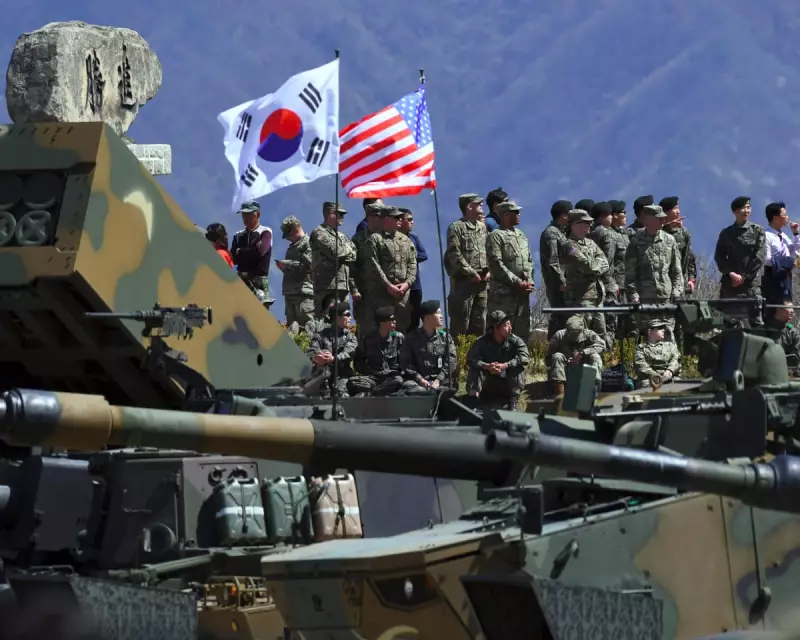
In a significant shift in military policy, the United States Department of Defense has announced plans to scale back its direct involvement in deterring North Korea, instead placing primary responsibility on its ally, South Korea. This strategic realignment was detailed in a Pentagon policy document released on Friday, which signals a "more limited" American role in countering Pyongyang's threats.
Strategic Rebalancing on the Korean Peninsula
The newly published National Defense Strategy explicitly states that South Korea possesses the capability to assume the lead role in deterring North Korea, with the US providing critical but reduced support. This document, which guides Pentagon policies, emphasises that this adjustment aligns with American interests in modernising the US force posture across the Korean Peninsula.
"South Korea is capable of taking primary responsibility for deterring North Korea with critical but more limited US support," the strategy affirms. It further notes that this redistribution of duties is consistent with broader US objectives to adapt military deployments in response to evolving global security challenges.
South Korea's Enhanced Defence Capabilities
South Korea, which currently hosts approximately 28,500 US troops as part of a combined defence arrangement against North Korean aggression, has been steadily bolstering its military preparedness. In a move underscoring its commitment, Seoul has increased its defence budget by 7.5% for the current year.
Over the past two decades, South Korea has worked diligently to expand its defence infrastructure, aiming to assume wartime command of the joint US-South Korean forces. With a standing military force of 450,000 troops, the nation has demonstrated a growing capacity to manage regional security threats independently.
Broader Regional Implications
The Pentagon's policy shift comes amid a backdrop of escalating tensions in the Indo-Pacific region. US officials have previously indicated a desire to enhance the flexibility of American forces stationed in South Korea, enabling them to address a wider array of threats beyond the Korean Peninsula.
This includes potential contingencies such as defending Taiwan and countering China's expanding military influence. While South Korea has historically resisted alterations to the role of US troops on its soil, the new strategy reflects a pragmatic approach to burden-sharing in an increasingly complex security environment.
Homeland Defence as Top Priority
The comprehensive policy document, which is typically updated by each new administration, identifies the defence of the American homeland as the Pentagon's foremost priority. In the Indo-Pacific theatre, the focus remains on preventing China from achieving dominance over the United States or its allies.
"This does not require regime change or some other existential struggle. Rather, a decent peace, on terms favourable to Americans but that China can also accept and live under, is possible," the document states, without explicitly mentioning Taiwan in its approximately 25 pages.
This diplomatic phrasing occurs against the ongoing dispute over Taiwan's status, with China asserting sovereignty over the island and not ruling out the use of force, while Taiwan maintains that only its people can determine their future.
The Pentagon's recalibrated strategy underscores a strategic pivot towards empowering regional allies like South Korea to take greater ownership of their defence, while the US concentrates on overarching global priorities and homeland security.