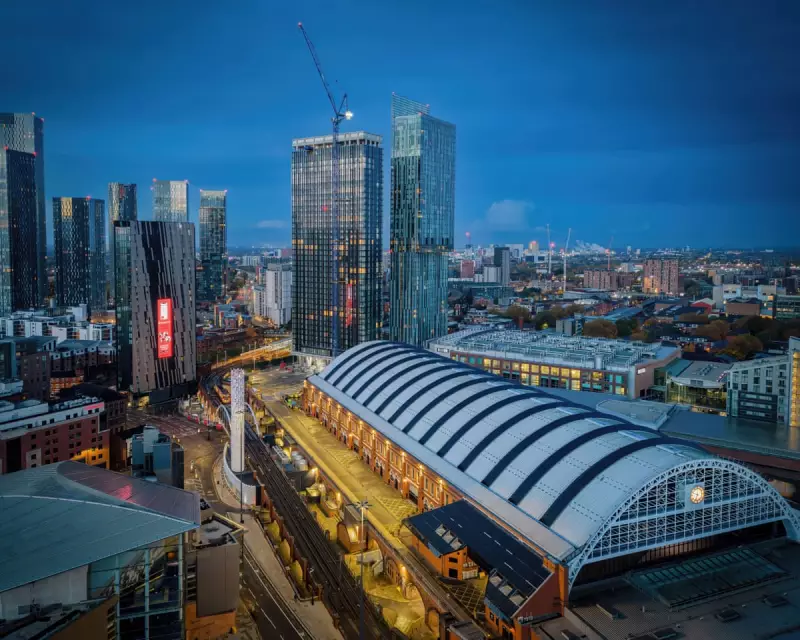
In a powerful critique of contemporary British politics, Greater Manchester Mayor Andy Burnham has positioned his city-region's approach as a vital blueprint for national renewal. He argues that the country must confront the legacy of four decades of damaging policies while rejecting the narratives of a resurgent right.
The Four Horsemen of Britain's Apocalypse
Burnham identifies what he terms the "four horsemen of Britain's apocalypse": deindustrialisation, privatisation, austerity, and Brexit. He contends that these interconnected forces have systematically weakened the nation's economic foundations and social fabric.
"The combined effects of austerity and Brexit in the 2010s laid them bare," Burnham states. "Our cities and towns were hollowed out and the country has been trapped ever since in a low-growth doom loop."

A Critique of the Right's Legacy
The mayor delivers a scathing assessment of policies originating in the Thatcher era and their contemporary manifestations. He argues that deregulation and privatisation created a "race to the bottom" that continues to drive today's cost-of-living crisis.
"Thatcher's deregulation and privatisation left people and businesses paying way over the odds for the essentials," Burnham asserts. "They are the root cause of today's cost-of-living crisis."
This critique extends to newer political forces, with Burnham suggesting that Reform UK's embrace of former Conservative politicians reveals it as "a full-on Thatcherite force with added Trumpian fervour" rather than a genuine friend of the working class.
The Manchester Model: Devolution in Action
Against this backdrop of national dysfunction, Burnham presents Greater Manchester's devolution journey as a compelling alternative. He describes how the city-region has developed "a new, more collaborative political culture that is the polar opposite of the Westminster and Whitehall world."
Practical Policy Reversals
This collaborative approach has enabled tangible reversals of 1980s-era policies:
- Public control has been retaken of the bus network
- The region is approaching a tipping point where more council and social homes are being built than are being lost through Right to Buy
- A long-term economic rebuilding strategy is addressing deindustrialisation
"We are taking a long-term approach to rebuilding an economy devastated by the deindustrialisation of the Thatcher era," Burnham explains.
Economic Success and Future Planning
The results of this approach are measurable. Greater Manchester has become the UK's fastest-growing city-region economy, expanding at double the national average rate. This week, the region unveiled plans to develop five global industrial clusters, representing a deliberate strategy of reindustrialisation.
Burnham emphasises that this growth enables more effective use of public funds: "We are showing that it is possible to make more effective use of public funds, reducing crisis spending in the long term."
Education and Opportunity
Crucially, this economic strategy is linked to educational reform. The region is creating new pathways for young people into emerging industries, offering what Burnham describes as "an equal alternative to the university route."
Manchesterism as National Solution
Burnham crystallises this approach as "Manchesterism" – a modern response to what he identifies as the "high-inequality, low-growth trap" created by 1980s policies that privatised economic power while overcentralising political power in Whitehall.
"It is about creating a new politics to plot our way out of that and develop a new economy," he states.
National Implications
The mayor suggests that applying Manchester's thinking at a national level could involve placing electoral reform centre stage to create more collaborative politics. This would enable consensus on the public investment needed to address simultaneous housing and cost-of-living crises.
Burnham concludes with a characteristically Mancunian flourish, quoting Factory Records founder Tony Wilson: "This is Manchesterism and, yes, as one of our famous sons, Tony Wilson, once said – it does mean doing things very differently."

The message is clear: as Westminster politics appears increasingly dysfunctional, Britain's future may well be decided in the north, with Manchester offering both critique and constructive alternative.