
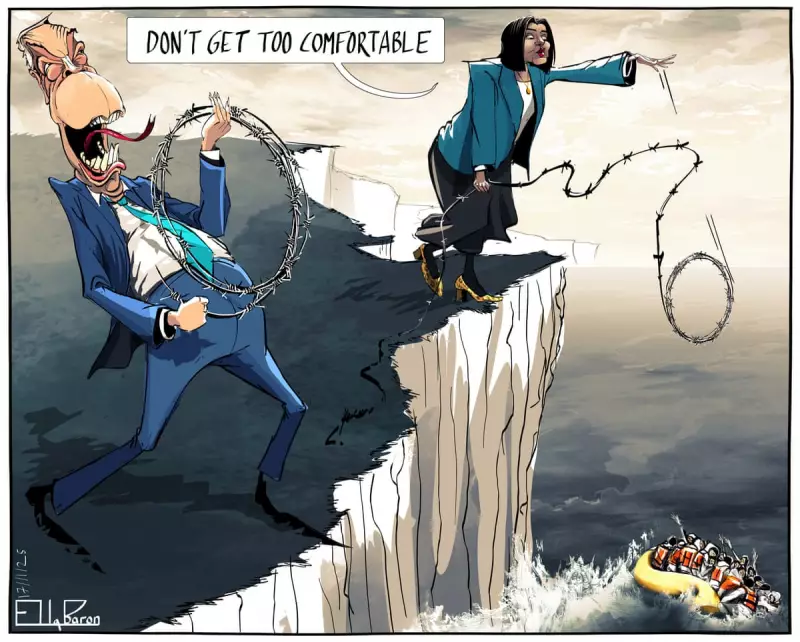
Political cartoonist Ella Baron has delivered a sharp visual commentary on the Labour Party's newly announced immigration policy, putting Shadow Justice Secretary Shabana Mahmood firmly in the spotlight. The cartoon, published in mid-November 2025, offers a critical perspective on the party's approach to border controls and migration management.
Analysing the Satirical Imagery
Baron's artwork presents a detailed critique of Labour's proposed immigration framework, using symbolic elements to convey complex political messages. The cartoon focuses specifically on Shabana Mahmood's role in shaping and promoting the new policy direction, highlighting the challenges facing opposition parties when developing credible alternatives to government initiatives.
The illustration captures the delicate balance Labour attempts to strike between maintaining border security and addressing humanitarian concerns. Through carefully crafted visual metaphors, Baron explores the tension between political rhetoric and practical implementation that often characterises immigration debates.
Political Context and Timing
The cartoon emerges during a period of intense scrutiny around immigration policy across all major UK political parties. With the policy announcement coming in November 2025, Baron's work reflects ongoing public and media interest in how opposition parties plan to handle one of the nation's most contentious issues.
Shabana Mahmood's prominent featuring in the cartoon underscores her significant role within Labour's frontbench team and her influence on policy development. The timing suggests the cartoonist is responding to recent parliamentary debates or public statements made by the Shadow Justice Secretary regarding immigration reform.
Broader Implications for Labour Strategy
Baron's critical examination raises important questions about Labour's positioning on immigration ahead of potential general elections. The cartoon appears to question whether the party has developed a sufficiently distinct or workable alternative to current government policies, or if it merely offers slight variations on existing approaches.
The artistic critique extends beyond mere policy details to address broader themes of political credibility and public trust. By visualising the potential contradictions or challenges in Labour's proposals, Baron invites viewers to consider the practical realities of implementing such policies.
This satirical interpretation comes at a crucial moment for UK immigration discourse, as all major parties refine their positions on border control, asylum processes, and international cooperation agreements. The cartoon serves as both political commentary and public accountability measure, challenging elected representatives and opposition figures to defend their policy positions against visual scrutiny.




