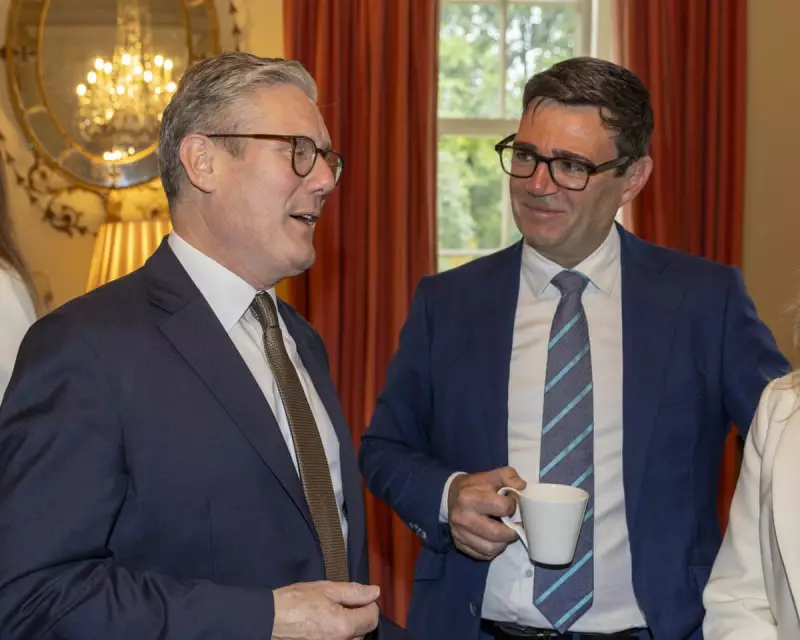
Labour's NEC Blocks Burnham Candidacy, Raising Questions About Starmer's Leadership Focus
The Labour Party's National Executive Committee (NEC) has made the controversial decision to block Andy Burnham from standing as a candidate in the Gorton and Denton constituency. This move has immediately sparked intense debate within political circles, raising significant questions about whether Keir Starmer is more concerned with protecting his own position as leader than with strengthening Labour's overall electoral prospects.
A Strategic Dilemma for Starmer's Leadership
In an ideal scenario for the Prime Minister, Andrew Gwynne's announcement that he was stepping down from his Gorton and Denton seat would have been followed by Burnham gracefully declining any opportunity to return to Westminster politics. The Greater Manchester mayor could have simply stated that he was committed to his current role and would not be pursuing a parliamentary seat at this time.
However, given the political reality that Burnham would likely seize this rare chance to re-enter Westminster, Starmer found himself facing two particularly difficult choices. The first option was to block Burnham's candidacy, which would inevitably lead to accusations of partisan control-freakery and authoritarian leadership. The alternative was to allow the candidacy to proceed, effectively putting the matter in the hands of fate and local party members.

The NEC's Decisive Intervention
It is crucial to understand that if Labour's national executive committee had granted Burnham his wish to stand, this would have represented merely the initial step in a longer process. The mayor would still have needed to secure local party backing and actually win the seat before arriving in parliament as a potential heir apparent to the leadership.
The NEC's decision, which effectively represents the position of Number 10, appears to place an absolute full-stop on this political chronology. This decisive action is perhaps not entirely surprising, given that while Starmer has developed a reputation for policy U-turns on national matters, he has consistently demonstrated decisiveness and even ruthlessness when it comes to internal party affairs.
Historical Precedents of Starmer's Internal Management
Within weeks of becoming Labour leader in 2020, Starmer took the dramatic step of banishing Rebecca Long-Bailey from his shadow cabinet. The leftwinger, who had come second in the leadership contest, was removed amid controversy surrounding antisemitism allegations. Later that same year, Jeremy Corbyn, whom Starmer had replaced as leader, was suspended from the party over similar disputes about antisemitism, never to return to the parliamentary Labour Party.
However, Sunday's decision to block Burnham carries notably greater political risks than these previous internal party moves. Starmer is no longer the bright-eyed new captain tasked by members with steering Corbyn's listing ship away from the rocks. While he achieved an improbable and decisive election victory just eighteen months ago, Labour are currently tanking in the polls, with Starmer's personal approval ratings approaching concerning levels comparable to those of Liz Truss during her brief premiership.
The Political Calculus Behind the Decision
There are, in fact, several legitimate political arguments that supporters of Starmer have put forward with considerable vehemence regarding why Burnham abandoning his mayoralty for a parliamentary tilt would not represent an entirely positive development. These arguments include the substantial financial costs associated with a mayoral byelection and the accompanying Labour campaign, particularly when this would occur just halfway through a four-year term.
Additional concerns focus on the potential damage that could be caused by a divisive Reform UK campaign in the constituency, alongside the destabilising impact of having a figure with such obvious leadership ambitions sitting on the Labour benches in the House of Commons. The presence of such a prominent potential rival could create continuous speculation and internal party tension.

The Significant Risks and Consequences
On the opposite side of the political ledger sits a series of risks and consequences that Starmer will now inevitably face following this decisive intervention. The primary criticism, likely to be thrown at him repeatedly by both Labour colleagues and opposition critics alike, is that this move demonstrates weakness rather than strength. Critics will argue that Starmer appears more focused on protecting his own position than on finding innovative ways to boost Labour's electoral chances.
While it remains true that Burnham's reputation within Westminster has been enhanced significantly by his nearly decade-long absence from parliamentary politics, he has nevertheless proved himself to be an adept and popular mayor of Greater Manchester. Burnham has successfully carved out a distinct political identity that combines left-leaning principles with growth-focused policies, which he recently termed "Manchesterism" in a public statement last week.
Electoral Implications and Party Concerns
As a totemic political figure in the north-west region, Burnham would have been strongly expected to win the Gorton and Denton byelection comfortably. If a less substantial or charismatic candidate is ultimately selected and the seat subsequently falls to Reform UK, the political repercussions for Starmer could prove genuinely grim and damaging to his leadership credibility.
At the national level, this incident reflects an increasing worry among many Labour MPs and ministers who are growing concerned about Starmer's ability to resurrect the party's fortunes. Many fear he may be unable to hold off what they view as the utterly terrifying prospect of a Reform UK government gaining power in future elections.
Perhaps more than any other consideration, preventing a Reform UK government is what Labour members and MPs desperately want to achieve. If they become convinced that Starmer cannot deliver this outcome, they will inevitably turn to alternative leadership figures. For the immediate future, that alternative will not be Andy Burnham. However, this episode represents merely a leadership debate that has been delayed rather than definitively concluded.