
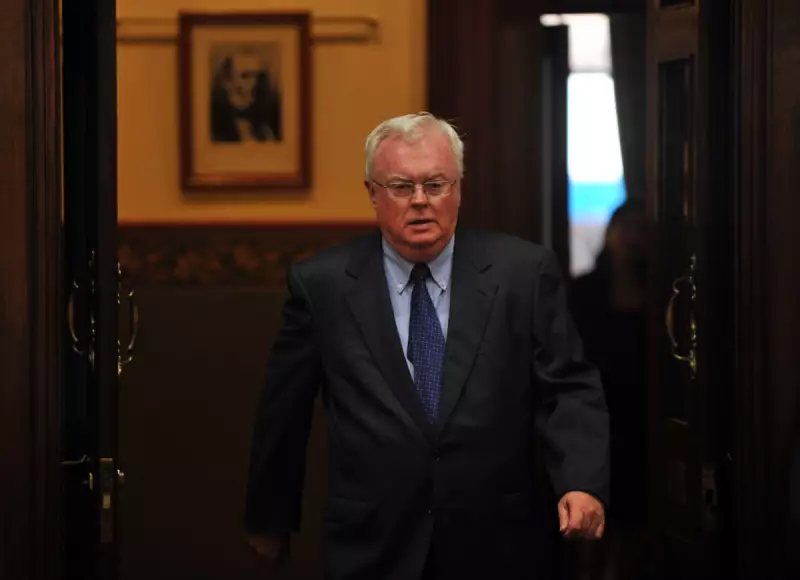
The Australian political landscape has lost one of its most formidable figures with the death of former Labor party powerbroker Graham Richardson at the age of 76.
His passing was officially announced on Saturday morning, marking the end of a long period of ill health that had plagued the former New South Wales senator for several years.
A Political Career Forged in Fire
Richardson's rise through Labor ranks began remarkably early when he became NSW Labor's general secretary at just 27 years old, during a period when internal party machinations were notoriously violent and uncompromising.
His political ascent continued when he was elected as senator for NSW in the 1983 election that brought Bob Hawke to power. At only 33 years old, Richardson quickly established himself as a force to be reckoned with in Canberra.
Following the 1987 election, Hawke promoted Richardson to minister for the environment, with subsequent cabinet posts including the portfolios of sport and social security demonstrating his versatility and political weight.
The 'Minister for Kneecaps' and Political Machinations
Throughout his career, Richardson earned a reputation as a ruthless powerbroker within the Labor party's right faction. His unofficial nickname, "minister for kneecaps," spoke volumes about his methods as a party room enforcer.
Former health minister Neal Blewett memorably described him as an "Antipodean Machiavelli" and "the arch proponent of vested interests," while ex-foreign minister Gareth Evans noted that Richardson's famous willingness to do "whatever it takes... was not always a recipe for good, principled government."
This philosophy became so central to Richardson's identity that he titled his 1994 autobiography Whatever It Takes, published when he resigned from the Senate.
Richardson played a crucial role in one of Australian politics' most significant leadership transitions, being seen as a key architect of the toppling of Bob Hawke as prime minister in favour of Paul Keating in 1991.
Controversies and Later Career
Richardson's career was punctuated by numerous scandals, though he was never found guilty of any misdemeanour. He appeared before two royal commissions investigating party donations and answering allegations about sex on a boat in Sydney harbour, though the latter were later recanted.
The 1991 Marshall Islands Affair ultimately forced his resignation from cabinet after allegations emerged that he used his ministerial position to assist his cousin. He spent his remaining parliamentary years on the backbench.
Later controversies included links to a prostitution ring in 1994 and a settlement with the tax office in 2008 concerning an undisclosed Swiss bank account.
Beyond politics, Richardson contributed to the 2000 Sydney Olympic Games as a board member of the Sydney Organising Committee and served as mayor of the athletes' village.
He later reinvented himself as an unapologetically fiery media commentator, maintaining his presence in public discourse long after leaving parliament.
In recognition of his contributions, Richardson was made an Officer of the Order of Australia in 2020.
On a personal note, Richardson was married twice - first to Cheryl Gardner, with whom he had two children, and later to Amanda, whom he married in 2007 and with whom he had another son.
Journalist Marian Wilkinson, who wrote the 1996 book The Fixer about Richardson, captured his political philosophy perfectly: "He was not a politician who believed in the rigid lines of black and white; he operated between those lines."




