
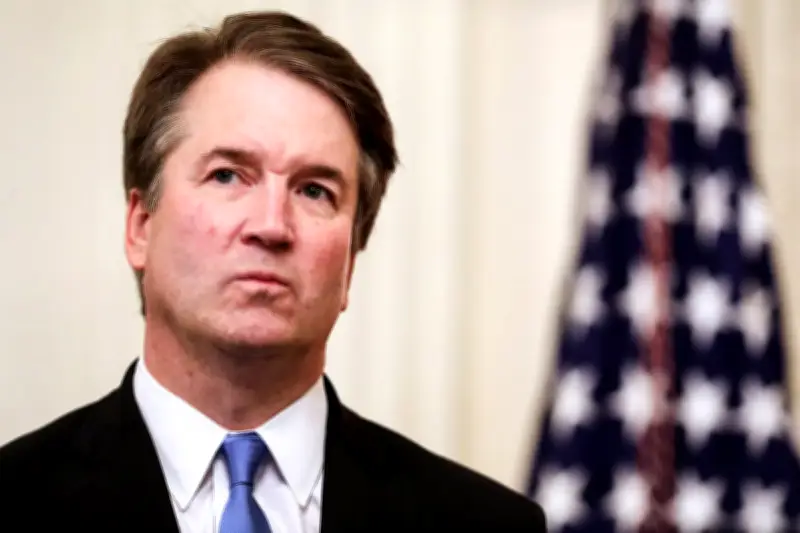
Brett Kavanaugh has become Donald Trump's chief enabler on the U.S. Supreme Court, issuing opinions that provide legal workarounds for the president's most controversial policies, according to a Guardian US column by Sidney Blumenthal.
Kavanaugh's Role in Trump's Agenda
While conservative justices Clarence Thomas and Samuel Alito voted to support Trump in 89% and 88% of cases this session, Kavanaugh's support rating is 76%. Yet his influence may be greater, as he crafts opinions that operationalize Trump's political issues through contrived justifications rather than lofty originalism.
Kavanaugh's opinions have been followed by mayhem in city streets, violence, killings, renewed Trump threats and tariffs, and chaos in Congress over birthright citizenship, fracturing Republican leadership before midterms.
ICE Stops and Racial Profiling
On September 8, 2025, Kavanaugh issued a sole concurring opinion in Noem v Vasquez Perdomo, staying a lower court's order that restricted ICE from targeting individuals based on race, language, or occupation. He argued that stopping people based on ethnic appearance, speaking Spanish, and working certain jobs was a “relevant factor” and “common sense” for “reasonable suspicion.”
Justice Sonia Sotomayor dissented, accusing the court of legitimizing “racial profiling on a massive scale” and warning: “We should not have to live in a country where the Government can seize anyone who looks Latino, speaks Spanish, and appears to work a low wage job.”
Legal scholars criticized Kavanaugh's reasoning. Jennifer Chacón, professor at Stanford Law School, noted his “invocation” of “common sense” came “at the expense of facts and evidence,” adding: “Note the number of factual assertions … supported by nothing more than 'common sense.' I am not omitting his citations to evidence; there are no such citations.” Duncan Hosie, an academic fellow at Stanford Constitutional Law Center, described Kavanaugh's claims as “factual revisionism” and “a previously unrecognized form of precedent subversion.” Sherrilyn Ifill, professor at Howard Law School, wrote: “Almost every word of this is preposterous.”
Since Kavanaugh's rationalization of “Kavanaugh Stops,” more than 170 U.S. citizens were detained in the first month, with reports of being “dragged, tackled, beaten, tased and shot,” according to ProPublica. Through July 2026, 32 American children have been detained, 31 people died at ICE detention camps, six people were shot and killed, including two U.S. citizens, Renee Good and Alex Pretti in Minneapolis. In July 2026, two men who were not ICE targets were killed.
In a December 2025 footnote in Trump v Illinois, Kavanaugh appeared to repudiate his earlier language, writing: “Officers must not make interior immigration stops or arrests based on race or ethnicity.” However, Stephen Miller ignored the footnote, and “Kavanaugh Stops” continued, with fatal consequences in Texas and Maine.
Tariffs and Trade
Kavanaugh applied similar methods in his principal dissent on February 20 in Learning Resources, Inc v Trump, where a 6-3 majority struck down Trump's claim of absolute power to impose tariffs under the International Emergency Economic Powers Act (IEEPA). Trump called those who ruled against him “fools” and “lap dogs,” but praised Kavanaugh: “I'm so proud of him.”
Kavanaugh's dissent relied on factual revisionism, citing “history, and precedent” and “common sense” to justify unilateral tariffs, though no president had used IEEPA for broad tariffs in its 49-year history. He distorted the definition of a tariff as a national security weapon belonging to the executive, not Congress. He also speculated about other statutes that “might justify most (if not all) of the tariffs at issue,” providing a roadmap for Trump.
Trump announced a 10% global temporary import surcharge under section 122 of the Trade Act of 1974, which was struck down as illegal by the U.S. Court of International Trade on May 7. Trump has since threatened further tariffs, including 25% on Brazil, 100% on Britain and European nations with digital services taxes, and a 50% tariff on most Canadian goods.
Birthright Citizenship
Kavanaugh's most notable opinion came on June 30 in Trump v Barbara, where he dissented by stating Trump's executive order violated federal law but was not unconstitutional. He argued that “significant illegal immigration into the United States is a new circumstance” unknown in 1868, and that framers of the 14th Amendment would not have intended birthright citizenship for children of illegal or temporary immigrants.
Legal scholars refuted Kavanaugh's claims. Anna O Law, constitutional scholar at CUNY Brooklyn College, noted that framers discussed Chinese and other immigrants in connection to birthright citizenship: “If the 14th Amendment framers wanted to exclude the babies of temporary visitors … they would have said so. They didn't.”
Kavanaugh suggested Congress could enact a statute creating exceptions, which he said would “pass constitutional muster.” Trump immediately hailed the idea, and House Speaker Mike Johnson echoed support, proposing a bill with no chance of enactment.
Kavanaugh's Background
Kavanaugh's controversial 2018 nomination centered on allegations of high school sexual misconduct. His earlier work as a staffer included serving as associate special counsel for Ken Starr, where he convinced Starr to investigate the suicide of Vince Foster, despite a prior report attributing it to depression. The investigation lasted three years.
During the 2000 Florida recount, Kavanaugh worked for the George W. Bush campaign, advancing the argument that differing vote-counting methods warranted halting the count, which became the basis for Bush v Gore. Justice Antonin Scalia later called that decision “a piece of shit.”
Now, Kavanaugh acts as though he is in an ex-officio capacity to the administration's legal staff, writing option memos. He has become a justice of the supreme court of counsel to Trump, more powerful than the next Roy Cohn.




