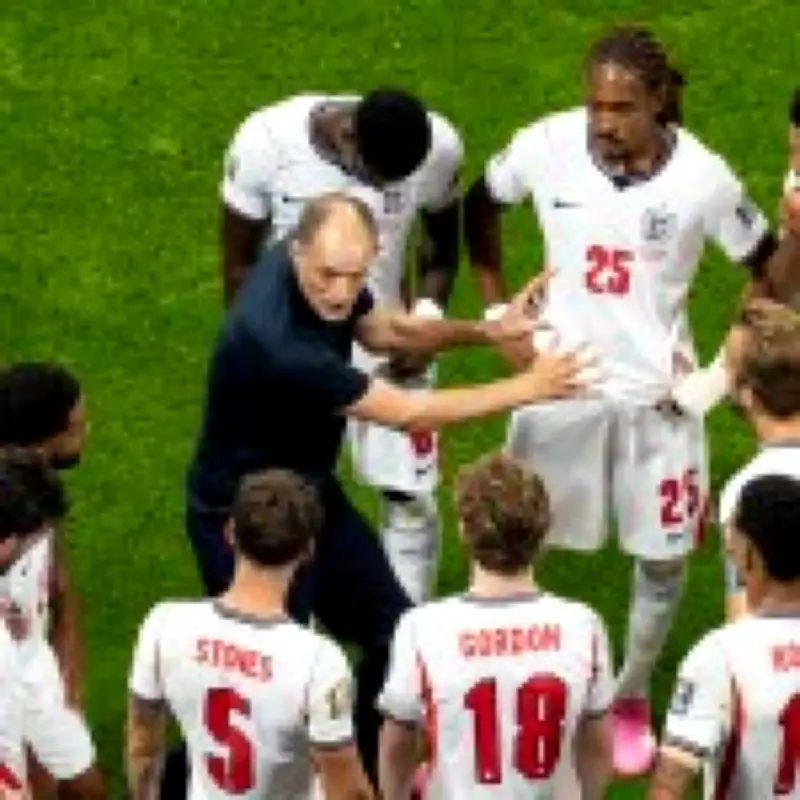
Three senior England players have privately complained about Thomas Tuchel's tactics during their 2-1 defeat to Argentina in the World Cup semi-final, according to reports. England took the lead in the 55th minute through Anthony Gordon, but a second-half collapse saw Enzo Fernandez equalise before Lautaro Martinez scored the winner in the second minute of injury time.
Tuchel's defensive changes criticised
Tuchel has faced strong criticism in the wake of England's defeat as he made three defensive substitutions and switched to a back five in order to protect his side's lead. Former England captain Wayne Rooney accused Tuchel of costing the team a place in the World Cup final against Spain and claimed the German's changes made the players 'lose belief'.
According to the BBC, at least three senior England players have 'complained privately' about the team's approach during the second half and believe Tuchel's changes 'exacerbated their defensive retreat'. The report adds that 'certain players believe the team should have had greater licence to press the ball' in order for England to stop Argentina's wave of attacks.
Argentina stunned by Tuchel's decisions
The Independent reports that Argentina were 'stunned' by Tuchel's decision to not bring on either Bukayo Saka or Noni Madueke in the second half in order to give England more attacking threat. After seeing England's defensive changes, Argentina head coach Lionel Scaloni opted to throw more caution to the wind by bringing on match-winner Martinez for left-back Nicolas Tagliafico.
Tuchel defends his approach
Tuchel, however, defended his decisions after England's collapse and claimed that an attacking substitution would not have caused Argentina problems. He admitted that England's 'big problem' is their inability to keep the ball and claimed 'no structure in the world' would have stopped the second-half collapse.
'I think ball possession plays a crucial role,' Tuchel said. 'It's maybe not in our DNA like it is in the Spanish, Argentinian or Brazilian DNA. To take the ball and control the game and the ball, which is also a big problem. But like in every structure, it was important to stay active and push out and fight duels… we just couldn't.'
'I think in this moment my feeling is that no structure in the world could have helped us because we were too passive. We were not physical enough. We didn't stop runs arriving in our box and the deliveries were then too good. Right after our goal, the momentum swings completely in ball possession and chances and it drops dramatically. We got too passive within our structure. I tried to help, not to become more passive with a back five, but to be more active, to be quicker out to the wingers, not to open up the gaps between the back four. We encouraged everyone to step out, to be more active within the structure, but we just struggled. We needed to get back on the ball otherwise you cannot break the pressure and you cannot get the momentum back.'