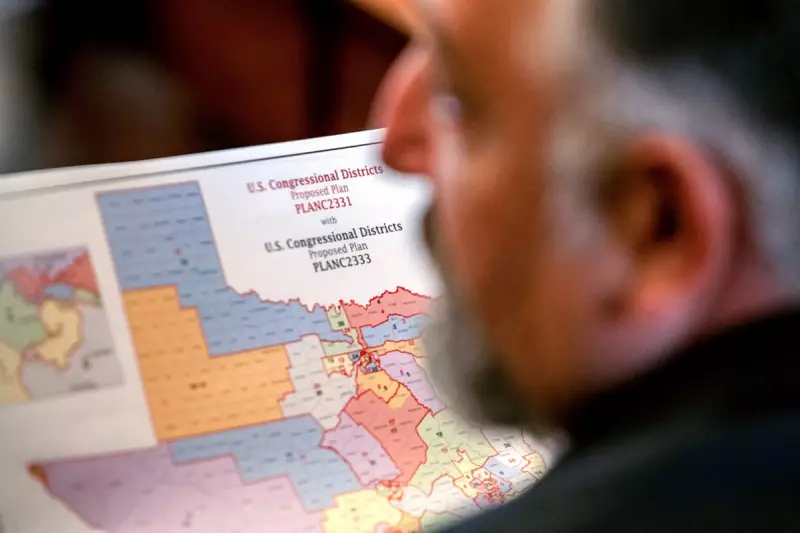
In a significant ruling with national implications, a federal judge has rejected newly proposed congressional maps in Texas, declaring them likely unconstitutional due to racial gerrymandering.
Court Blocks 2025 Redistricting Plan
On Tuesday, a panel of three federal judges instructed the state of Texas to abandon its 2025 congressional maps and revert to the previously approved 2021 versions for next year's midterm elections. The decision came after Judge Jeffrey Brown determined that the plaintiffs, including the League of United Latin American Citizens, are likely to succeed in proving that the 2025 maps were racially gerrymandered.
The court approved a preliminary injunction to prevent the use of the controversial maps, which had been unveiled in Austin, Texas, on 20 August 2025 by State Representative Matt Morgan. The proposed districts would have created five additional Republican seats, part of a broader national push for more GOP-friendly maps encouraged by the Trump administration.
The Legal Argument Against Racial Gerrymandering
In his ruling, Judge Brown emphasised that while politics undoubtedly influenced the redistricting process, the evidence pointed overwhelmingly to racial motivations. The judge highlighted a pivotal July letter from the head of the Justice Department's civil rights division, Harmeet Dhillon, which he described as containing a "legally incorrect assertion".
This letter targeted four of Texas's "coalition districts"—where no single racial group constitutes a majority—claiming they were unconstitutional and threatening legal action if they were not redrawn. Judge Brown noted that the Justice Department's letter "targeted only majority-non-white districts" and was a "threat based entirely on their racial makeup."
Furthermore, the judge pointed to public statements from Texas Governor Greg Abbott, who "explicitly directed the legislature to redistrict based on race" and repeatedly stated that his goal was to eliminate coalition districts and create new majority-Hispanic districts.
National Implications and Likely Appeal
This ruling strikes at the heart of a contentious national issue. While courts can no longer intervene in maps drawn for purely partisan reasons following a 2019 Supreme Court decision, they retain the power to block districts that are racially gerrymandered.
The Texas case is almost certain to be appealed, given the high political stakes. The decision represents a major setback for Republicans who have been pursuing aggressive redistricting strategies in several states. In response, some Democratic-led states have begun pushing to add more blue seats to counteract these moves.
Typically, redistricting occurs once per decade following the census, but Texas's mid-decade effort has now been halted. The state must now use the 2021 maps for the upcoming elections, though the legal battle is far from over as the case proceeds to a full trial.