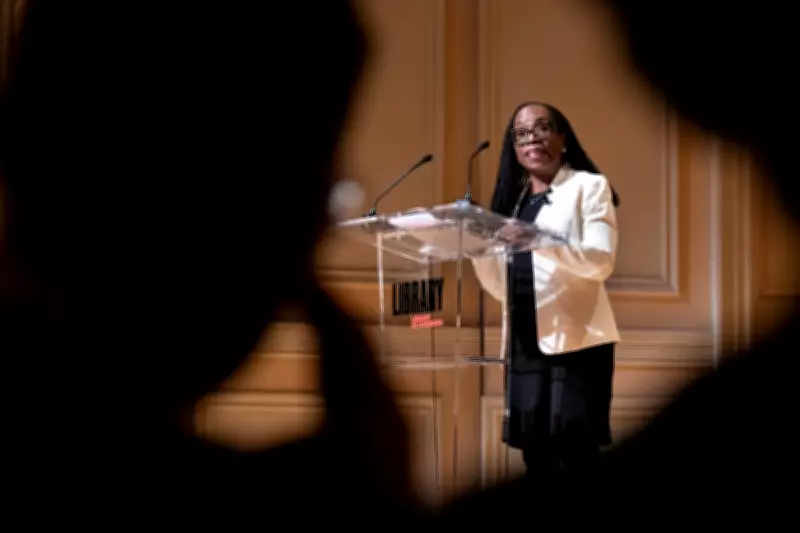
Justice Ketanji Brown Jackson issued a rare public rebuke of the US Supreme Court on Monday, declaring that the nation's highest court 'can and should be better' following a series of controversial moves by its conservative supermajority.
Jackson's Warning on Political Perception
Speaking at a conference hosted by the American Law Institute in Washington DC, Jackson emphasized that 'courts are apolitical, not supposed to be issuing rulings that are in the political realm.' She stressed the need for the court to 'be scrupulous about sticking to the principles and the rules that we apply in every case, and not look as though we're doing something different in this kind of context.'
Jackson, the newest member of the court and its fiercest liberal voice, delivered the remarks weeks after writing a solo dissent as the Supreme Court effectively gutted a key section of the Voting Rights Act. The court, which has held a six-justice conservative majority since 2020, has faced questions over a series of brief emergency orders allowing former President Donald Trump's policies to temporarily take effect.

Real-World Consequences
Warning of the 'real world consequences that are occurring' from the court's rulings, Jackson noted that 'no one really has a clear sense of why it's happening or what the court's reasoning is. So I just think we can and should be better.'
Jackson was nominated by President Joe Biden in 2022 and is one of the Supreme Court's three liberal justices. Her conservative counterparts have repeatedly pushed back at the suggestion that politics plays a role in the court's decisions. Chief Justice John Roberts insisted earlier this month that Supreme Court judges are not 'political actors.'
Criticism of Recent Decisions
Jackson's comments come amid criticism of decisions widely viewed as benefiting Trump and his allies, including the overturning of federally protected abortion rights, the granting of presidential immunity for official acts, and the court's latest ruling weakening the Voting Rights Act.
At Monday's event, Jackson pointed to her written dissent from last month, in which she argued against the court's decision requiring Louisiana to redraw its congressional map. The ruling set the stage for a blitz by Republicans to redraw such maps in US southern states, challenging the influence of Black and other minority voters.
Dissent and Response
In her solo dissent, Jackson wrote that the Supreme Court's 'principles give way to power' and that the ruling had 'spawned chaos.' Citing that dissent on Monday, she said the Supreme Court needs 'to be very constrained.'
She went on to emphasize the importance of the court's public perception, stating: 'Public confidence is really all the judiciary has … Everyone believes the court system is outside the political sphere. I think that means it's incumbent on us to do things, to act in ways that shore up public confidence.'
In response to Jackson's dissent last month, conservative Justice Samuel Alito called her arguments 'groundless and utterly irresponsible,' adding: 'What principle has the court violated? … The principle that we should never take any action that might unjustifiably be criticized as partisan?'