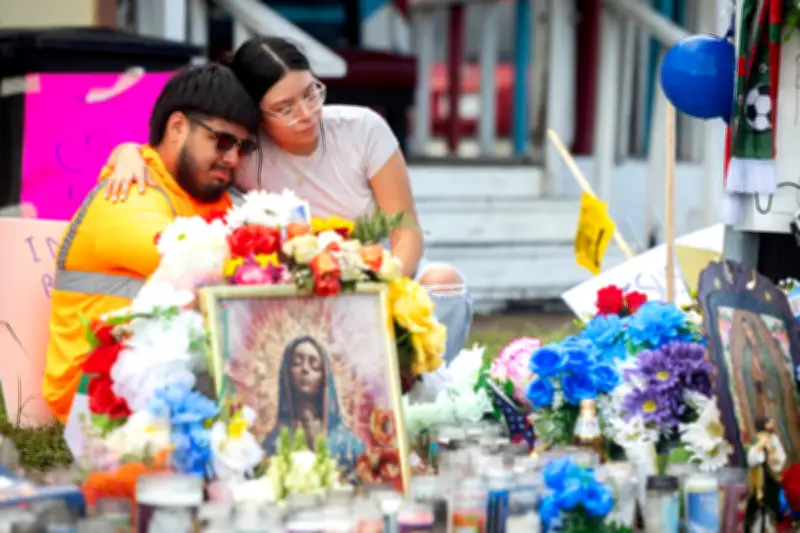
Lorenzo Salgado Araujo, a 52-year-old Mexican immigrant who had lived in the United States for 35 years, was shot and killed by Immigration and Customs Enforcement (ICE) agents on July 7, 2025, in Houston's East End. His son, Ronaldo Salgado, identified his father not by sight but by his voice in a video of the incident, crying for help. The killing has sparked renewed calls for transparency in immigration enforcement, including the use of body cameras and marked vehicles.
Details of the Shooting
According to the Department of Homeland Security (DHS), ICE agents in unmarked vehicles attempted to stop Salgado Araujo, mistaking him for another individual. The DHS claims he rammed an ICE vehicle and tried to run over an agent, who fired in self-defense. However, at least two surviving passengers dispute this account, stating that no agent stood in front of the van and that shots were fired through the passenger side. No released footage supports the government's version of events.
Salgado Araujo's family had prepared for a possible ICE detention, advising him to sign nothing and remain calm. His son believes his father may have feared that the armed men in unmarked vehicles were criminals attempting to steal his work tools. The incident highlights the difficulty of distinguishing lawful authority from armed strangers when government agents conceal their identity.
Pattern of Fatal Shootings
Salgado Araujo's death is at least the 10th fatal shooting involving federal immigration officers since President Donald Trump returned to office. The day after an ICE agent killed Renée Good in Minneapolis, former acting ICE director John Sandweg called the rise in shootings a direct byproduct of the administration's shift toward arrests on public streets. Less than a week after Salgado Araujo's killing, an ICE officer fatally shot a 26-year-old Colombian man in Biddeford, Maine.
Senator Jon Ossoff had previously questioned why 'roving gangs of masked men' were 'demanding papers, dragging people from their cars, and shooting people to death.' A federal court ordered immigration agents in Chicago to wear body cameras, and state and local lawmakers pursued measures requiring agents to unmask and identify themselves. Yet Trump signed a $70bn immigration-enforcement bill funding ICE and border patrol through 2029 without requiring agents to unmask or wear body cameras.
Lack of Transparency
No official informed Salgado Araujo's family of his death; Ronaldo learned it from social media and then called his mother. The three men who contradict ICE's version of events, including Salgado Araujo's brother, were detained and interviewed separately, giving consistent accounts, according to their attorney. Houston's district attorney says federal authorities have denied him access to the van.
Representative Sylvia Garcia says ICE's acting director promised to equip all field officers with body cameras by the end of July, but the Trump administration has at last conceded the principle that transparency is necessary. However, the pattern of concealment and violence continues to erode trust.
Impact on the Community
Salgado Araujo died in Magnolia Park, a historic Mexican American neighborhood in Houston. Residents had already learned to watch for unmarked cars before his death. Hundreds gathered there on Saturday to mourn him and resist a familiar cycle in which state silence follows state violence. As Jamil Smith, a Guardian US columnist, writes: 'If Americans want a government that commands trust rather than fear, they must demand more of those who exercise its power than of those who must live with what it does. A government confident in the legitimacy of its actions should never be afraid to show its face.'