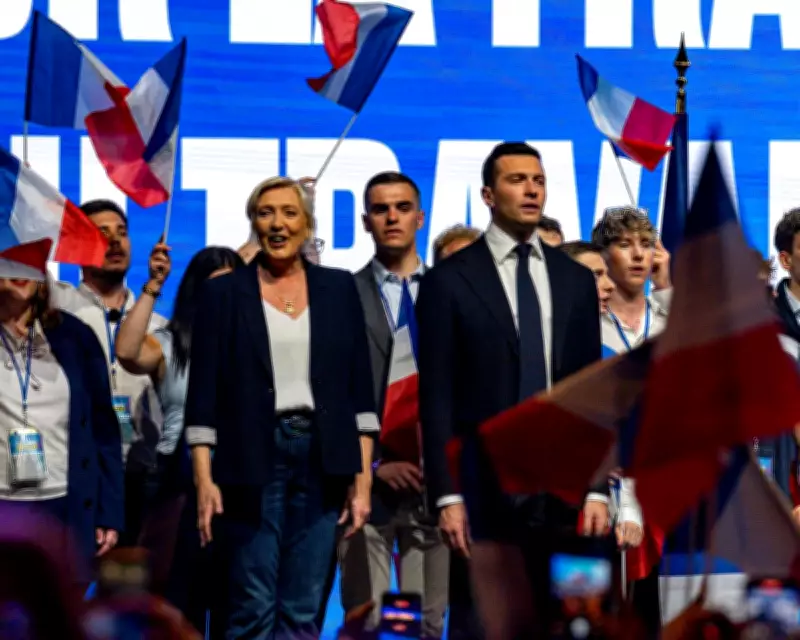
Marine Le Pen and Jordan Bardella attended the National Rally's 'Fête de la Nation' event in Mâcon on 1 May 2026, as the far-right party gears up for the 2027 presidential election. Despite widespread pessimism, the outcome remains uncertain.
Apocalyptic Forecasts Are a National Sport
France has a long tradition of predicting its own collapse. At a recent dinner in Paris, friends served up great food alongside apocalyptic forecasts: after nine years of Emmanuel Macron's rule, the country stands at the abyss, between civil war and financial bankruptcy. Under the grey Paris sky, there was little agreement, but one year before the 2027 presidential election, many French people seem convinced that the far-right National Rally (RN) will conquer the Élysée Palace for the first time.
Is This Pessimism Justified?
Author Michel Houellebecq once said, 'France has a talent for depression,' but he has often been wrong about French politics. He gave Macron no chance in 2017 and imagined an Islamist party winning in 2022. So, is the anxiety over next year's vote another passing moment in a country prone to hysteria?

To be sure, the far right has never been closer to power. Polls suggest the RN candidate—whether Marine Le Pen or Jordan Bardella—would win every plausible runoff except against former Prime Minister Édouard Philippe. But Philippe now faces a judicial probe over corruption allegations, and the centre-right field is crowded. The left is divided and faces an uphill battle.
The Decisive Question: Will Leftwing Voters Hold Their Noses?
As in 2017 and 2022, the runoff may hinge on whether leftwing voters can support the centre-right candidate. Philippe retains some credibility among leftwing voters as mayor of Le Havre, but many are tired of choosing the lesser evil. Some non-far-right voters even seem to want the RN catastrophe to happen, out of nihilism or a craving for spectacle. More often, it is resignation: French people resemble someone who, exhausted by fear of a burglar, leaves the jewellery box on the doorstep.
History Offers Two Lessons
First, French presidential elections rarely turn out as predicted a year in advance. In 2012, no one expected François Hollande to win after Dominique Strauss-Kahn's withdrawal. In 2017, Macron was a little-known former banker. The race remains wide open.
Second, France has a reverse 'shy far-right voter' phenomenon. Polls routinely overestimate RN support in runoffs. In 2022, polls averaged Le Pen at 44.2%, but she got 41.45%. In 2017, the average was 37.78%, but she finished at 33.9%. While voters may boast about voting RN to stick it to Paris, in the voting booth, many choose the status quo. Apathy is a form of performance.
Reasons for Optimism
Despite deep anxiety, most French people are content with their present lives. In 2026, 75% of respondents in the Ipsos Happiness Index said they were happy, up 4% from 2024. With 60% owning homes, the electorate remains cautious. In the Fifth Republic's history, only François Mitterrand in 1981 was elected on a genuinely radical manifesto. The only radical force with a credible path today is RN, but as the poet Paul Claudel warned, 'The worst is not always certain.'
France's fatalist streak coexists with a deep voluntarist and idealist tradition—the nation of liberty, equality, fraternity. That tension keeps the country politically alive and far from apathetic. There are reasons for optimism.