
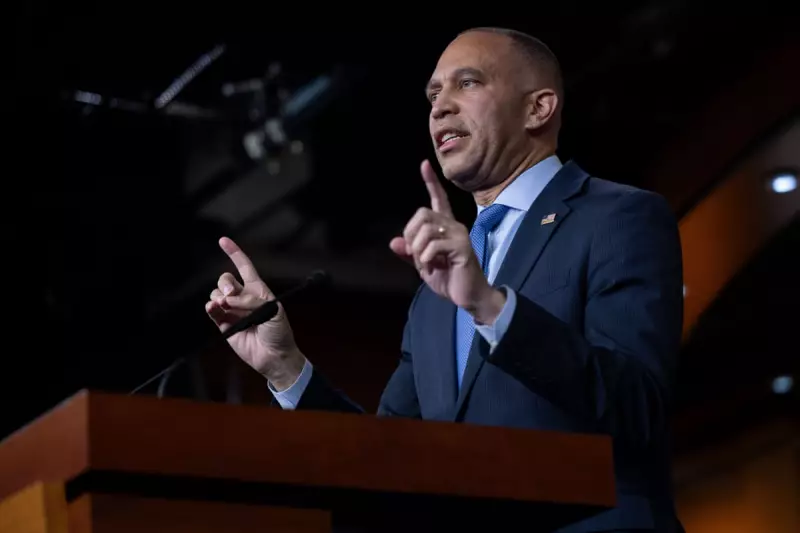
Senior House Democrats have declared their firm opposition to the proposed legislation aimed at ending the US government shutdown, citing its failure to address critical healthcare funding demands that could see millions facing higher insurance premiums.
Healthcare Tax Credits at Heart of Dispute
For several weeks, Democratic lawmakers have insisted that any government funding measure must include an extension of tax credits for Affordable Care Act health plans. These subsidies, originally established under President Joe Biden, are scheduled to expire at the end of December, which would inevitably drive up premium costs for enrolled Americans.
The political standoff intensified when Congressional Republican leaders, encouraged by Donald Trump, refused to incorporate the healthcare extensions into funding legislation. This disagreement triggered what has become the longest government shutdown in American history.
Senate Compromise Faces House Resistance
The Democrats' united front showed its first cracks earlier this week when a breakaway faction within the Senate collaborated with Republicans to draft a compromise bill. This legislation authorises government funding through January but notably excludes the healthcare tax credit extensions that Democrats consider essential.
Following the Senate's approval of this bill on Monday evening by a narrow 60-vote margin, attention has shifted to the House of Representatives, where voting is expected to commence on Wednesday afternoon.
House Minority Leader Hakeem Jeffries condemned the proposed legislation, describing it as a "partisan Republican spending bill that continues to gut the healthcare of the American people."
Jeffries emphasised that House Democrats remain willing to negotiate with Republican counterparts at any time or place to find a bipartisan solution, but firmly rejected what he characterised as their "my way or the highway approach to governance."
Democratic Coalition Opposition Grows
The resistance extends beyond leadership, with the influential New Democrat Coalition, the House's largest ideological caucus representing centrist views, announcing its formal opposition to the measure on Tuesday.
Chair Brad Schneider stated, "While New Dems always seek common ground, our coalition remains united in opposition to legislation that sacrifices the wellbeing of the constituents we're sworn to serve." He highlighted that the Senate-approved bill fails to protect healthcare access, reduce costs, or counter what Democrats view as the administration's extreme agenda.
The progressive wing of the party echoes this sentiment, with Congressional Progressive Caucus chair Greg Casar labelling the compromise "a betrayal of millions of Americans counting on Democrats to fight for them."
Precarious Vote Count for Speaker Johnson
The unified Democratic opposition creates significant challenges for Republican Speaker Mike Johnson, who faces an extremely narrow margin for passage. With the Republican majority standing at 219 members under full attendance, Johnson can afford to lose only two votes.
The situation is complicated by expected Republican defections, including Kentucky Representative Thomas Massie, who is likely to vote against the bill.
However, Democrats may also experience some internal dissent. Maine Representative Jared Golden, who recently announced he won't seek re-election in a district that supported Trump, was the sole Democrat in September to back a Republican funding bill that similarly excluded tax credit extensions.
Washington Representative Marie Gluesenkamp Perez, representing another Trump-friendly district, also expressed support for the earlier Republican version. Neither lawmaker's office immediately responded to inquiries about their voting intentions regarding the current Senate compromise.
Senate Passage and Future Uncertainties
The compromise legislation narrowly cleared the Senate on Monday evening, receiving exactly the 60 votes required for advancement. All Republican senators supported the measure except for Kentucky's Rand Paul, joined by eight moderate Democratic caucus members.
This group included several recently re-elected or retiring senators: Jeanne Shaheen and Maggie Hassan of New Hampshire, Tim Kaine of Virginia, Dick Durbin of Illinois, John Fetterman of Pennsylvania, Catherine Cortez Masto and Jacky Rosen of Nevada, and Maine Independent Angus King.
Although these moderates failed to secure the tax credit extensions, they did obtain a commitment from Republican Senate Majority Leader John Thune to hold a vote by mid-December on extending the subsidies. However, significant uncertainty remains about whether sufficient Republican support exists for passage, and Speaker Johnson hasn't agreed to schedule a House vote on the matter.
The compromise has generated backlash from progressive organisations that previously supported Senate Minority Leader Chuck Schumer's strategy during the shutdown. Both Indivisible and MoveOn have announced campaigns opposing Schumer's continued leadership, with MoveOn Political Action executive director Katie Bethell stating, "It is time for Senator Schumer to step aside as minority leader to make room for those who are willing to fight fire with fire when the basic needs of working people are on the line."




