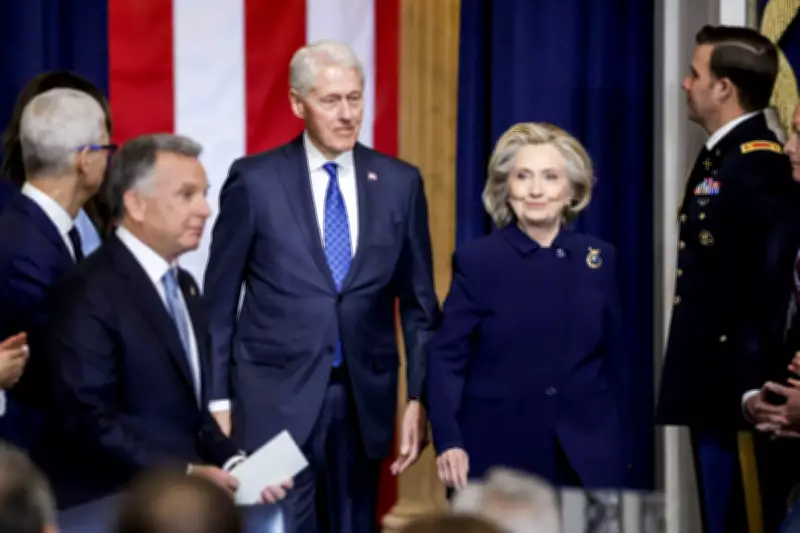
Clintons Face Congressional Contempt Vote Amid Epstein Investigation Standoff
The political drama surrounding the Jeffrey Epstein investigation has intensified dramatically, with former President Bill Clinton and former Secretary of State Hillary Clinton now facing potential criminal contempt of Congress charges. The full House of Representatives is poised to vote this week on whether to hold the Clintons in contempt, a move that could result in substantial fines or even incarceration if they are convicted.
Republican Committee Chair Rejects Clinton's Compromise Offer
Republican Congressman James Comer, who chairs the powerful House Oversight Committee, has firmly rejected an offer from Bill Clinton to conduct a transcribed interview regarding matters related to the investigations and prosecutions of Jeffrey Epstein. In a decisive social media post, Comer declared that "the Clintons do not get to dictate the terms of lawful subpoenas," insisting instead that both Clintons must sit for sworn depositions before the committee to fulfill the panel's subpoenas.
The Clintons' legal team had proposed a compromise arrangement where Bill Clinton would participate in a transcribed interview while Hillary Clinton would submit a sworn declaration. However, Comer's rejection of this proposal has pushed the confrontation closer to a critical vote that could have significant legal consequences for both former officials.

Legal Battle Over Subpoena Validity Intensifies
The Clintons' attorneys have mounted a vigorous defense against the congressional subpoenas, arguing in a detailed letter dated 12 January that the demands are:
- Invalid and legally unenforceable
- Untethered to a valid legislative purpose
- Unwarranted as they do not seek pertinent information
- An unprecedented infringement on the separation of powers
Their legal team contends that the subpoenas "run afoul of the clearly defined limitations on Congress' investigative power propounded by the Supreme Court of the United States." They further assert that the demands represent "nothing more than a ploy to attempt to embarrass political rivals, as President Trump has directed."
Bipartisan Support for Contempt Charges Emerges
In a notable development, nine of the committee's twenty-one Democrats joined Republicans in supporting the contempt charges against Bill Clinton, arguing for full transparency in the Epstein investigation. Three Democrats also supported the charges against Hillary Clinton, indicating some bipartisan concern about cooperation with the congressional inquiry.
The Republican-controlled oversight panel had already advanced criminal contempt of Congress charges last month in response to the Clintons' refusal to testify before Congress. This procedural step has now set the stage for the full House vote that could dramatically escalate the legal pressure on both former officials.
Epstein Files Release Fuels Political Controversy
The confrontation occurs against the backdrop of recent revelations from the Department of Justice, which released more than three million files related to Jeffrey Epstein on Friday. This massive document dump included:
- Over 2,000 videos related to the investigation
- Approximately 180,000 images from the case files
- Previously unknown emails between billionaire Elon Musk and Epstein
Democrats have responded to the document release by promising to fight what they're calling a "full-blown cover-up" of the Epstein files. Many senior Democrats, along with Republican Congressman Thomas Massie of Kentucky, argue that millions more pages of information are being withheld by the Justice Department.

Historical Context and Political Implications
Bill Clinton's relationship with Jeffrey Epstein has re-emerged as a focal point for Republicans amid the broader push for accountability regarding the convicted sex offender, who died by suicide in 2019 while facing sex trafficking charges in a New York jail cell. Like numerous other prominent figures, including Donald Trump, Clinton maintained a well-documented social relationship with Epstein during the late 1990s and early 2000s, though he has never been accused of wrongdoing in his interactions with the late financier.
The Clintons have remained highly critical of Chairman Comer's approach, accusing him of injecting politics into the investigation while failing to hold the Trump administration accountable for delays in producing the Department of Justice's case files on Epstein. This political dimension adds another layer of complexity to an already contentious investigation that continues to reverberate through Washington's corridors of power.