US Childcare Funding Crisis: Families Face 'Impossible Choices' Amid Federal Freeze
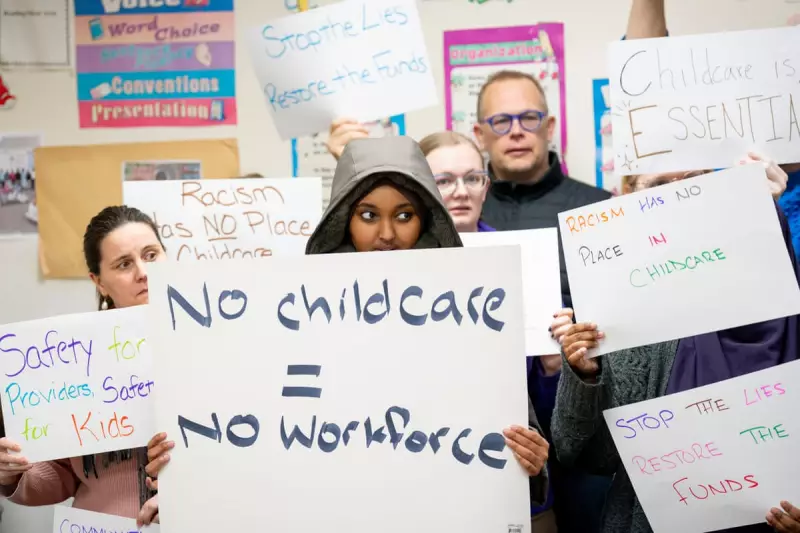
Parents, teachers, childcare workers, and community members gathered at Nokomis Daycare Center in Minneapolis, Minnesota, on 31 December 2025, holding handmade signs during a press conference. This demonstration highlighted a growing national crisis as US families grapple with "impossible choices" due to the Trump administration's push to freeze federal childcare and family assistance funds in five states.
Funding Freeze Threatens Billions Across Democratic States
The proposed freeze targets billions of dollars in Minnesota, New York, California, Illinois, and Colorado—all states with Democratic-led governments. According to the Department of Health and Human Services, the affected funds include nearly $2.4 billion through the Child Care and Development Fund (CCDF), $7.35 billion through the Temporary Assistance for Needy Families (TANF), and $869 million through the Social Services Block Grant (SSBG).
Alice Dryden, a childcare worker in Chicago, Illinois, described the potential freeze as a "disaster" for reliant families. "If we had to close our doors or close some classrooms, these families would be faced with impossible choices," Dryden explained. "This is a support network for the entire community. Our workforce allows the rest of the workforce in the city and the state to function."

Fraud Allegations Debunked as Misleading Narrative
The freeze stems from claims of potential fraud and misuse of taxpayer funds, incited by a viral video from a conservative influencer who collaborated with Minnesota Republicans. The video alleged fraud at a Somali daycare center in Minnesota, but media outlets have debunked these allegations, finding no evidence of childcare centers misusing federal funds.
Lily Crooks, a childcare worker in Minneapolis, Minnesota, expressed horror at the situation. "A lot of this reaction about fraud is actually about the Feeding Our Future scandal, which has already been widely covered," Crooks said. "Having it brought up more broadly as fraud in childcare centers is extraordinarily misleading. Then to have that misleading narrative be picked up by our federal government, which would then freeze childcare funds to an entire state, was extremely stressful and scary."
Crooks added that childcare providers have been fighting for decades to be seen as more than babysitters and are now struggling to avoid being labelled as criminals. "The funds are tied to families, so it's actually cutting off childcare funds to families, not to childcare centers," she noted.
Economic Ripple Effects and Workforce Concerns
The impacts of freezing these funds extend beyond childcare centers, threatening working parents and local economies. Crooks emphasized that parents reliant on these funds might be unable to work without them, creating ripple effects. "It's already extremely difficult for families to receive childcare assistance, and to have it have yet another hurdle is going to drive people out of the workforce," she added.
Francis Ramirez, a childcare worker in Lancaster, California, with 27 years of experience, shared her shock upon learning about the freeze attempt. "I was in shock. It's my only income. I'm a single mom," Ramirez said. She also highlighted fears among families regarding immigration enforcement, noting that some are afraid of current ICE activities.
Political Backlash and Legal Challenges
Claudia Alvarado, a childcare worker in Hollister, California, strongly criticized the Trump administration's actions. "California's childcare workforce is under unprecedented attack from President Donald Trump and his administration's racist and hateful ideology," Alvarado stated. "Childcare is not a partisan issue."
Pam Frank, a childcare worker in Springfield, Illinois, pointed out the existing shortage of childcare providers in the US, with workers significantly underpaid. Childcare prices nationwide average $13,000 annually, rising faster than inflation in nearly every state, and 45 states have fewer providers than before the Covid-19 pandemic.

"We already have a shortage," Frank said. "Most of the workers that work in the field already qualify for additional services. So it'll be devastating, because parents won't have anywhere to take their children. Myself, this is my sole income, so if there's a freeze on the program, then I would have to try to go to find work, but this is my career. I've been doing this for 30 years."
Court Intervention and Ongoing Disputes
The impacted states have sued the Trump administration to halt the freeze, securing a court order on 9 January to temporarily block the freezing of funds. They are seeking a longer-term injunction as a federal court hears the case.
The White House did not respond to multiple requests for comment. A spokesperson for the Department of Health and Human Services deferred to a post on X from HHS general counsel Mike Stuart, who claimed the lawsuit was a "partisan political stunt" against freezing federal funds to the states.
"HHS stands by its decision to take this action to defend American taxpayers. We identified serious concerns in these states that warranted immediate review and action," Stuart said. "These same officials were complicit in this perpetuation of this fraud and allowing it to happen. Waste, fraud, and abuse will not be tolerated in the Trump administration."
Attorneys general from the five states argue that the administration has not provided any evidence of fraud or justification for freezing the funds, alleging that these actions violate the law and the US Constitution. The federal government has not provided a timeline or details for the freeze, noting that funds will remain frozen until HHS's Administration for Children and Families completes a review and determines state compliance with federal requirements.