
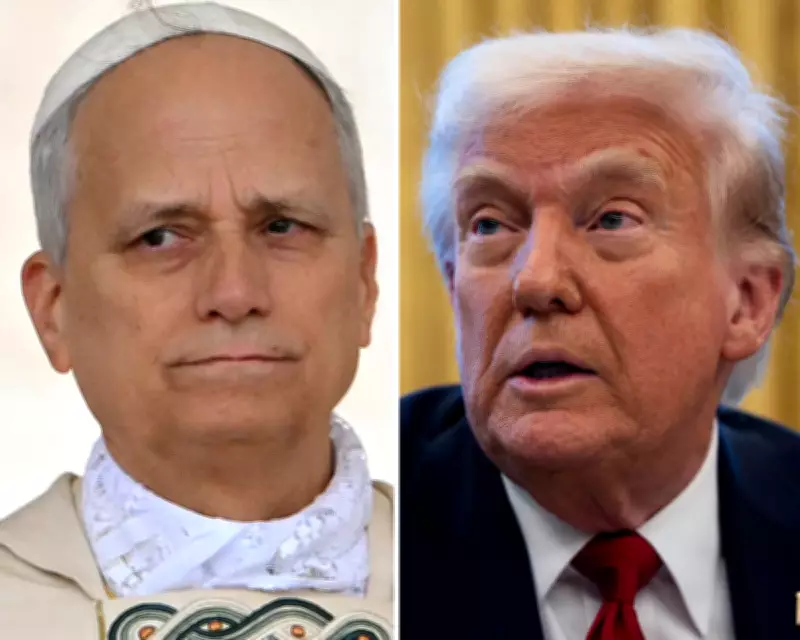
American Catholics Navigate Faith and Politics in Trump-Pope Conflict
The ongoing tension between religious faith and political allegiance has become a defining characteristic of the American Catholic experience, particularly in recent weeks as former President Donald Trump engages in a public feud with Pope Leo XIV. This conflict has prompted Catholics across Atlanta to reflect deeply on their spiritual convictions and political loyalties.
Conservative Catholics Express Complex Views
Alex Sullivan, a conservative Catholic father of five attending traditional Latin mass at Saint Monica Church in Duluth, Georgia, described his faith as "almost medieval" while acknowledging Trump's criticism of the pope went "over his skis a little bit." Despite this, Sullivan maintained his support for the pontiff, stating: "No, I will not support the pope any less. There have been times in the past when this pope or the prior pope have done things that I struggle with. Usually I have to pray about it, and sometimes I have to be OK with not being OK with what he said and just living in that tension."
This tension has intensified since Pope Leo began advocating for peace in the Iran conflict following U.S. bombing that commenced on February 28th. During Palm Sunday services, the pontiff proclaimed: "Brothers and sisters, this is our God: Jesus, King of Peace, who rejects war, whom no one can use to justify war. He does not listen to the prayers of those who wage war, but rejects them, saying: 'Even though you make many prayers, I will not listen: your hands are full of blood.'"
Trump's Escalating Rhetoric and Controversial Imagery
The conflict escalated when Trump threatened to bomb civilian infrastructure in Iran on Easter Sunday unless the regime opened the Strait of Hormuz. Two days later, the former president made extraordinary threats, writing on Truth Social: "A whole civilization will die tonight." Pope Leo XIV called these threats "unacceptable" and urged the public to contact political leaders.
On April 12th, three American cardinals appeared on 60 Minutes questioning the morality of U.S. attacks on Iran. Trump responded with a lengthy Truth Social post calling the pope "WEAK on Crime, and terrible for Foreign Policy," while suggesting Leo's ascension as the first American-born pontiff represented the church's response to Trump's election.
The controversy deepened when Trump posted an AI-generated image depicting himself as Christ, which he later removed, claiming he believed it showed him "as a doctor" in flowing red and white robes before a heavenly host.
Atlanta Catholics React with Concern and Disapproval
Software engineer Alex Aboutanos noted the historical precedent of political figures clashing with religious leaders but criticized Trump's tone: "I can disagree with my own personal father, but I don't speak to him like that. I don't name-call him. I have to listen to what he says and then disagree. That's not proper." Regarding the AI image, Aboutanos added: "That move was wrong, and I think he recognized that, and it was a rare move where he actually removed it."
Nick Dicarlo, a conservative operations manager, expressed particular concern about the religious imagery: "In terms of his depiction of himself as our Lord, you know ... that's a pretty major problem. I don't know what he's thinking there. Really, what he needs to do is publicly recant it because that's something that needs some reparation."
Conservative Trump Voters Express Discomfort
Kate Stroth, a Trump voter attending mass at Atlanta's Cathedral of Christ the King, described the AI image as "one of the first things that he's ever done that I was just strongly opposed to." She continued: "He's not a Catholic, so it hasn't changed my opinion of him. It actually just shows a lot of blind spots that he might have with regards to faith and his awareness of his own faith, but it doesn't necessarily change my viewpoint of him as a president."
Her husband Dave Stroth explained their voting behavior focuses on issues rather than individuals, citing "peace through strength, limited crime on streets, proper immigration" as priorities. However, he acknowledged: "To attack the pope as weak, he probably didn't need to go there. It's classic Donald Trump, back to The Art of the Deal. If he's a world leader, he's fair game, but my pope I'll protect, so that was probably unkind."
Admiration for Pope's Peace Stance and Political Reconsideration
Many Catholics expressed admiration for Pope Leo's uncompromising position against war as fundamental Catholic doctrine. James Echols, attending mass at St. Patrick's Catholic Church in Norcross, criticized Trump's rhetoric: "The president was saying that the pope wanted Iran to have nuclear weapons, and I don't think the pope said that. The president just says stuff that people haven't said." When asked if he viewed Trump's comments as an attack on his religion, Echols responded: "I don't think he really cares about religion. I think he just says things to try to get people on his side."
Maribic Echols, who voted for Trump in 2024 while her husband supported Kamala Harris, revealed the controversy has caused her to reconsider her support: "I've changed, because this is not what I was expecting when I was voting for him – about the war, and about people being arrested who are not supposed to be arrested."
Catholic Political Allegiance in Question
Approximately 55% of American Catholics voted for Trump in 2024, but polls suggest this support is eroding due to multiple factors including the Iran war, economic concerns, and various scandals. Nick Dicarlo summarized the complex relationship many Catholics have with political parties: "We're Catholic first. The Republican party does not perfectly align with my views. They're just closer than the Democratic party. And they almost always fail to live up to even the principles they say they have. But in some of the core issues affecting our culture ... they will at least more slowly do damage than the alternative."
This ongoing dialogue among American Catholics highlights the profound challenge of maintaining religious principles while navigating the turbulent waters of contemporary politics, with the Trump-Pope feud serving as a particularly vivid illustration of this enduring tension.




