From Presidential Power to Prison Bars: Bolsonaro's Dramatic Downfall
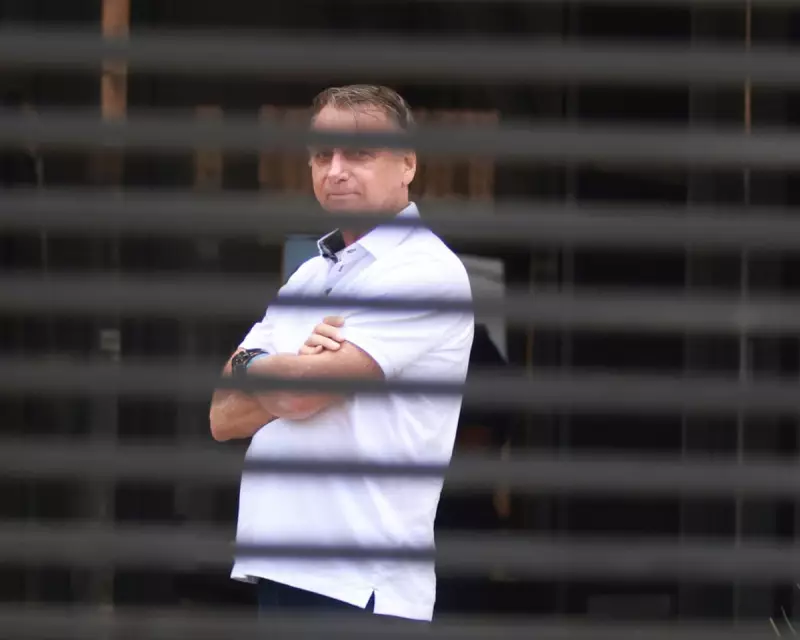
Former Brazilian president Jair Bolsonaro stands at the entrance of his home in Brasília, where he remains under house arrest this September, awaiting what many anticipate will be his imminent transfer to a maximum security prison. The far-right leader, who received a staggering 27-year sentence two months ago for attempting to "annihilate" Brazil's democratic institutions, appears destined for incarceration as legal procedures near their conclusion.
Allies Sound Alarm Over Prison Conditions
Bolsonaro's political allies have discovered a newfound concern for prison conditions as the reality of incarceration looms for the former president. Senator Izalci Lucas, from Bolsonaro's Liberal party (PL), recently visited the Papuda maximum security prison complex alongside three other allies in what appeared to be an attempt to persuade the supreme court against sending the 70-year-old politician there.
Lucas expressed grave concerns about Bolsonaro's ability to withstand imprisonment at Papuda, citing the former president's severe intestinal problems resulting from a near-fatal knife attack during the 2018 presidential campaign. "His health situation is extremely serious. He won't be able to handle it if they take him to Papuda," the senator warned, also highlighting overcrowded cells holding up to 40 inmates and complaints about "horrible food."
A Stark Contrast to Previous Rhetoric
The situation presents a remarkable irony given Bolsonaro's historical stance on prison conditions during his four-decade political career. The former paratrooper once questioned why Brazil should "give those dirtbags a good life" and suggested prisoners "should just get fucked, full-fucking-stop." On another occasion, he simplistically declared that avoiding prison merely required refraining from rape, kidnapping, or robbery.
Reimont Otoni, a congressman for President Lula da Silva's Workers' party (PT), noted the hypocrisy: "Only now has the extreme right – which has always claimed that human rights were not for criminals – decided to visit a prison to find out what conditions are really like." Otoni emphasized that while Bolsonaro is indeed a criminal, he still deserves dignified treatment in prison rather than "humiliating, degrading treatment."
Papuda or Papudinha: The Likely Destinations
Speculation surrounds whether Bolsonaro will be sent to the main Papuda prison complex, which currently houses approximately 14,000 inmates, or the adjacent Papudinha facility reserved for police officers and "special" prisoners. The latter appears more probable and would offer significantly more comfortable conditions than the main prison.
According to reports, Bolsonaro could expect a 24 square metre cell in Papudinha – roughly equivalent to two parking spaces – featuring a 12 square metre bathroom with shower and a 12 square metre veranda. The former president would be permitted to have a television and even a minibar provided they were donated by his family, though this remains a world away from the luxury of the Oscar Niemeyer-designed presidential palace Alvorada, located just 12 miles away.
Political Reactions and Democratic Implications
Fábio Wajngarten, Bolsonaro's former communications minister, lamented what he called the "brutal" finale to the former president's "impeccable" political career, claiming Brazil was about to witness "the greatest political injustice in its history."
However, for millions of Brazilians who believe Bolsonaro plotted to prevent Lula da Silva from taking power and even conspired to have him assassinated, the expected jailing brings satisfaction. Otoni described the moment as necessarily sad but vital for Brazilian democracy: "The message to Brazil, and to the world, is that crime doesn't pay."
Senator Lucas condemned the potential Papuda transfer as "a form of revenge" from Supreme Court judge Alexandre de Moraes, who oversaw Bolsonaro's coup trial and will make the final decision about his imprisonment in the coming days. As Brazil awaits this historic moment, the nation confronts the profound symbolism of incarcerating a former president who sought to undermine its democratic foundations.