
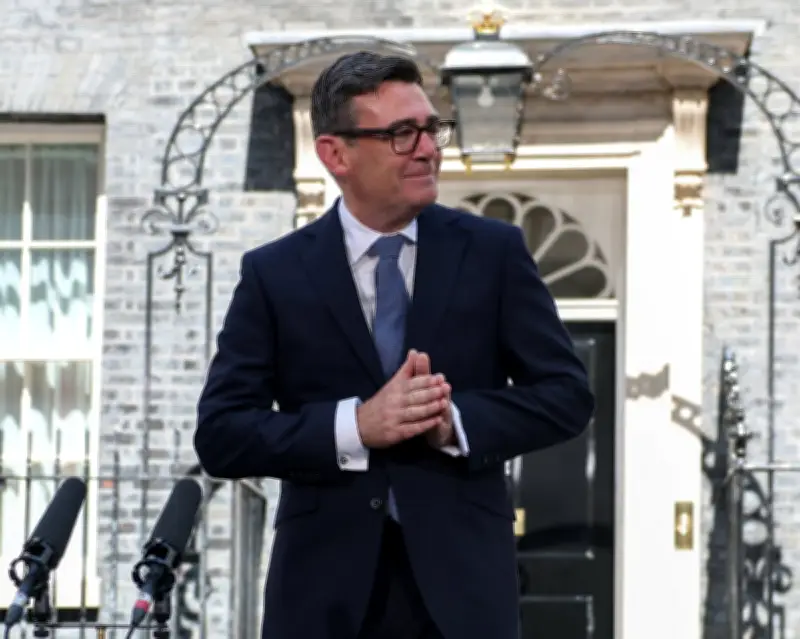
Andy Burnham became UK prime minister on Monday, vowing his government would be “a circuit breaker for Britain”. In his first address outside Downing Street, he pledged to end rough sleeping and named John Healey as chancellor, a surprise choice that ended weeks of speculation.
First day in power
Burnham’s first instruction as prime minister was to end rough sleeping, a flagship policy from his time as mayor of Greater Manchester. He also announced a 10-year plan for Britain, with measures to cut energy bills and bus fares expected later that day. His speech, delivered without podium or notes, was watched by Liverpool mayor Steve Rotheram, former Everton manager Peter Reid, and ex-Oldham council leader Arooj Shah.
According to community affairs correspondent Chris Osuh, there is “genuine excitement” in Manchester about a prime minister who understands the country beyond the M25. Burnham is the first official Labour and Co-operative MP to become prime minister, a movement rooted in the north-west.
Cabinet appointments
The biggest surprise of the day was John Healey as chancellor, a role for which Ed Miliband and Shabana Mahmood had been tipped. Healey, a former Treasury minister under Gordon Brown, is seen as a unifying figure. “Nobody in the Labour party has got a bad word to say about him,” said opinion columnist Gaby Hinsliff. “His resignation as defence secretary under Keir Starmer was a cataclysmic moment.”
Ed Miliband was appointed foreign secretary, expected to take a more pro-Gaza stance. Shabana Mahmood remains home secretary, Yvette Cooper becomes health secretary, and Wes Streeting takes on defence. Burnham said his cabinet reflects all parts of the party, though the wholesale clear-out of Starmer loyalists—including former chancellor Rachel Reeves, who declined another role—may fuel factional tensions.
Policy direction
Burnham’s first policy instruction—ending rough sleeping—was deliberate, said Chris Osuh. “Manchester’s regeneration predates Burnham, but the rough sleeping policy was distinctly his. Taking this to national scale is about his ambition and vision.”
On the North Sea, environment correspondent Sandra Laville noted uncertainty: “If it’s giving the go-ahead to drilling in Rosebank and Jackdaw, that’s in line with the Labour manifesto. But he could make a front-foot argument against more drilling.” She pointed out that Jackdaw would provide only 27 full-time jobs, while the green economy is worth over £100bn a year.
Political editor Pippa Crerar highlighted the risk of a scrutiny gap, with parliament on summer recess. “Journalists haven’t had the chance to interrogate him on his plans. He’s kept everything in a ‘black box’.” Only Burnham, chief of staff James Purnell, and Louise Haigh knew the contents.
Reaction and analysis
First Edition readers expressed both optimism and concern. One reader said early optimism was crushed by speculation of new North Sea drilling. However, liveblogger Andy Sparrow praised Burnham’s “strong streak of humility and realism”, noting his acknowledgment that “my generation of politicians” must “raise our game”.
Burnham’s speech included a promise to “bring back hope”, with the Guardian splashing “Burnham arrives as PM with promise to ‘bring back hope’”. Other front pages ranged from “New PM starts with a purge” (The Times) to “Seventh heaven?” (Metro), referencing the six prime ministers in a decade.




