
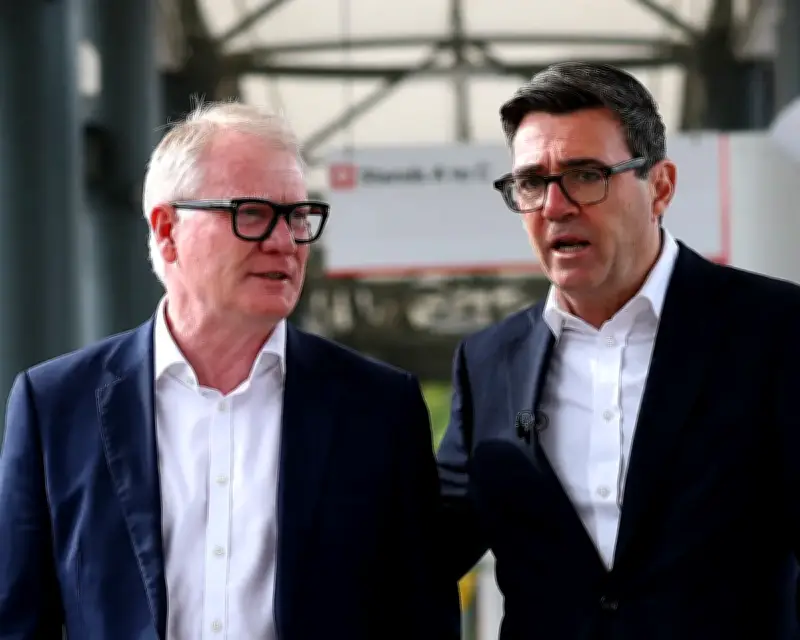
Andy Burnham will present proposals this week to grant mayors new powers to take control of local planning decisions and greenlight large-scale developments. The move will allow mayors to “call in” decisions and direct councils to either proceed with or refuse them, and also grant upfront permission so developers can begin building without applying.
Powers to override councils
The measures are intended to prevent “nimby” councils from blocking major developments that could boost local growth or help the government achieve its target of building 1.5 million homes by the end of the parliament. However, Burnham acknowledged that mayors might also block projects that councils want to advance. “Sometimes … challenge does need to be made to local decision-making, and actually it cuts both ways,” he told the Sunday Times. “It’s not all about nimbyism. Sometimes it’s the other way round. It’s a local authority putting forward something that’s unacceptable in terms of the impact on the community … so it’s a two-way street.”
The new powers will apply to developments of more than 150 homes, commercial spaces exceeding 15,000 square metres, or any building 30 metres or taller—roughly 10 storeys. Burnham defended the approach against concerns that it could disempower councillors, MPs, and constituents. “The question is: do you want somebody who’s elected by the people of that area to consider a decision, or a far less accountable decision-making process?” he said.
Backing from mayors
Ten of the 14 devolved mayors from different parties have backed the move. It will bring them into line with the mayor of London, Sadiq Khan, who received similar powers earlier this year as an emergency measure to unblock stalled sites and deliver thousands more affordable homes in the capital. Burnham added: “In my view, it will prompt a much more joined-up discussion about planning and local authorities. I think knowing the mayor has that role, councils will come to the mayor and say: ‘How can we work this thing out so that it is acceptable?’”
The government is just over a quarter of the way to its housing target, which housing secretary Angela Rayner recently insisted remains in place. Decisions must align with planning rules, local plans, and national policy, with ministers retaining a backstop power to intervene. Mayors will also gain more influence over how national housing funding from Homes England is spent in their areas, and they will be able to charge a levy on development to fund large infrastructure. A consultation will be published next week.
Criticism and political context
The Liberal Democrats described the move as a “direct attack” that would silence residents. Gideon Amos, the party’s housing and planning spokesperson, said: “Taking powers away from communities and local councillors is taking powers away from local people. This plan is a direct attack on communities across the country. Labour’s chaotic patchwork approach to devolution will simply not work to solve the housing crisis. Instead of silencing residents and handing mayors a blank cheque, the government should be empowering local councils with the resources to deliver genuinely affordable homes alongside the infrastructure to support them.”
Burnham faces a difficult autumn after a summer-long honeymoon period, during which a series of announcements by the prime minister helped his party jump ahead of Reform in the polls for the first time in a year. Later this year, his chancellor John Healey will give his first budget, likely constrained by high borrowing figures and the ongoing impact of the war in Iran. Burnham will also make decisions on Shabana Mahmood’s flagship immigration changes, including whether people already in the country should wait longer to achieve settled status.
The Guardian recently revealed the prime minister was considering exempting care workers from the changes, though that could mean carving out hundreds of thousands of people. “It’s important to see that issue within a bigger picture,” Burnham told the Sunday Times. “Migration is down, boat crossings are down, removals are up. I think what we’ve got to do in the autumn is present that full picture, and those decisions around ILR [indefinite leave to remain] will be part of that whole picture.” Asked whether he had made a decision on the overall package, he said: “Not yet, no.”




