Tuesday 12 May 2026 11:54 am | Updated: Tuesday 12 May 2026 12:00 pm
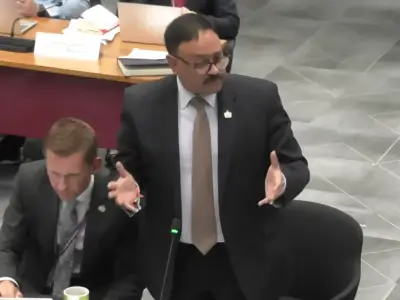
If Labour cannot cut taxes, it could at least make them simpler, argues Alan Vallance, CEO of the Institute of Chartered Accountants in England and Wales (ICAEW). Writing ahead of the King's Speech, Vallance highlights that Britain's tax code is now among the most complicated in the world, leaving businesses grappling with arbitrary distinctions that consume time and money.
A Stark Choice for the Government
The government faces a stark choice: continue layering new rules and reliefs onto an already tangled tax system, or confront the complexity that businesses across the country warn is holding back growth. ICAEW's latest polling found that nine in 10 chartered accountants would support legislation to simplify the UK's tax system. These professionals work with businesses daily, from start-ups and SMEs to major employers—84 per cent of FTSE 100 companies have an ICAEW member on their board. Members report that doing business is too difficult, too expensive, and too uncertain, barriers the government needs to tackle to enable growth.

The Growing Burden of Complexity
Britain's tax code has built up gradually over decades, with successive governments adding new exemptions, thresholds, reliefs, and temporary fixes without considering the wider picture. Businesses face costly disputes over arbitrary distinctions, such as whether giant marshmallows should be zero-rated or standard-rated for VAT. While these cases may sound amusing, they represent wasted time, administrative burden, costs, and uncertainty that distract from growing the economy.
The same applies to employment taxation. Businesses frequently face confusion over employment tax status rules when hiring staff or contractors, increasing compliance costs and legal risk. A recent example was the first-tier tribunal decision on 1 May 2026, which ruled that football referees were not employees for tax or national insurance purposes, ending nearly a decade of litigation that went up to the Supreme Court. At a time when the UK struggles with productivity and labour market participation, these distortions matter.
A Difficult Economic Moment
This comes at a particularly difficult economic moment. ICAEW's latest Business Confidence Monitor found sentiment remained in negative territory, held back by geopolitical instability and escalating energy costs caused by the Iran war. Negative confidence readings are not abstract statistics; they typically coincide with periods when businesses delay investment, hold back recruitment, and become cautious about expansion. Against this backdrop, the government should seek every opportunity to send clear pro-growth signals to the business community, especially as it considers local election results and searches for solutions to unlock the economy and voter confidence. Tax simplification offers precisely that opportunity.
Benefits of a Simpler System
A simpler system would bring substantial benefits. Simplifying VAT by broadening the base would ultimately raise revenue that could be used to lower more damaging taxes, such as employer's National Insurance contributions. It would also produce more predictable revenue, giving the Chancellor more flexibility to respond to fiscal pressure or deliver policy priorities.
Beyond the Exchequer, the gains would be felt across the economy. A simpler system would boost investment by reducing the uncertainty premium that businesses currently price into decisions about where to commit capital. It would expand capacity at HMRC, freeing resources spent administering and policing reliefs to focus on tackling avoidance and supporting compliant taxpayers. It would also strengthen the UK's international competitiveness—for mobile investment, the simplicity of a tax system often matters more than its headline rates.

Practical Steps for Immediate Action
There are practical steps the government could take immediately. A commitment to a long-term tax simplification roadmap would provide businesses with greater certainty over the direction of travel. Streamlining VAT rates and reducing unnecessary anomalies would cut disputes and compliance costs. Reviewing cliff edges across the tax system could remove disincentives to work, invest, and grow. Greater clarity around employment status would support businesses to hire with confidence. Simplification must also look ahead to the future economy; as AI and automation reshape industries, the government will need to think carefully about how the tax base evolves.
The King's Speech Opportunity
The King's Speech offers ministers the opportunity to reset the conversation. If the government is now serious about growth, it cannot afford to ignore the growing consensus from business and the accountancy profession. Britain's tax system has become too complicated, and the cost of inaction is too great.
Alan Vallance is CEO of the Institute of Chartered Accountants in England and Wales (ICAEW).