
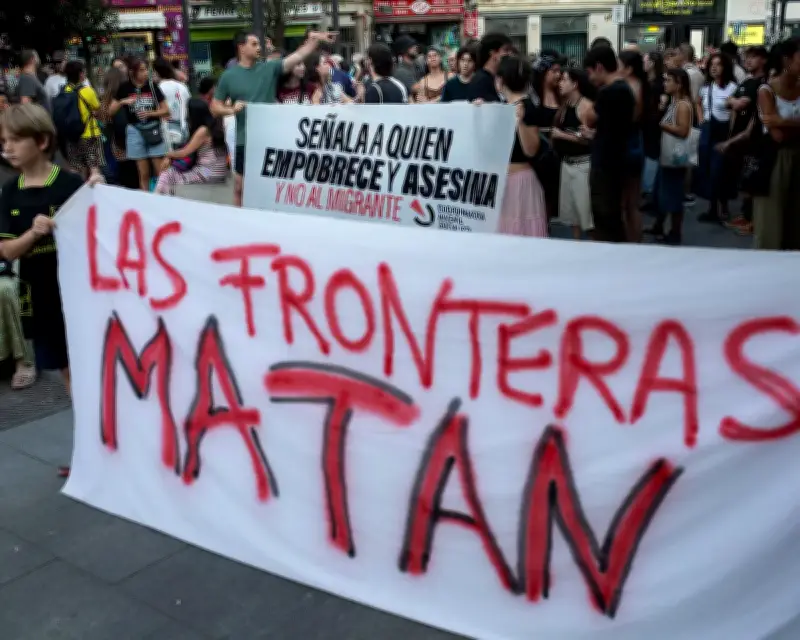
Giuseppe Martinico, professor of comparative public law at the Dirpolis Institute, Sant’Anna School of Advanced Studies in Pisa, Italy, argues that the EU's migration response is not merely a result of the far right's success but a broader cultural shift within the European political mainstream. Writing in response to an analysis by Alberto Alemanno, Martinico suggests that positions once associated with the radical right have traveled well beyond it.
Mainstream convergence on migration
Martinico points to the convergence between governments as politically different as Denmark and Italy as evidence that radical-right positions have become mainstream. He notes that parts of the centre-left and centre-right have progressively abandoned a rights-based understanding of migration. According to Martinico, migrants increasingly disappear from the European political conversation as persons—as bearers of rights whose dignity should constitute a limit to what political majorities may legitimately do.
The professor's comments come amid ongoing debates over EU migration policy, with member states adopting increasingly stringent measures. Martinico's analysis highlights a shift in political discourse, where terms and policies once confined to the far right are now part of mainstream European common sense.
Weak European Commission response
Martinico attributes this cultural transformation to an increasingly weak European Commission. He observes that the second Ursula von der Leyen commission was born under the auspices of a strong presidency, but that political authority has progressively evaporated. The response to the Ceuta crisis is revealing, he says, as neither the commission’s president, Von der Leyen, nor its European commissioner for internal affairs and migration, Magnus Brunner, has provided a strong political signal to counterbalance the competitive hardening of national positions.
The Ceuta crisis, which involved a mass influx of migrants into the Spanish enclave, exposed divisions among EU member states and the commission's limited influence. Martinico argues that the firewall around the far right becomes almost irrelevant once much of the mainstream has internalised the assumptions that it was originally supposed to contain.
Deeper problem than far-right cooperation
Martinico concludes that the real question is no longer simply whether mainstream parties cooperate with the far right, but how much of the far right’s understanding of migration, rights and belonging has already become mainstream European common sense. This suggests a fundamental shift in the EU's political landscape, with implications for future policy decisions.
The professor's letter was published in response to an article by Alberto Alemanno, which examined how the far right is tightening its grip on the EU from the inside. Alemanno's analysis, published on 18 August, focused on the influence of far-right parties within EU institutions. Martinico's response expands this discussion, arguing that the problem is deeper than the collapse of traditional political barriers.




