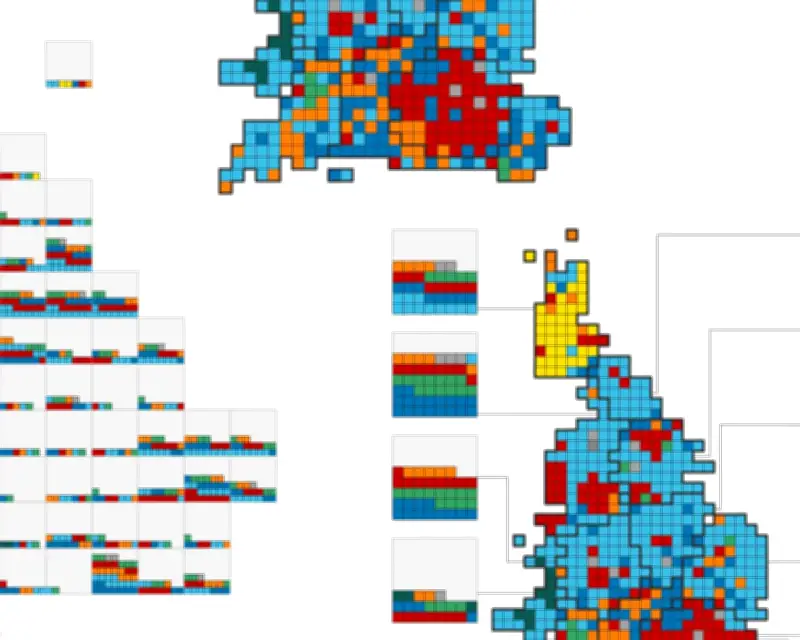
Readers have responded to a Guardian analysis examining what Britain would look like under an electoral system of proportional representation (PR). Antonio Voce and Ashley Kirk’s article, published on 22 July, provides a helpful view on how Britain’s electoral landscape could look under different voting systems.
PR systems produce fairer representation
Perhaps most striking is that whichever the PR system used, when compared with first past the post (FPTP), they all make a good job of producing a parliament that reflects how the nation voted. According to Michael Bursill of Reigate, Surrey, there is not as much difference between them as enthusiasts of each PR system might expect, in terms of each party winning its fair proportion of seats, and in terms of voters therefore getting a fair say in who governs us.
Bursill also emphasises that the numerics of the systems proposed do not have to be as they are in the article’s examples. Using the additional member system does not mean we need to increase our parliament to more than 1,000 MPs. Using a single transferable vote (STV) does not mean we have to have constituencies any bigger than, say, four to seven MPs. And party list districts do not have to be as big as the official English regions or the whole of Scotland. PR for Westminster can be designed with MPs much more localised, if that is what the people want.

The need for expert design and legitimacy
The much-needed new Westminster election system coming our way needs to be as good as we can make it. This requires both expert design and legitimacy with the public. Bursill notes that if Andy Burnham is as good as his word to date, he will set up a National Commission on Electoral Reform, as already proposed by the all party parliamentary group for fair elections.
First past the post produces absurd outcomes
Tom Beard of Worcester Park, London, argues that voters may resist replacing a system they understand, yet they may not truly understand its absurd outcomes. For instance, both Margaret Thatcher in 1983 and Theresa May in 2017 secured exactly 42.4% of the vote. Under FPTP, this gave Thatcher a landslide majority of 144 seats, but left May with a minority, reliant on the DUP to form a government.
While the additional member system is often touted as a British compromise, it introduces its own flaws. Beard contends that if we are to reform our democracy, the only sensible choice is STV. By providing a choice of several constituency MPs, STV forces politicians to compete for our votes, effectively eliminating safe seats and complacency. Crucially, it delivers a truly representative parliament where parties must work together in coalition to govern.