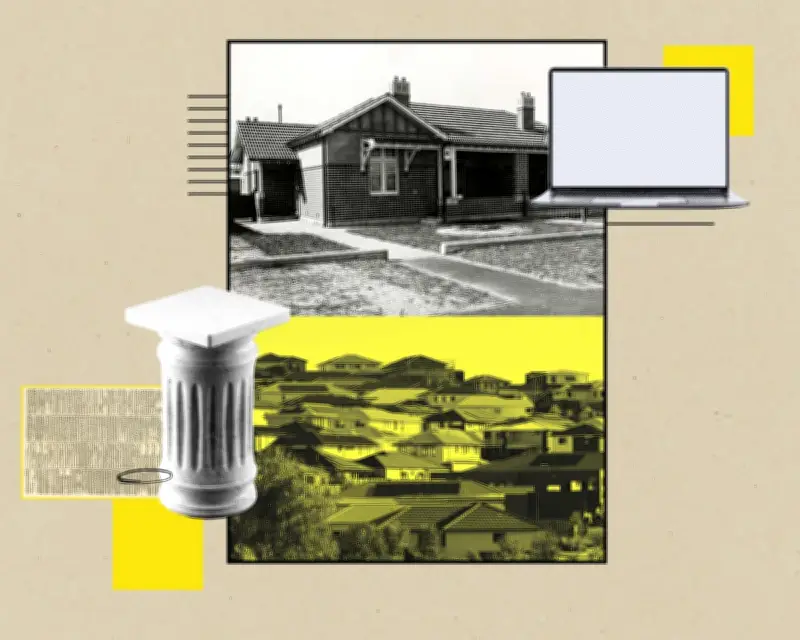
Australia's federal government recently enacted its first major tax reform in nearly 30 years, a significant achievement that may signal a turning point in the housing crisis. This moment invites a revisiting of Australia's housing history within the broader context of social policy, highlighting public investment for economic growth and citizen needs. While railways, telegraphs, hospitals, schools, and welfare are well-known, governments also invested in housing despite resistance from interest groups.
Public investment in housing: a democratic process
This public investment in housing demonstrates how democratic processes worked in this difficult policy area. Most initiatives were led by Labor governments, some by conservatives, but all recognized the social and economic value of decent housing and the difficulties low-paid workers faced accessing it via the market. In 1914, architect John Sulman declared that “the unsolved problem” in Australia was providing housing at a price that “the living wage workers can pay,” a truth that remains largely unchanged.
Some public investments were easier to achieve than others. Australia's first public housing in Sydney's Rocks district, constructed in the early 1900s, supported commerce and shipping needs. Part of the wharves redevelopment after a bubonic plague outbreak, The Rocks project allowed the conservative state government to fund over 100 new dwellings because wharf labourers needed to live nearby for round-the-clock work.

Contentious builds and citizen protest
Most builds were more contentious, pressured by citizen protest and supported by garden suburb advocates who saw inner-city housing as “slums” and a source of social decay. Daceyville in Sydney's south-east was a prime example. Established after the 1910 election of New South Wales's first Labor government, it was precipitated by the demolition of swathes of housing for city improvement. By 1912, more than 5,700 people were displaced. Residents, city missionaries, and the popular press mounted petitions and led deputations to protest what journalists called inhuman evictions.
Daceyville was not the only outcome of this protest. The Strickland Building in Chippendale was the first of four blocks of inner-city flats erected by Sydney city council between 1914 and 1927. With resident demand for housing near work trumping anti-slum orthodoxy, these projects show how contingent outcomes could be in this high-stakes context.
The 1940s: largest public housing investment
The largest and best-remembered investment came in the 1940s, driven by an extreme housing shortage and fear of social unrest. Thousands of families lived in boarding houses and temporary shelter after the Depression. The Commonwealth Housing Commission promised a “new social order” and sought to offset the attractions of communism. It broke new ground by declaring housing “a right” that should “cease to be a field of investment yielding high profits.” Between 1945 and 1956, more than 96,000 new dwellings were funded through the commonwealth-state housing agreement.
These investments were not sufficient but eased rental pressure on working-class families more than any intervention before or since. By abandoning the orthodoxy of “economic rent,” it enabled families in greatest need to access housing. This investment also underpinned the leap in Australia's home ownership rates from 53% in 1947 to 73% in 1966.
Decline of public housing and recent reforms
A downside of this pivot was that sold stock was not replaced. The Menzies government viewed home ownership as an alternative to public rental rather than a complement, so support wound down. Between 1958 and 1973, the proportion of new housing that was public fell from 17.8% to 7.7%. Waiting lists have grown ever since.
In 2007, the Rudd government addressed the disparity between low incomes and market rents through a new housing policy. Despite its limits, it enabled thousands of people who would otherwise have remained homeless to access secure housing. This investment, part of the global financial crisis stimulus package, demonstrated how such policy can normalize fiscal intervention. It was redeployed early in the Covid pandemic, preventing widespread unemployment, and underpins the government's recent tax reforms.

Australian governments' past housing investments were hard-won. Despite limitations, they made access to housing more equitable because they recognized its social and economic value. Understanding their complexity and purpose helps expand and strengthen the options we now see as politically feasible.