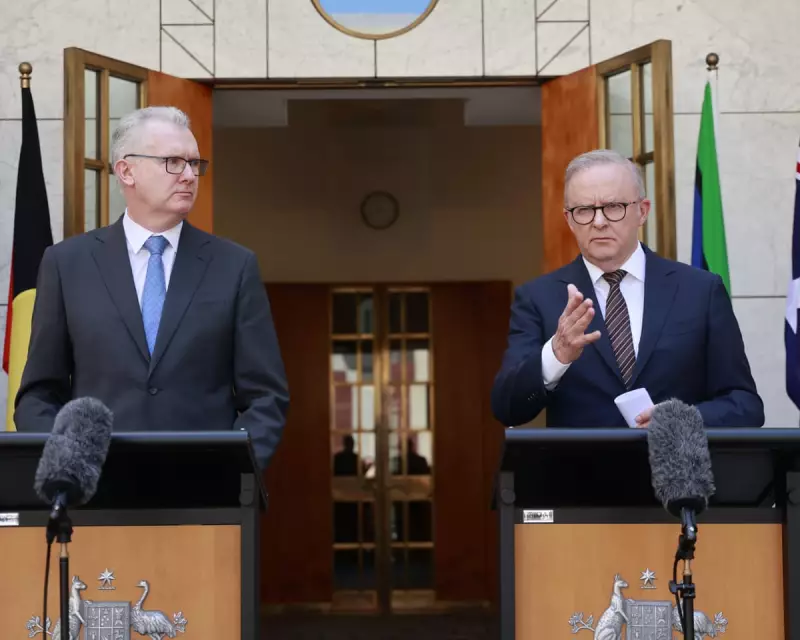
The Australian federal government has unveiled an urgent five-step plan to significantly strengthen the nation's hate speech laws in the wake of the devastating Bondi Beach terrorist attack. The move, announced by Home Affairs Minister Tony Burke and Prime Minister Anthony Albanese, aims to combat antisemitism and crack down on what officials describe as 'completely dehumanising' rhetoric from hate preachers.
Government Responds to Bondi Tragedy with Legal Overhaul
The proposed legislative push comes after the horrific attack last Sunday night, where Sajid Akram and his son Naveed allegedly shot 15 people and injured dozens more at a Hanukah celebration. Prime Minister Albanese stated on Friday that new evidence suggests the attack, the worst in Australia's history, was inspired by Islamic State ideology.
The government's plan includes creating an aggravated hate speech offence for leaders and preachers who promote violence, and establishing a new regime to list organisations whose leaders engage in hate speech that incites racial hatred or violence. Minister Burke emphasised that the laws would be drafted to the absolute limits permitted by the Australian constitution to capture rhetoric that currently escapes punishment by stopping short of explicitly advocating physical violence.

Defining the Limits of Hate Speech
While the government is determined to lower the legal threshold for hate speech, Burke declined to specify whether particular phrases, such as 'globalise the intifada' chanted at some protests, would be explicitly banned. He described the chant as 'horrific' but explained that legislation typically frames offences around concepts like 'promoting hatred' rather than listing specific slogans, leaving final interpretation to the courts.
New South Wales Treasurer Daniel Mookhey has labelled the slogan, which references Palestinian uprisings, as an example of hate speech. The government has not officially named organisations that could be listed under the new regime, but groups like Hizb ut-Tahrir and the National Socialist Network are considered potential targets.
Constitutional law expert Professor Luke Beck of Monash University noted that the High Court's implied right to political communication would shape the final legislation. The reforms intend to outlaw 'serious vilification' based on race and the advocacy of racial supremacy, building on existing state laws and federal civil penalties under the Race Discrimination Act.
Calls for Broader Protections and Political Context
The proposed crackdown has sparked calls to widen its scope. Independent MP Allegra Spender, whose electorate includes Bondi Beach, urged the government to expand protections beyond race and religion to cover other minorities, including the LGBTQ+ community.
"No community should ever be targeted," Spender told Guardian Australia, highlighting neo-Nazi rhetoric against transgender people. She had previously pushed, unsuccessfully, for a broad anti-vilification provision in hate crime laws passed just last February.
These existing laws, which the new plan seeks to strengthen less than a year later, criminalise threats of violence based on religion, sex, sexual orientation, gender identity, and other attributes. The government's fast-tracked response signals a major shift in Australia's approach to policing hate speech and combating extremism in the aftermath of national tragedy.