
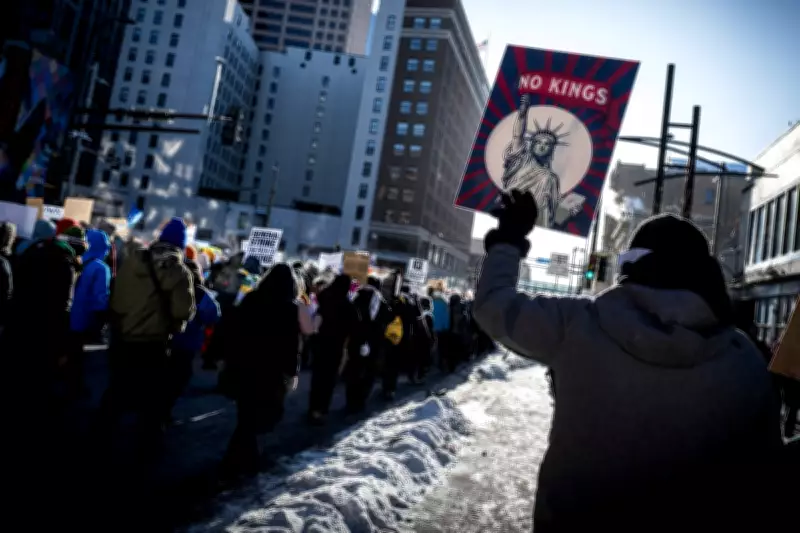
Third Major 'No Kings' Demonstration Announced for Late March
Organisers have confirmed that a third nationwide 'No Kings' protest will take place on 28 March, with expectations that it could become one of the largest demonstrations in American history. The announcement comes amid escalating tensions over the operations of Immigration and Customs Enforcement (ICE) and the Department of Homeland Security across the United States.
Flagship Event in Twin Cities Following Fatal Shootings
The flagship event will be held in Minnesota's Twin Cities of Minneapolis and St Paul, where federal immigration agents fatally shot two residents, Alex Pretti and Renee Nicole Good, earlier this month. These incidents have intensified local outrage and galvanised support for the protest movement.
Ezra Levin, co-founder of Indivisible and a key coordinator of the No Kings Coalition, described the upcoming protest as a response to what many Americans perceive as a 'reign of terror' by ICE and DHS in communities nationwide. Levin emphasised that the demonstration aims to be a 'raucous, joyful and nonviolent but powerful display' of democratic values.
Building on Previous Success and Expanding Reach
The No Kings movement emerged in summer 2025 as a reaction to concerns about rising authoritarianism under President Trump, building upon earlier 'Hands Off' rallies organised by Indivisible. The coalition now includes a diverse array of groups:
- Indivisible
- The protest group 50501 (representing 50 protests, 50 states, 1 movement)
- Various labour unions
- Legal organisations such as the American Civil Liberties Union
- Advocacy groups including the Movement for Black Lives
Following the last No Kings protests in October, which attracted approximately 7 million attendees, organisers are aiming for 9 million participants in the March event. Recent polling from YouGov indicates that public sentiment may be shifting, with more Americans now supporting the abolition of ICE than opposing it.
Emphasis on Safety, Training and Strategic Action
The No Kings Coalition has placed significant emphasis on ensuring protests remain safe and nonviolent. Organisers are receiving training in de-escalation techniques and are collaborating closely with local partners to maintain lawful demonstrations.
Beyond the mass mobilisation, the coalition is pursuing multiple strategic approaches:
- Online training sessions for safely documenting and observing ICE agents, which have already attracted over 200,000 viewers
- Pressure campaigns targeting elected officials, including calls for the resignation of DHS Secretary Kristi Noem
- Continued community organising between protest events
Historical Context and Protest Effectiveness
Protest activity has surged during the second Trump term, with a Guardian analysis of Crowd Counting Consortium data revealing that demonstrations in the past year have outnumbered those during the first year of Trump's initial term. Protest researcher Erica Chenoweth noted that current mobilisation represents 'a very historic time' in American civic engagement.
Community responses to ICE operations have become increasingly creative and determined. Examples include:
- Protesters in Los Angeles using bullhorns and Mexican music to disrupt ICE agents
- Washington DC residents employing anti-fascist tactics from Latin America, such as banging pots and pans
- The widespread use of whistles as both alert systems and protest symbols
Levin stressed that while mass protests are crucial, they represent just one component of a broader pro-democracy movement. 'Authoritarians typically do not give up power willingly,' he observed, emphasising the need to develop 'the muscle and sophistication' of democratic resistance beyond single-day demonstrations.
The third No Kings protest aims not only to challenge what organisers describe as administration authoritarianism and ICE lawlessness but also to welcome newcomers to protest participation. With careful planning and strategic coordination, the movement continues to evolve its approach to protecting civil liberties and democratic principles across the United States.




