
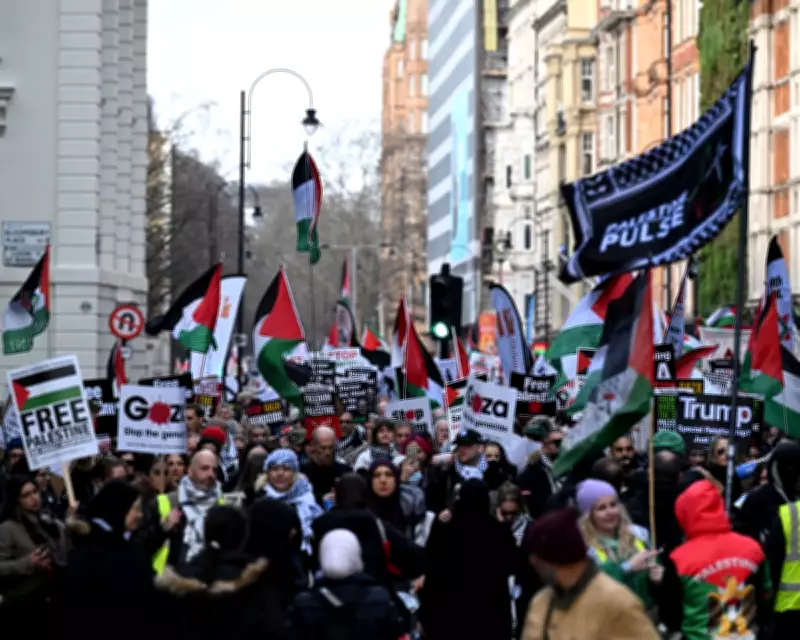
Veteran human rights campaigner Peter Tatchell has been arrested during a pro-Palestine demonstration in central London, sparking immediate controversy over freedom of expression and police interpretation of protest slogans. The 74-year-old activist, renowned for decades of advocacy on LGBTQ+ rights and social justice issues, was detained by Metropolitan Police officers on Saturday afternoon while participating in a Palestine solidarity march.
Arrest Over Controversial Placard Content
Tatchell was taken into custody for holding a placard that displayed the phrase "globalise the intifada" alongside additional text clarifying his position. The sign specifically read: "Globalise the intifada: Non-violent resistance. End Israel's occupation of Gaza & West Bank." According to police statements, officers arrested the campaigner on suspicion of committing a public order offence, directly citing the inclusion of the word "intifada" as problematic under current interpretations of the law.
The activist was transported to Sutton police station in south London following his detention. In response to the arrest, Tatchell issued a strong statement through his foundation, characterising the police action as "part of a dangerous trend to increasingly restrict and criminalise peaceful protests" in the United Kingdom. He emphasised that his arrest represented what he views as a significant "attack on free speech" within the context of legitimate political demonstration.
Defining 'Intifada' and Clarifying Intentions
Tatchell provided detailed explanation of his chosen terminology, seeking to clarify potential misunderstandings about his placard's message. "The Arab word intifada means uprising, rebellion or resistance against Israel's occupation of the West Bank and Gaza," he stated. "It does not mean violence and is not antisemitic. It is against the Israeli regime and its war crimes, not against Jewish people."
The veteran campaigner further elaborated on his specific interpretation of non-violent resistance, drawing parallels with historical movements. "By 'non-violent resistance' I was advocating boycott, sanction and divestment – the same tactics that helped bring down the apartheid regime in South Africa," Tatchell explained. "'Globalise the intifada' means create a worldwide campaign like the anti-apartheid movement."
Police Policy and Previous Arrest Context
The Metropolitan Police have recently implemented stricter guidelines regarding certain protest terminology. In December, the force announced that demonstrators chanting "globalise the intifada" would face arrest because "the context has changed" following the Bondi Beach terror attack in Sydney. This policy shift has created new boundaries for acceptable protest language in London's increasingly tense political atmosphere.
Tatchell revealed that this represents his second recent arrest related to protest placards concerning the Israel-Gaza conflict. Last May, police detained him for holding a sign that read: "Stop Israel genocide! Stop Hamas executions! Odai Al-Rubai, aged 22, executed by Hamas! RIP!" He was initially arrested for a racially and religiously aggravated offence in that incident, though he claims police have since admitted he was wrongly detained and he is awaiting a settlement regarding that case.
Historical Advocacy and Current Controversy
The activist emphasised his longstanding record of opposing antisemitism, seeking to distinguish his criticism of Israeli government policies from prejudice against Jewish people. "I have a long history of defending Jewish people against the antisemitism of the far right and Islamist extremism," Tatchell noted. "I joined the March Against Antisemitism, with the chief rabbi and thousands of Jewish people, on 26 November 2023, just after the 7 October massacre."
Tatchell expressed particular concern about what he perceives as police overreach in interpreting protest messages. "The police are totally wrong to conflate support for Palestinian resistance to oppression with hatred and attacks on Jews," he argued. The campaigner also mentioned that three other individuals were recently charged with similar offences at a London rally last month for expressing support for an intifada against what they characterise as Israel's war crimes.
This arrest occurs against the backdrop of ongoing debates about protest rights, free speech boundaries, and police powers in the capital. As tensions surrounding the Israel-Gaza conflict continue to manifest in London's streets, incidents like Tatchell's detention highlight the complex challenges facing both demonstrators and law enforcement in navigating politically charged language while maintaining public order and protecting fundamental rights.




