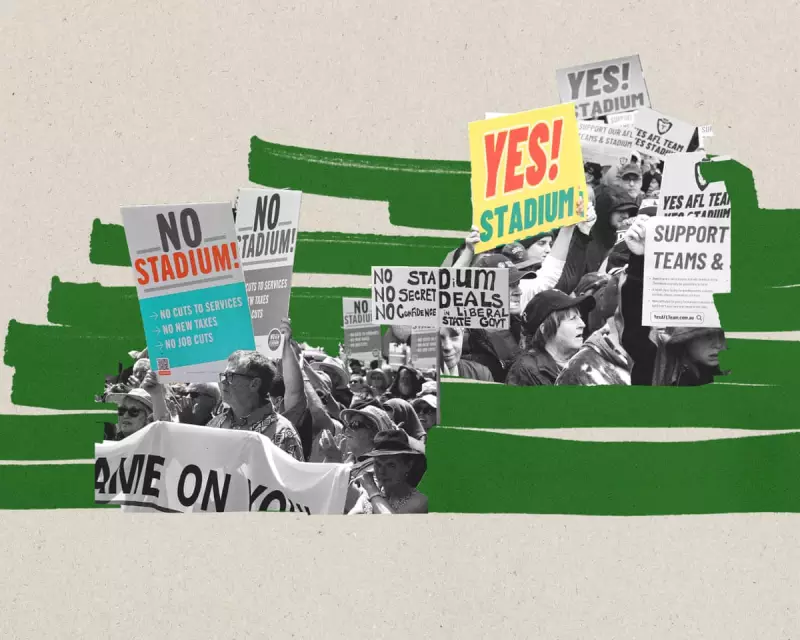
Thousands of protesters descended upon the lawns of Hobart's parliament house this weekend, creating a dramatic scene of division over plans for a new AFL stadium at Macquarie Point. In what police described as a significant crowd of up to 15,000 people, supporters braved pouring rain to voice their backing for the controversial project.
The Stadium Standoff: A State Divided
The rally represented a protest against a protest, coming just one week after anti-stadium campaigners gathered 7,000 people according to organisers. The polarising issue has split Tasmania, with premier Jeremy Rockliff taking to the stage as drizzle intensified over Hobart. The Liberal leader told the soaked crowd, "I think we're going to need an even bigger stadium," receiving cheers from supporters who view him as the man who secured Tasmania's AFL future.
Organisers had hoped Sunday's gathering might become Tasmania's largest ever political rally. Historical comparisons are difficult, but approximately 10,000 protested against damming the state's wild rivers in 1983, while around 5,000 marched against the Vietnam conflict in 1970. In that context, the turnout was impressive, particularly given the miserable weather conditions.

The Financial Stakes and Political Battle
At the heart of the controversy lies the stadium's eye-watering $1.13 billion price tag. The AFL's invitation for Tasmania to join the mainland competition in 2023 came with the condition that the state builds an expensive stadium on what many consider precious land. While the AFL invests tens of millions annually in Tasmania, it has offered just $15 million toward the roofed venue.
With the federal government committing $240 million, Tasmania - already $5 billion in debt and suffering a recent credit rating downgrade - must find the remainder. This financial burden has sparked fierce opposition from those who argue the money should be spent on health, education and housing instead.
The debate reaches its climax this week with a decisive parliamentary vote that remains too close to call. Rockliff praised Sunday's attendees for giving Tasmania "hope," telling them, "The big difference between this rally and so many other rallies around Tasmania, you're actually standing here for our future, and for something, not against something."
Influential Backing and Community Concerns
What made Sunday unusual for a protest was the power of those on stage. Rockliff stood alongside Labor leader Josh Willie, former Labor leader David O'Byrne, construction union representatives, and famous sports figures. Melbourne Football Club president and Tasmanian product Brad Green also voiced support.
Behind the scenes, an independent planning commission has already found the project should not proceed due to its high cost and numerous problems. Treasurer Eric Abetz labelled these conclusions "subjective assessments," while one of the assessors, urban planner Shelley Penn, responded that "there's a difference between taste and quality."
Opponents include the Greens and several independents, along with community members concerned about the site's significance to the local Palawa people and former soldiers. VFL great Brent Crosswell, a member of the Tasmanian team of the century, recently spoke against the building, describing the AFL's stadium requirement as "condescending" and "despicable."
Despite the controversy, the Tasmania Football Club - nicknamed the Devils - has attracted more than 200,000 members and enjoys almost universal support. CEO Brendon Gale defended the deal, stating, "The AFL has given the state an opportunity to be part of this incredible national platform and put the state on the map."
As retired mechanic Brian Clark, attending his second-ever rally at age 66, put it: "There's going to be a lot of angst if this doesn't go through. It's part of Tasmania, it's part of me. I'm nearly 70 and I want this. I've wanted it for 30, 40 years." Whatever parliament decides this week, the acrimonious debate has already left a significant stain on the state that will require substantial healing regardless of the outcome.