
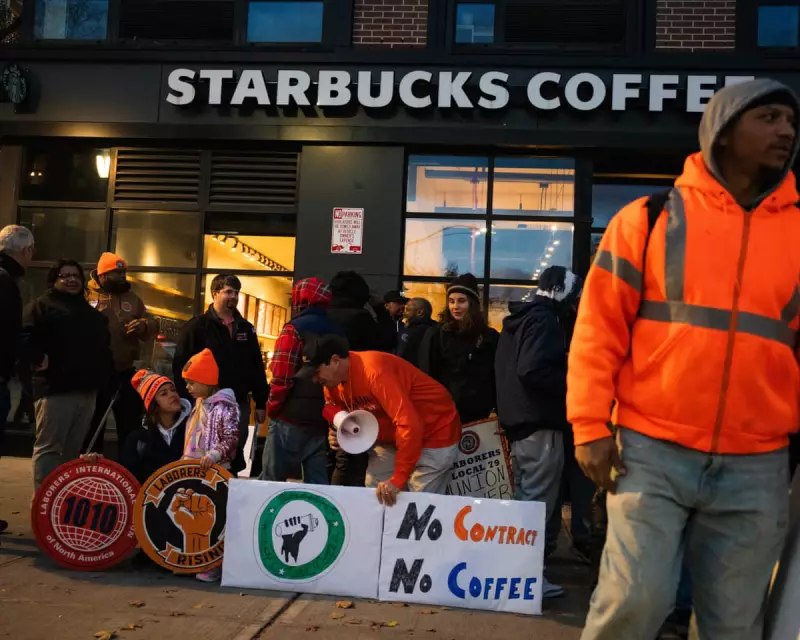
Hundreds of striking Starbucks workers and their supporters brought a Brooklyn neighbourhood to a standstill on Thursday, transforming a corporate promotional day into a loud protest for fair pay and working conditions.
The 'Red Cup Rebellion' Takes Hold
In the Clinton Hill area of Brooklyn, the scene was one of determined solidarity. Despite a brisk temperature of 40°F (4.4°C), hundreds of picketers filled the sidewalks outside a popular Starbucks on Lafayette Avenue. Their chants of 'What's disgusting? Union-busting!' and 'No contract, no coffee!' echoed through the streets, creating a powerful display of collective action.
This local protest was part of a much larger, coordinated effort. More than a thousand Starbucks workers across the United States walked off the job in a single day, with actions taking place in over 40 cities. This marked one of the most significant strikes yet for the rapidly growing union movement within the world's largest coffee chain.
The timing was strategic. The walkout was deliberately scheduled to coincide with Starbucks' lucrative 'Red Cup Day', a high-volume promotional event. Organisers aimed to maximise pressure on the company by disrupting one of its busiest days, dubbing the action the 'red cup rebellion'.
Community Support and Disrupted Business
The impact in Brooklyn was immediately visible. Kaari Harsila, a 21-year-old shift supervisor and a lead organiser of the rally, estimated that more than half of potential customers chose not to cross the picket line. Those who attempted to enter the store were met with vocal disapproval from the crowd.
Inside, the scene was starkly different from a normal day. Edwin Augustly, a 50-year-old union member from Local 79, observed, 'It's pretty empty in the store right now. I live in the neighbourhood, and this Starbucks is pretty much always full. And today it's not like that at all.' To keep the store open, Starbucks had brought in regional and district managers to work behind the counter, a move Harsila interpreted as a sign the company was 'scared' to shut down.
The protest drew support from a wide coalition. It wasn't just Starbucks employees on the line; they were joined by allies from other unions and local community figures. Jacob Muldoon, 25, a former barista now working at UPS, attended to show solidarity. He highlighted the transformative power of a union contract, stating his own pay had increased by $8 an hour after unionising, and he now receives benefits like free healthcare.
A Broader Fight for Workers' Rights
The strike follows a breakdown in contract negotiations between Starbucks and Workers United. The union had spent months demanding improvements to staffing and pay and attempting to resolve hundreds of unfair labour practice charges filed against the company. Last week, the union announced workers had voted to authorise an open-ended strike.
Since 2021, more than 650 Starbucks stores have unionised, despite significant pushback from corporate management. The struggle in Brooklyn, therefore, is part of a much larger national picture. New York assembly member Claire Valdez and Randi Weingarten, president of the American Federation of Teachers, both spoke at the rally, framing the baristas' fight as part of a broader movement for dignity and fair treatment for all workers.
While Starbucks expressed disappointment at the strike action and insisted the 'vast majority' of its stores were unaffected, the evidence in Brooklyn suggested a different story. For the workers on the picket line, the sight of customers turning away was a clear sign of a successful rebellion and a step towards a fair contract.




