
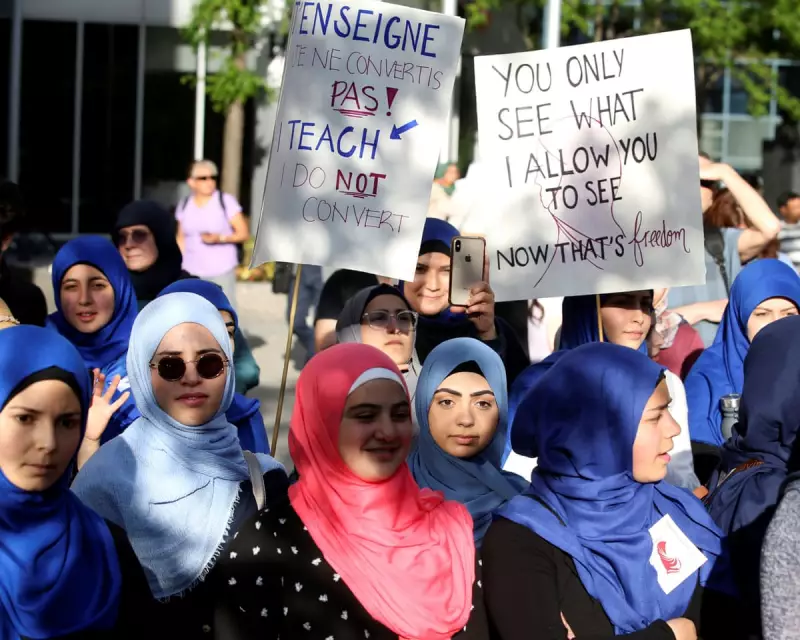
The government of Quebec has unveiled sweeping new legislation that significantly expands its controversial secularism policies, introducing a ban on public prayer and further restrictions on religious symbols.
New Provisions and Expanded Bans
Introduced by the governing Coalition Avenir Québec (CAQ) on Thursday, Bill 9 outlaws prayer in public institutions, including colleges and universities. The legislation also prohibits communal prayer on public roads and in parks, with groups facing fines of C$1,125 for violations, though short public events with prior approval are exempt.
This represents an intensification of the province's secularism agenda, building upon the foundation of Bill 21, which was passed in 2019. That earlier law banned teachers, police officers, government lawyers, and other authority figures from wearing religious symbols at work.
The new bill plans to extend that prohibition to anyone working in daycares, colleges, universities, and private schools. Furthermore, full face coverings would be banned for anyone within those institutions, including students.
Government Justification and Public Reaction
Quebec's secularism minister, Jean-François Roberge, defended the measures as necessary steps toward the province's full secularization. He specifically criticised previous accommodations by post-secondary institutions, including prayer rooms, stating to reporters that schools "are not temples or churches or those kinds of places".
Minister Roberge cited recent protests organised by the group Montreal4Palestine outside Montreal's Notre-Dame Basilica, which included prayers, as part of the impetus for the new rules. "It's shocking to see people blocking traffic, taking possession of the public space without a permit, without warning, and then turning our streets, our parks, our public squares into places of worship," he said.
The province will also limit the offering of kosher and halal meals in public institutions. Roberge rejected allegations that the law disproportionately affects religious minorities, asserting, "We think that when the state is neutral, Quebecers are free... We have the same rules applying to everyone."
Criticism and Legal Challenges
However, the proposed law has sparked immediate condemnation from community groups and religious leaders. For many Muslim students, the new rules "feel like a personal attack against our community," said Ines Rarrbo, a first-year mechanical engineering student, in an interview with the Canadian Press. "It's as if we're not welcome here."
Stephen Brown, president of the National Council of Canadian Muslims, condemned the move as "political opportunism" and a "doubling down on identity politics and division."
In a formal statement, the Assembly of Quebec Catholic Bishops declared that the proposed bill constitutes a "radical infringement on the rights and freedoms of the Quebec population" and noted that "the government has not demonstrated the need for such legislation."
Like its predecessor, Bill 21, this new legislation pre-emptively invokes the notwithstanding clause, a legal mechanism that shields it from challenges under the Canadian Charter of Rights and Freedoms. The Supreme Court of Canada is expected to hear a legal challenge regarding the use of this clause in the coming months, a case that will be closely watched as Quebec continues its assertive push for state secularism.




