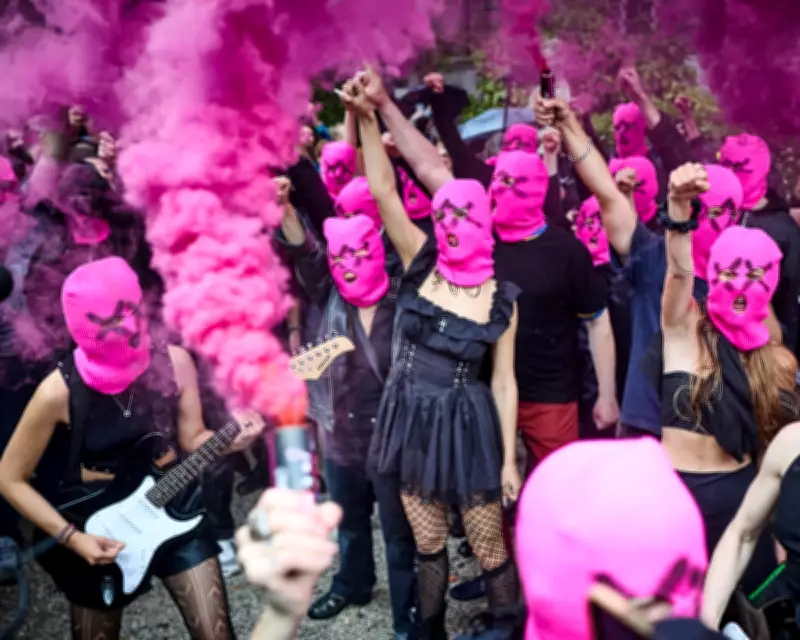
Pussy Riot protesters forced the temporary closure of the Russian pavilion at the Venice Biennale on the second day of the preview, staging a chaotic demonstration against Russia's participation in the art festival. Wearing pink balaclavas, around 40 activists, including members of Femen, ran towards the pavilion, lit pink, blue and yellow flares, played punk music, and shouted slogans such as "Blood is Russia's Art". They attempted to enter but were pushed back by police lining the entrance.
Protest Details
Some protesters had slogans written on their bodies, including "Curated by Putin, dead bodies included", "Russia kills, biennale exhibits", and "Russian art, Ukrainian blood". A statue outside the pavilion was wrapped in a Ukrainian flag. Nadya Tolokonnikova, a founding member of Pussy Riot, expressed horror at the sight of people partying at the pavilion on the first day, where crates of prosecco were loaded and loud techno music played. She pleaded with biennale president Pietrangelo Buttafuoco to "stop taking Russian money" and offered to curate the 2028 Russian pavilion using work by imprisoned artists.
Diplomatic Row
A diplomatic dispute over Russia's involvement has escalated. The Financial Times reported that the European Commission told the Italian government and biennale organizers that allowing the Russian delegation would breach EU sanctions. No arrests were made during the protest, which drew a large crowd of bewildered visitors.

Before the event, the jury that selects the Golden Lion prizes resigned en masse, stating they would not consider entries from countries whose leaders are subject to international arrest warrants, which would exclude Russia and Israel. An Italian news outlet claimed the jury resigned after being told by biennale lawyers they could be held personally responsible if Israel pursued legal action. A biennale representative confirmed the report to the Guardian.
British Pavilion and Other Protests
At the opening of the British pavilion for Lubaina Himid, a representative of the British ambassador said no minister attended due to Russian involvement. The Department for Media, Culture and Sport was approached for comment. Later, the Art Not Genocide Alliance (Anga) demonstrated outside the Israeli pavilion, which was locked from the inside. Over 200 participants signed a letter demanding the cancellation of the Israeli pavilion over the war in Gaza. Israel's foreign ministry condemned Anga's actions as "anti-Israeli political indoctrination" and "direct discrimination".
A larger demonstration coordinated by Anga is expected on Friday, involving Italian labour unions, art workers, curators, and nearly 20 artists. Some artists may create picket lines outside their pavilions. Protest and politics are not new at the biennale; in 1968, protests against the Vietnam War occurred, and in 1974, the event was dedicated to the people of Chile under Augusto Pinochet.
A government spokesperson said: "The UK strongly opposes Russia's participation at the Venice Biennale. We stand in solidarity with the people of Ukraine who have endured more than four years of illegal Russian aggression. As a result we have made the decision not to have government ministers attend the Biennale this year."