Minnesota Economic Blackout Sparks National Solidarity Movement
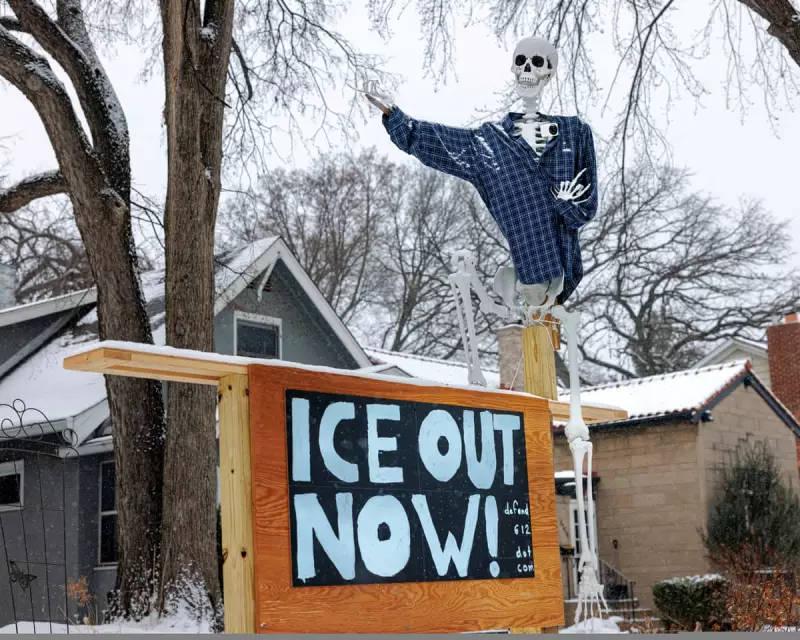
A skeleton decoration stands above a sign outside a home in Minneapolis, Minnesota, on Wednesday, symbolising the haunting presence of federal immigration enforcement in the community. This visual marker coincides with growing protests that are now spreading far beyond state borders.
National Expansion of Economic Action
Organisers behind Friday's economic blackout in Minnesota are actively pushing to take their demonstrations nationwide. What began as a local call for Minnesotans to refrain from working, shopping, or attending school in protest against Immigration and Customs Enforcement operations and the fatal shooting of Renee Nicole Good has evolved into a coordinated national movement.
Planned solidarity actions are now scheduled across numerous American cities including Orlando, Florida; Columbus, Ohio; Phoenix, Arizona; Seattle, Washington; Los Angeles, California; and New York City. This geographical spread represents a significant escalation in labour-led protest tactics against federal immigration policies.
Major Union Leadership and Historical Context
The Service Employees International Union, representing nearly two million service and healthcare workers across the United States, is spearheading calls for nationwide participation. David Huerta, president of SEIU-United Service Workers West and SEIU California, invoked historical civil rights struggles during a recent television appearance.
"Martin Luther King wrote to Cesar Chavez during the Great Boycott and said our separate struggles are really one struggle," Huerta stated. "Right now, more than any time ever, we see our civil rights, workers' rights, and immigrants' rights in alignment with one another."
He emphasised the particular situation in Minneapolis, noting "the violence, the cruelty that's being brought by this federal government against working people" and asserting that "it is now more than ever that we have to stand together, regardless of our differences."
Worker Perspectives and Community Impact
Jim Badger-Aguilar, a public employee at the Massachusetts Commission for the Blind and SEIU Local 509 member, plans to participate in Boston's blackout event. He criticised ICE's conduct, stating it has "gone well beyond what even some of the worst expectations many of us had" regarding the Trump administration's immigration policies.
As a blind public sector worker, Badger-Aguilar highlighted budget concerns: "The billions and billions of dollars that are going to ICE are at the cost of public services and of services for people with disabilities, people who are homeless, people who are poor, other working people."
Minnesota Labor Response to ICE Operations
Chelsie Glaubitz Gabiou, president of the Minnesota Regional Labor Federation, AFL-CIO, described the ICE operations in her state as creating a "crisis" for thousands of workers who fear being targeted while commuting to their jobs.
"This is a crisis for all of our workers," she emphasised. "This is a crisis for our local economy, and we're doing everything we can with our employers to keep our workplaces safe. Our communities and our democracy is under attack when you can't even have the freedom to move to go to work."
Glaubitz Gabiou strongly contested official claims that ICE primarily targets undocumented immigrants with criminal records, sharing specific cases of legal workers being detained. "There is no rhyme or reason besides racial profiling for how people are being picked up in this community," she asserted.
Broad-Based Support and Faith Community Involvement
The executive board of the Minnesota AFL-CIO, representing over one thousand affiliated local unions, formally endorsed the day of action on January 20th, with dozens of additional labour unions across the state following suit.
Faith leaders announced that numerous places of worship throughout Minnesota will participate in Friday's actions. JaNaé Bates Imari, a minister and co-executive director of the multi-faith non-profit Isaiah, declared during a press conference: "I stand before you with so many clergy, not just here, but across this great state, who are calling for ICE to leave."
She encouraged faith communities to "open your doors for people to have lament, to have prayer, to take moral and faithful action together" on Friday.
Local Business Closures and Federal Response
Dozens of small businesses in the Minneapolis area—including bars, restaurants, and bakeries—have announced plans to close in solidarity with the economic blackout.
The US Department of Homeland Security responded critically to the labour actions, with a spokesperson calling the protests "beyond insane" and questioning why labour leaders would oppose removing "public safety threats" from communities. The department provided twenty-three uncaptioned photographs of individuals they described as criminals whom labour unions were allegedly attempting to protect through the blackout.
This controversy unfolds against a backdrop where, under the Trump administration, thousands of ICE targets had no criminal record, and numerous US citizens have been detained. The administration also issued over fifteen hundred pardons in 2025, including for US Capitol insurrectionists and wealthy campaign donors.
The economic blackout represents a significant escalation in labour movement tactics, transforming a Minnesota protest into a nationally coordinated action that bridges workers' rights, immigrant rights, and civil rights concerns across multiple American communities.