
Major Police Powers Expansion in Melbourne's Heart
Victoria Police has implemented sweeping new search authorities across inner Melbourne that will remain in effect for six months, enabling officers to conduct random pat-downs and vehicle inspections without requiring warrants or reasonable suspicion.
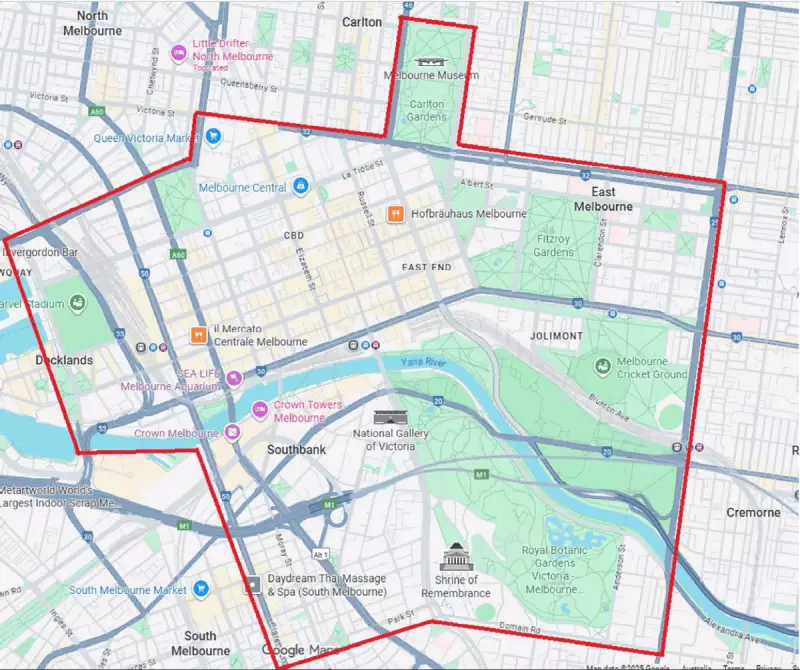
The controversial designation, activated under the Control of Weapons Act, covers Melbourne's Central Business District, Docklands, Southbank, the sporting and entertainment precinct, plus sections of East Melbourne and South Melbourne. These enhanced police powers commenced on Sunday and will continue until 29 May 2026.
What the New Search Powers Entail
Under this unprecedented declaration, both police officers and Protective Service Officers (PSOs) can randomly stop and search individuals using electronic wands or physical pat-downs. The authority extends to requiring people to remove outer clothing items such as jackets, scarves, and headwear, plus empty bags and pockets for inspection.
Vehicles operating within the designated zone are also subject to warrantless searches. Additionally, police may demand the removal of face coverings that could conceal identities or provide protection against crowd-control substances like pepper spray. Those refusing mask removal requests can be ordered to leave the area immediately.
The legislation makes it an offence to obstruct officers conducting searches or to disregard police directions to vacate the designated zone. These powers, typically reserved for managing specific protests or demonstrations, have never before been applied to such an extensive geographic area for this duration.
Human Rights Organisations Voice Strong Opposition
Inner Melbourne Community Legal chief executive Nadia Morales condemned the measure as "complete overkill," emphasising its unprecedented scope and duration. "What it means is that a police officer or protective services officer can stop and search anyone, no questions asked, at any time in the CBD and its surrounds," Morales stated.
Human Rights Law Centre legal director Sarah Schwartz expressed concern that ordinary Melburnians going about their daily lives could be affected. "People could be heading to study at the State Library, or heading to a free music gig at Federation Square and end up humiliated by Victoria police," Schwartz noted.
Liberty Victoria president Gemma Cafarella described the declaration as an "abuse" of police powers, questioning both its necessity and effectiveness. The organisation's March report revealed that illicit items, including weapons, were seized in only 1% of warrantless searches conducted in designated areas over a two-year period.
Police Justification and Community Impact Concerns
Victoria police confirmed this represents the first area declaration of this duration under recent legislative changes. A police spokesperson defended the measures as "invaluable tools in assisting police with removing weapons from the streets, as knife crime in Victoria has risen."
The spokesperson asserted the force maintains "zero tolerance towards racial profiling" and that officers receive training to "police in response to a person's behaviour, not their background." The official statement included the reassurance: "If you aren't carrying a weapon, you don't have anything to worry about."
However, community legal advocates fear the powers will disproportionately affect minorities, vulnerable populations, and marginalised groups, including people experiencing homelessness or mental health challenges. Morales highlighted that random police stops often prove "humiliating and makes them feel like they have done something wrong."
The extended designation period raises significant questions about the balance between public safety measures and civil liberties in Victoria's capital city.




