
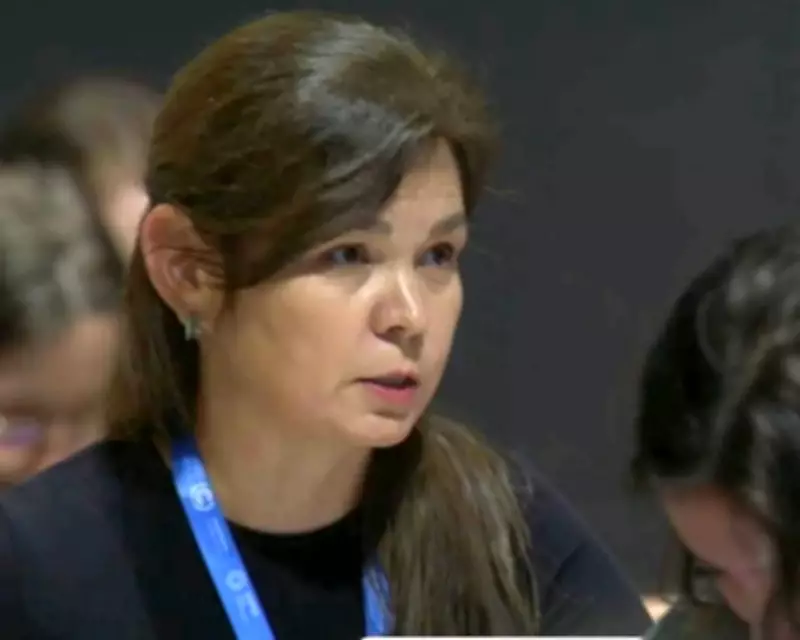
The arrest of Daria Egereva, a prominent Indigenous rights activist in Russia, has drawn international attention to the challenges faced by the country's native peoples. The operation began at 9am Moscow time, spanning all 11 time zones of Russia, as Federal Security Service (FSB) agents raided the homes and workplaces of 17 Indigenous rights activists. Officers conducted searches, confiscated laptops and phones, and arrested activists, interrogating them about their participation in international forums. While most were released, many have since left the country. Others remain but have stopped speaking out.
Six months later, Egereva remains in jail, accused of membership in a terrorist group. No trial date has been set. Her supporters assert the charges are fabricated and that she was targeted for her outspoken advocacy. Egereva, a member of the Selkup Indigenous group from western Siberia, was a leading figure in Russia's Indigenous rights movement. As a member of the UN's Indigenous Peoples' Coordinating Body, she held international status. Weeks before her arrest, she played a key role at COP30 in Brazil, co-chairing the Indigenous People's Forum on Climate Change.
Threats to Indigenous Peoples
Her imprisonment highlights the plight of Russia's Indigenous people, who face threats from authoritarianism, extractivism, and climate breakdown. "They are really seeing the worst effects of climate change," said Alicia Moncada, director of global advocacy at Cultural Survival. "They are on the frontline of the frontline – that’s why [Egereva’s] advocacy was super important." The polar north is heating faster than any other part of the planet, with temperatures in Arctic regions rising three to four times faster than the global average. Communities on permafrost are witnessing the collapse of their world.
"The elders are saying that nature has stopped trusting us," said one exiled Indigenous leader, who requested anonymity. "The traditional ways of predicting nature are not working any more." Many settlements sit near rivers and lakes, and melting permafrost is causing banks to crumble. "There is a real threat of destruction for a lot of those villages," he said. Melting ice has also created new tensions over critical mineral resources. "All these resources of the Russian Federation, a majority of them are located under the lands of Indigenous people: gold, diamonds, oil, gas, coal," the leader said. "For some people it is a treasure, but for us it is a curse."
Companies are pushing Indigenous communities off their lands, and environmental degradation makes hunting and fishing impossible. "One of the elders said that we can adapt to anything, but we will not be able to survive without our land," he added.
New Generation of Leaders
Although Indigenous groups maintained their identities, by the end of the Soviet era they lacked independent organization and relied on the state. Egereva was part of a new generation of leaders encouraging community self-empowerment. However, this assertiveness brought them into conflict with authorities. Even before the war in Ukraine, the Russian state claimed that enemies were exploiting environmental and Indigenous issues. Now, the war serves as a pretext for a crackdown on civil society, with Indigenous people among those affected.
To date, 830 organizations and 20,813 individuals have been placed on the "list of terrorists and extremists," according to the UN. Among them is Aborigen Forum, a network of Indigenous defenders designated an "extremist organization" in July 2024. Russian authorities base their charges against Egereva and her co-defendant, Natalia Leongardt, a civil rights activist, on their involvement with Aborigen. Authorities claim it is part of an anti-state "post-Russia free nations forum."
Court Proceedings
In a bail hearing on April 29, Egereva and Leongardt denied being part of any anti-state conspiracy. "I am not familiar with and do not know this organization," Egereva told the court. "What we are being accused of is completely untrue … I ask to be allowed to return home and embrace my children." The court refused bail, remanding them in custody until at least mid-June. The following day, Russia celebrated a new federal holiday: the "Day of Indigenous Small-Numbered Peoples."
The Russian embassy stated: "The investigation concerning Daria Egereva is an internal Russian legal matter, conducted in full accordance with Russian law. As proceedings are ongoing, we are not in a position to comment on the specifics of the case. Russia firmly rejects any allegations of violations of Indigenous people’s rights. Unlike a number of western states – including Britain in its former colonies – Russia has no history of forced assimilation of Indigenous communities. Russian law affords Indigenous peoples special legal protections, guaranteeing their collective and individual rights, cultural identity, and linguistic heritage under the constitution and in line with international norms. Russia is actively engaged in the international climate agenda, taking account of both the challenges and the economic opportunities emerging in its northern regions – including expanded access to the northern sea route and mineral resources in permafrost zones. All such projects are carried out with the aim of supporting regional development, creating jobs and attracting investment, including for the benefit of Indigenous communities in these areas."




