
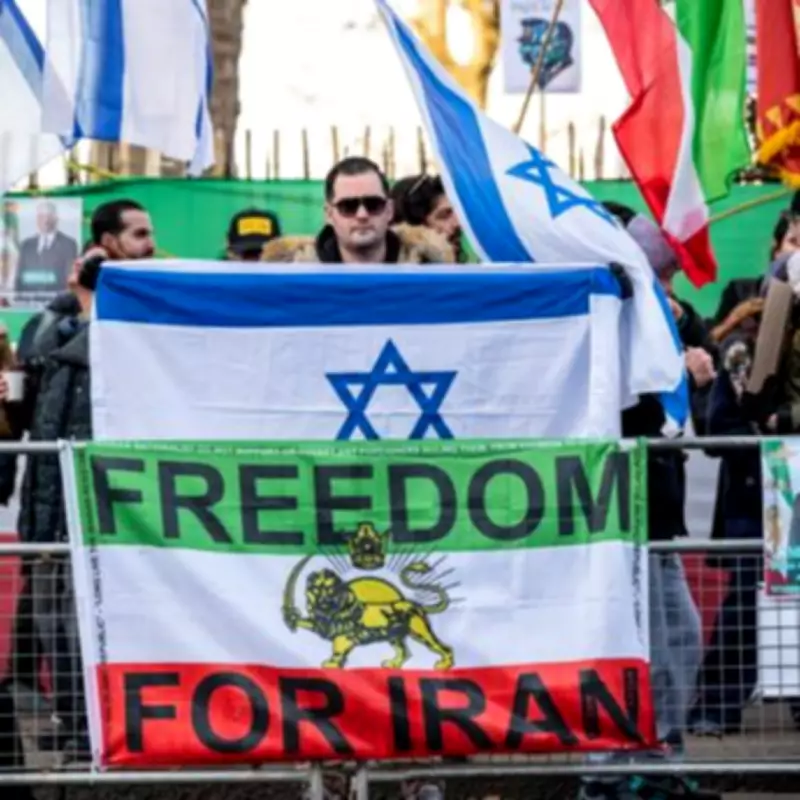
Understanding the Symbolism Behind Dual Flags at London Demonstrations
Recent protests across Central London have featured a striking visual juxtaposition that has captured public attention and sparked curiosity. Demonstrators have been seen flying Iranian flags alongside Israeli ones during gatherings outside significant locations including the Iranian Embassy in Kensington and Downing Street. This pairing appears particularly noteworthy given the current strained diplomatic relations between the two nations, which were highlighted during last year's Twelve Day War that involved missile attacks and significant casualties.
The Context of London's Protest Movements
These demonstrations have drawn substantial crowds, with reports indicating thousands of participants gathering to show solidarity with Iranian protestors. The protests serve multiple purposes: calling for the UK government to designate Iran's Islamic Revolutionary Guard Corps as a terrorist organisation, demanding the closure of the Iranian embassy in London, and seeking the expulsion of regime agents operating within the country. During these gatherings, protestors have engaged in powerful symbolic acts including saluting photographs of those killed in recent Iranian uprisings.
Decoding the Flag Symbolism
Professor Anoush Ehteshami, an expert in International Relations at Durham University's School of Government and International Affairs, provides crucial insight into this phenomenon. The Iranian flag displayed alongside the Israeli standard is not the current flag of the Islamic Republic adopted in 1980, which features religious symbolism including the word "Allah" and repeated inscriptions of "Allahu Akbar." Instead, protestors are displaying the pre-revolutionary flag used before 1979, which features a distinctive gold emblem of a lion with a sword before a rising sun, sometimes accompanied by the crown of former crown prince Reza Pahlavi.
Professor Ehteshami explains: "The Iranian flag we see is not the flag of the Islamic Republic, but it's the traditional flag that was used before the revolution by the monarchy. That's the critical issue here: they are aligning with Reza Pahlavi, the former crown prince, with that flag as his support and are at the same time bringing the Israeli flag in because he has close links with Israel and also because Israel has been involved in punishing the Islamic Republic in one form or another."
Political Alignments and International Support
This dual flag display represents a complex political statement that acknowledges several interconnected realities. Firstly, it shows support for Reza Pahlavi and the opposition movement he represents. Secondly, it recognises Israel's involvement in actions against the current Iranian regime. Thirdly, it symbolises the alignment between Pahlavi's supporters and Israeli interests, creating a visual representation of this political relationship during public demonstrations.
The protests occur against a backdrop of ongoing tensions between Iran and Israel, highlighted by recent military conflicts and strong verbal exchanges between leaders. Israeli Prime Minister Benjamin Netanyahu has publicly criticised Iran's "axis of evil," while Iran's Supreme Leader Ayatollah Ali Khamenei has described Israel as a "superfluous and fake Zionist regime." This context makes the flag pairing at London protests particularly significant as a statement of opposition alignment.
The Broader Implications for London's Protest Landscape
These demonstrations represent more than just symbolic flag displays; they reflect London's position as a global stage for international political expression. The city's protest spaces have become arenas where complex geopolitical relationships are visually represented and where diaspora communities and political supporters can voice their positions on international conflicts. The careful selection of historical symbols alongside contemporary national flags demonstrates sophisticated political messaging that requires understanding of both historical context and current international relations.
As London continues to host such demonstrations, the visual language of protest becomes increasingly important for communicating complex political positions to both domestic and international audiences. The pairing of these particular flags serves as a powerful example of how historical symbols can be repurposed for contemporary political statements, creating layered meanings that resonate with multiple audiences simultaneously.




