
Haiti is facing what police unions describe as the greatest security failure in its modern history after coordinated gang assaults over the weekend left nearly a dozen people dead and forced hundreds to flee their homes in the central Artibonite region.
Wave of Violence and a Police Plea for Help
Beginning late on Friday and continuing through Saturday, heavily armed gang members launched large-scale attacks on towns including Bercy and Pont-Sondé. They set fire to homes, killed men, women, and children, and broadcast their assaults live on social media, plunging the region into chaos.
Haiti's police unions issued desperate emergency calls for backup, stating that 50% of the Artibonite region had fallen under gang control. In a statement on Sunday, the SPNH-17 police union declared the situation catastrophic, noting that the population could no longer live, work, or move freely. They emphasised that losing control of both the West and Artibonite departments represented an unprecedented security collapse.
Confirmed Deaths and a Desperate Exodus
On Monday, Pont-Sondé official Guerby Simeus confirmed nearly a dozen deaths from the attacks. The victims included a mother and her child, as well as a local government employee. Simeus reported that gangs remained in control of Pont-Sondé and that no additional police reinforcements had arrived to assist.
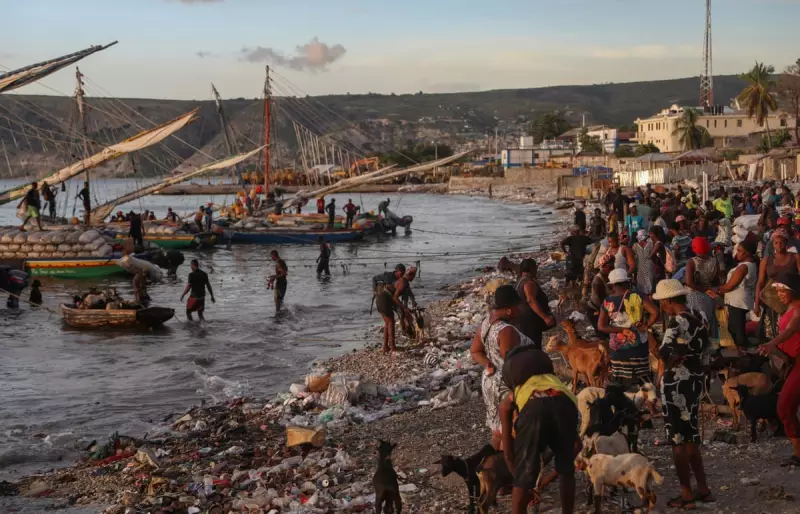
Survivors, many escaping under cover of darkness, fled to the coastal town of Saint-Marc. By Monday, hundreds of angry citizens gathered there, demanding government action against the gangs that have repeatedly targeted the central region. The frustration boiled over, with crowds attempting to break into the mayor's office.
"Give me the guns! I'm going to fight the gangs!" exclaimed survivor Réné Charles. "We've got to stand up and fight!" Another protester told the Associated Press they were prepared to take justice into their own hands, having lost faith in the government's ability to protect them.
A Deepening Humanitarian Catastrophe
The attacks have exacerbated an already dire humanitarian situation. Political activist Charlesma Jean Marcos urged displaced survivors, who are sleeping on streets and in public parks, to seek refuge in police stations and government buildings. He warned of impending hunger, stating that while local support was possible in the short term, it was unsustainable.
This crisis unfolds against a backdrop of record displacement and famine. More than half of Haiti's population faces crisis-level hunger, with gangs blocking main roads. Nationwide, violence has displaced a record 1.4 million people.
The weekend's violence has been attributed to the Gran Grif gang, one of Haiti's most brutal groups, which operates in the Artibonite area. Its leader, Luckson Elan, is under UN and US sanctions. The gang was also responsible for a massacre in Pont-Sondé in October 2024 that killed at least 100 people.
A recent UN report noted a dramatic rise in killings in Artibonite and Centre departments, with 1,303 victims reported from January to August this year. The report concluded that the assaults "underscore the capacity of gangs to consolidate control" across the region due to limited law enforcement. Haiti's national police did not immediately respond to requests for comment on the latest crisis.




