
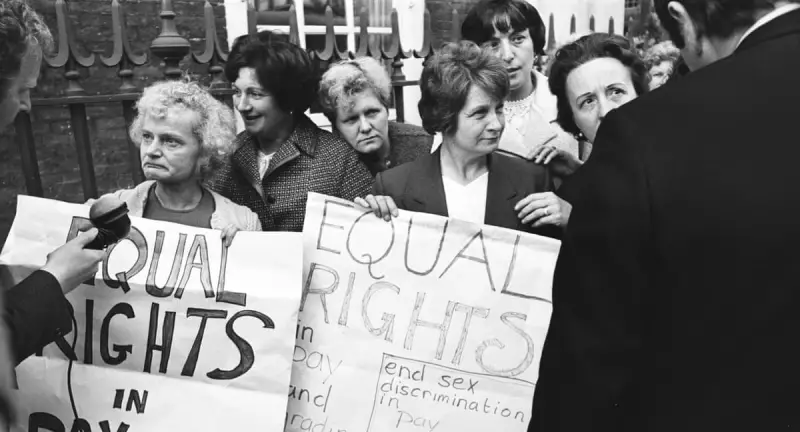
Fifty years after the Sex Discrimination Act transformed women's rights in the UK, the stories of the campaigners who fought for it risk fading into history. Often reduced to caricatures or forgotten entirely, their battle against entrenched workplace sexism was a pivotal chapter in Britain's social history.
The Daily Grind of Institutional Sexism
In the late 1960s, female journalists like Celia Brayfield faced a professional landscape rife with everyday prejudice. Working on the women's pages of Fleet Street newspapers, they navigated a world where wearing trousers could bar entry to press conferences at venues like The Savoy, and where editors showed profound disinterest in the burgeoning women's liberation movement sweeping America.
Brayfield, who started her career at 19 as an assistant to Shirley Conran at the Observer, recalls the Daily Mail as a "very sexist organisation." She learned to strategically bury mentions of equality deep within articles, often not before the fifth paragraph. This constant exposure to discrimination, she says, was radicalising.
When mainstream editors rejected her interviews with feminist leaders like Kate Millett, Brayfield turned to the underground press, such as Frendz magazine. Alongside Conran, she joined Women in Media, a pressure group founded in 1970 to challenge sexism within the industry and beyond. One of their key battles was against the broadcasters' refusal to let women read the news, with a BBC executive claiming in 1972 that the public would find it "unnatural."
From Dagenham to Westminster: Building Pressure for Change
The fight for legal equality had deeper roots. Despite female trade unionists campaigning since the 19th century, and the vital roles women played in the Second World War, post-war workplaces were fundamentally unequal. It was standard for women to earn four-fifths of a man's wage for the same job.
The 1968 strike by 187 sewing machinists at Ford's Dagenham plant became a legendary flashpoint. Though Employment Secretary Barbara Castle negotiated an end to the strike, the resulting pay rise to 92% of the male rate was not full equality. The subsequent Equal Pay Act of 1970 was a compromise, with a five-year implementation delay and limited scope.
Parliamentary allies like Labour MP Joyce Butler and Liberal peer Nancy Seear repeatedly tried to introduce anti-discrimination bills. Outside Westminster, activists mobilised, gathering signatures for a massive petition and lobbying MPs. Women in Media formed an Anti-Discrimination Bill Action Group (Adbag), deploying tactics from decorating letters with fabric hearts to confronting politicians directly.
Their efforts culminated in a major show of force on 28 June 1973. Led by Guardian women's editor Mary Stott, a coalition delivered a petition to Buckingham Palace and held a "Women's Parliament" at Caxton Hall, processing to Downing Street with wax torches.
A Landmark Act and Its Lasting Legacy
The political pressure intensified. In a bold move ahead of the October 1974 election, Women in Media established the Women's Rights Campaign and put forward deaconess and GP Una Kroll as a candidate in Sutton and Cheam. Though she won only 298 votes, the stunt generated significant publicity.
Soon after Labour secured a majority, it committed to outlawing sex discrimination. The National Council for Civil Liberties (NCCL), with future minister Patricia Hewitt as its first women's officer, drafted a bill. The debates were fierce, covering the powers of a new enforcement body and the scope of the law. Feminists wanted it to cover financial matters like pensions, but ministers reserved these for separate treatment.
The Sex Discrimination Act and the Equal Pay Act finally came into force on 29 December 1975, alongside the new Equal Opportunities Commission (EOC). The fight then shifted to enforcement, with groups like the NCCL pursuing landmark test cases, such as Belinda Price's successful challenge against the Foreign Office's age limit.
Reflecting on the campaign, Celia Brayfield emphasises the enduring nature of the struggle: "We really did set out to change our society... but it's a fight you have to keep winning. There's never any sitting back and saying 'we've won' because you never have." The 1975 Act was a monumental, hard-won compromise that reshaped British society, yet its history reminds us that the pursuit of equality is never truly finished.




