
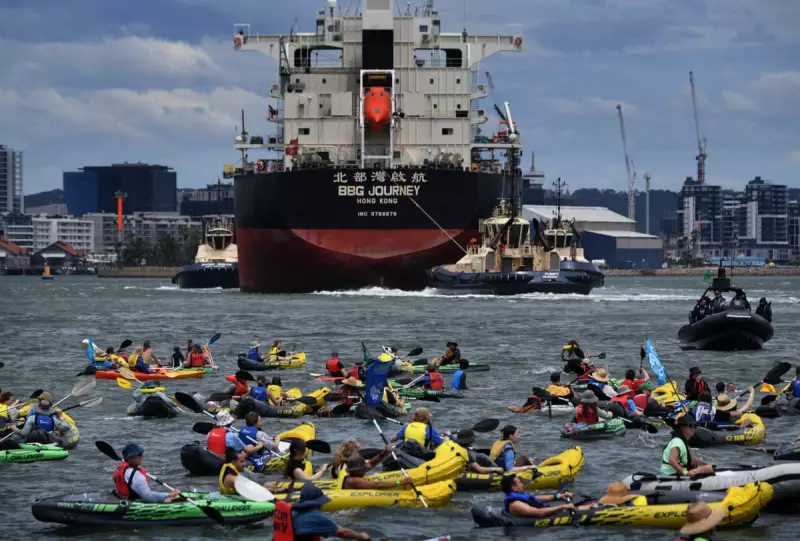
In a dramatic display of environmental activism, thousands of climate protesters converged on the world's largest coal port in Newcastle, Australia, successfully blocking multiple coal ships from entering the facility during a six-day demonstration organised by the Rising Tide movement.
Paddling Against the Tide
Among the estimated 8,000 participants was 71-year-old Annabelle*, who travelled from Melbourne to join what has become one of Australia's largest annual climate protests. Despite knowing arrest was likely, she paddled determinedly into the shipping channel in her kayak alongside hundreds of fellow activists.
"I just paddled and paddled, madly paddled," Annabelle told reporters after her arrest. "I was determined to get into that channel, it's the first time I've done something like this, and I wanted to stop that ship."
The New South Wales government had established an exclusion zone marked by yellow buoys around most of Newcastle Port, granting police additional powers to arrest anyone crossing the boundary. Police waited in boats just inside the zone, ready to intercept protesters who defied their directions.
Festival Atmosphere Meets Serious Protest
The event blended serious environmental activism with elements of a community festival. Foreshore Park buzzed with activity featuring a community kitchen, live music stage, and information tents providing legal advice and taking statements for those charged.
Horseshoe Beach became the focal point of the water-based protest, packed with people waving climate action flags and dancing in costumes while the water filled with colourful kayaks. Despite the festive atmosphere, the underlying message remained urgent and serious.
By Monday morning, more than 130 people had been arrested and charged under either the Marine Safety Act or Crimes Act for blocking the shipping lane. The protest marked the third year of Rising Tide's growing movement, which continues to attract participants despite government warnings about potential arrests.
Diverse Participants United by Climate Concerns
The protest drew people from across Australia with varied backgrounds but shared climate concerns. Twenty-two-year-old Zac Tritton, who actually works in Newcastle's coal industry, attended because he worries about climate collapse and its impact on regions like the Hunter that depend on fossil fuel extraction.
"I think this rhetoric coming from within the coal corporations – that coal's not going anywhere, and that protesters like this are here to threaten the communities and threaten jobs – is misleading," Tritton explained.
He pointed to recent Treasury modelling showing Australia's coal and gas exports will plunge by 50% in the next five years, emphasising that "we need to be prepared for it."
Rising Tide's core demands include the immediate cancellation of all new fossil fuel projects, taxing fossil fuel profits at 78% to fund community and industrial transition, and ending coal exports from Newcastle by 2030.
Official Responses and Community Support
Newcastle's deputy lord mayor, Charlotte McCabe, who attended the event, acknowledged council concerns about supporting workers in declining industries. "We have been calling for transitional support from both the state and federal governments for some time," she stated.
This year, the council approved land-based activities for the event after consultation showed strong community support – 86% of respondents backed using park sections for live music, while 76.6% supported temporary camping areas.
However, NSW Police Minister Yasmin Catley took a harder stance, telling ABC Radio Newcastle: "This is not an event. This is a protest. And we are absolutely committed to keeping that shipping lane safe."
She justified the government's position by citing past behaviour of protesters being "reckless and dangerous."
Personal Sacrifices for Planetary Future
For organiser Zack Schofield, 26, the protest holds personal significance. "I grew up in Newcastle," he shared. "I learned to count by counting the coal ships on the horizon with my mum."
He believes Newcastle bears special responsibility as the world's largest coal port: "We have in Newcastle a responsibility at a global scale to do everything in our power not just to protect the livelihoods of Hunter workers, but to protect the future generations of the entire planet."
After her arrest, Annabelle returned to the park waving the yellow slip police had given her with her charge. The crowd erupted in applause as she and dozens of other arrested protesters returned. She faces charges under section 214A of the Crimes Act for blocking a major facility, which carries a maximum penalty of two years in prison or a $22,000 fine.
Despite the risks, Annabelle remains committed, inspired by her daughter's successful activism to end native logging in Victoria. "I have been protesting, writing emails, doing vigils for a long, long, long, long time now – it seems to fall on deaf ears," she reflected. "She can't get arrested any more, but I can."
*Name changed to protect identity




