
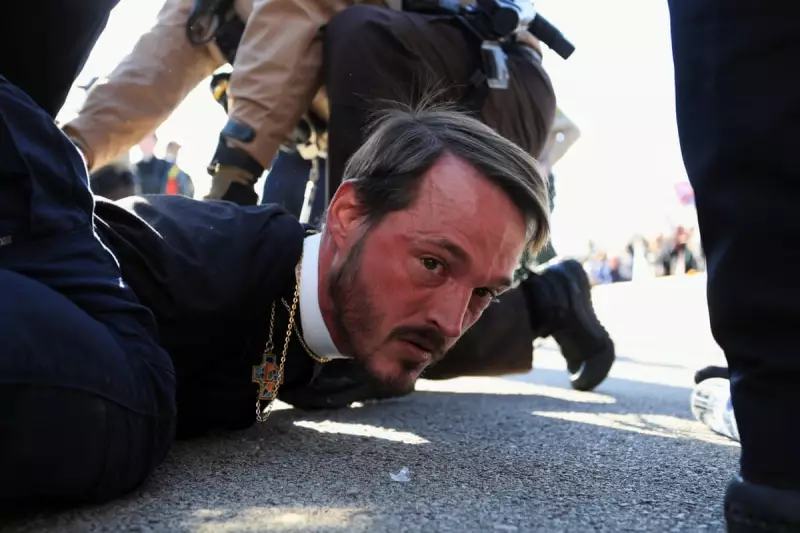
In a dramatic display of religious resistance, Chicago's faith leaders have positioned themselves at the forefront of opposition against what they describe as the Trump administration's brutal immigration crackdown. The movement has seen clergy members detained, pepper-sprayed, and taking legal action against federal authorities.
Frontline Resistance and Police Detentions
The conflict reached a pivotal moment when Michael Woolf, minister at Lake Street Church of Evanston, was detained by Illinois state police during a protest against immigration actions. His arrest symbolises the escalating tensions between religious communities and federal immigration enforcement.
According to recent figures, Immigration and Customs Enforcement (ICE) and Department of Homeland Security officials have arrested 800 people as of 1 October, employing violent tactics that include body-slamming protesters and deploying teargas in residential areas. These operations have created what community leaders describe as a pervasive atmosphere of fear throughout Chicago's immigrant communities.
Reverend Ciera Bates-Chamberlain, executive director of Live Free Illinois, emphasised the unique role faith leaders play in this crisis. "Faith leaders bring a very powerful prophetic and moral compass into the space," she stated. "While many others may be able to argue the economic impact, or argue the law, faith leaders are typically the ones who are arguing and standing on the side of humanity and for people."
Interfaith Coalition and Sanctuary Movement
Chicago religious leaders have established an interfaith coalition called Faith over Fear, designed to train clergy members as rapid responders to raids and ensure churches remain sanctuaries for immigrants. This development comes after the Trump administration overturned previous policy to allow immigration enforcement to make arrests in churches earlier this year.
One of the most visible actions has been the regular Friday gatherings outside the Broadview processing facility, where ICE holds people slated for deportation. Dozens of people from various faith communities rally there weekly, with clergy members sometimes using non-violent tactics to attempt to block vans from leaving the facility.
Reverend David Black of the First Presbyterian Church of Chicago described being shot in the head with pepper balls while praying outside the facility. "As atrocious and nightmarish as this time has been and continues to be, there's an enormous amount of good that is coming out of people learning to organise and take responsibility for our society," Black reflected. "People are not waiting for our government to come save us."
Legal Challenges and Spiritual Support
Faith leaders have publicly pleaded with ICE and DHS to allow them access to detained individuals to provide spiritual comfort and religious rituals, including delivering communion to immigrant detainees. When federal authorities prevented this access, church leaders responded by suing the Trump administration for violating their first amendment rights.
Rami Nashashibi of the Inner-City Muslim Action Network described the current situation as "an unprecedented moment" characterised by "masked agents in unmarked cars, smashing windows and pulling people out of vehicles in front of their children." He emphasised the need for faith communities to build power together to respond to what he termed "fascist interventions" in American cities.
The coalition has been careful to frame the issue as affecting multiple communities, not just immigrants. Nashashibi noted that Black communities on Chicago's South Side have also experienced intense violence, and American citizens have been confronted by ICE. "Faith communities have been trying to make sure that our communities don't conflate this as simply an 'immigrant issue'," he explained.
Janie Pochel of the Chi-Nations Youth Council brought Indigenous spiritual practices to the protests, conducting smudging ceremonies and prayers outside the detention facility. "It's important that we were there to witness some of the brutality and also for the people on the inside - for them to know that there's people here that care," Pochel stated.
As the movement grows, faith communities have become central hubs for organising, food distribution, Know Your Rights trainings, and sanctuary for Chicagoans of all backgrounds who oppose the federal government's immigration enforcement presence in the city.




