
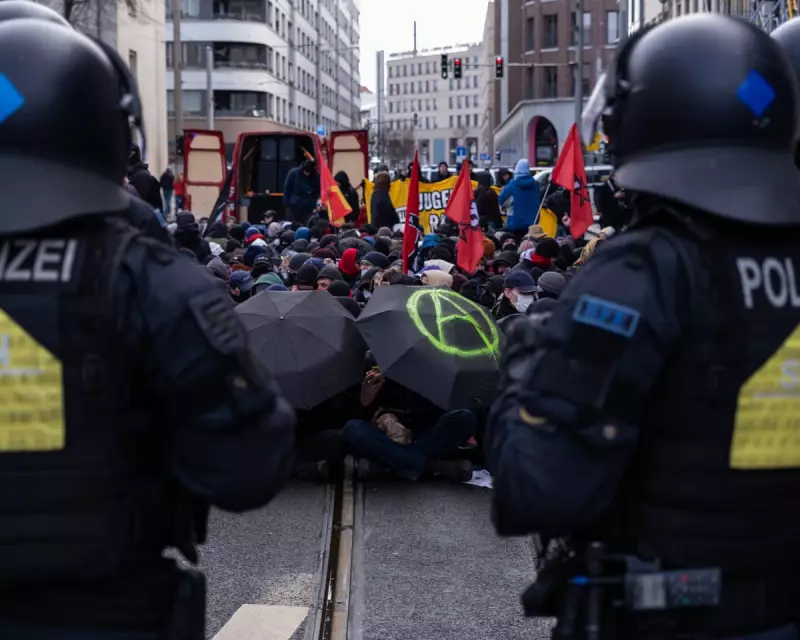
Germany's far-right Alternative für Deutschland (AfD) party has enthusiastically endorsed a controversial decision by the United States government to classify four European left-wing networks, including a prominent German anti-fascist group, as terrorist organisations.
The party is now pressuring the German government and other European nations to implement similar bans, a move that historians and experts warn could enable a widespread crackdown on left-wing activism across the continent.
US Designation and AfD's Reaction
The US State Department announced its ruling on Thursday, applying the terrorist designation to Germany's Antifa Ost, Italy's International Revolutionary Front, and two Greek organisations: Armed Proletarian Justice and Revolutionary Class Self Defense. This classification allows the US to freeze any assets these groups hold there and ban their members from entering the country.
Stephan Brandner, the AfD's deputy federal spokesperson, seized upon the announcement, stating, "Antifa is a terrorist organisation, and it would be easy for the German state to take action against it, only those in power don't want to." He accused the German state of deliberately tolerating far-left violence. The AfD has long campaigned for such a ban, even before becoming the largest opposition party in the German parliament earlier this year.
Historians Warn of a 'Dangerous Precedent'
However, academics specialising in the history of anti-fascism have raised significant alarms. They argue that at a time when far-right parties are gaining electoral ground in Europe, this move sets a perilous precedent.
Mark Bray, a professor at Rutgers University, pointed out that of the four groups banned, only Antifa Ost is explicitly anti-fascist. "The others are revolutionary groups," he said, suggesting the Trump administration is deliberately conflating different movements under the broad "antifa" label to justify future crackdowns on domestic opposition.
Echoing this concern, historian Richard Rohrmoser told Der Spiegel that the term 'antifa' is so vague it could be applied not just to groups engaged in violence but also to peaceful organisations like the Anne Frank Center. "Trump is pursuing a perfidious tactic," Rohrmoser said. "By labelling groups as 'antifa', he can ban leftwing groups and demonstrations and crack down on opposition figures."
The Groups Under Scrutiny
The German domestic intelligence service, the BfV, which itself classifies the AfD as a "confirmed rightwing extremist" force, has previously noted that the antifa movement lacks a fixed organisational structure or clear hierarchies.
Regarding the specific groups banned by the US:
- Antifa Ost: Members are accused of attacks on far-right figures, including a neo-Nazi in Dresden, between 2018 and 2023. Six alleged members were charged in Germany in July, and a prominent member, Maja T, is being held in custody in Hungary facing a potential 23-year prison sentence.
- Italy's Fai/Fri: Considered a structured, 'horizontal' movement of anarchist cells, it has claimed responsibility for numerous acts of violence, including a parcel bomb that exploded in the hands of former European Commission President Romano Prodi in 2003.
- The Greek groups are accused of planting bombs.
Mary Bossis, an emeritus professor of international security, emphasised that violence on the fringes of a movement does not define the whole. "Standing against fascism does not make someone a terrorist," she stated. Greek media have described the US decision as a "dangerous development" given the rising threat from the far-right on both sides of the Atlantic.




