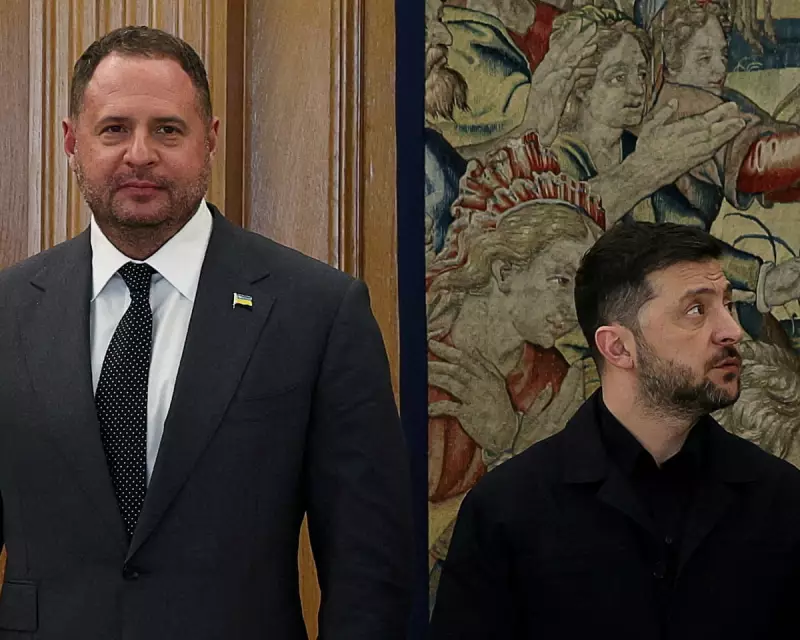
Zelenskyy's Inner Circle Upended by Shock Resignation
Ukraine's political landscape is undergoing what experts describe as a "mini-revolution" following the sudden departure of President Volodymyr Zelenskyy's most powerful aide and closest confidant. Andriy Yermak, who served as chief of staff and headed Ukraine's delegation to peace talks with Russia, resigned on Friday after anti-corruption investigators searched his apartment.
The Untouchable Enforcer's Downfall
Yermak's resignation marks a seismic shift in Ukraine's wartime power structure. The former intellectual property lawyer turned B-movie producer had been Zelenskyy's most loyal associate since their days working together in television production. When Zelenskyy won the 2019 presidential election, Yermak transitioned into politics alongside him, initially as a foreign policy adviser before becoming chief of staff a year later.
During the full-scale war, Yermak became increasingly powerful and appeared untouchable. He managed Ukraine's most sensitive foreign policy channels, maintaining regular contact with national security advisers from allied countries and leading the team working on peace negotiations. Beyond his diplomatic role, he functioned as Zelenskyy's chief political enforcer, often issuing direct orders to ministers and embodying the president's will.

Grudging Admiration and Ruthless Control
Despite his unpopularity among the Ukrainian elite, many acknowledged Yermak's formidable work ethic and strategic scheming with reluctant respect. His extraordinary level of control over access to the president, unusual in democratic systems, was often justified by the wartime context. Crucially, his role as a lightning rod for criticism frequently shielded Zelenskyy from direct political attacks.
Yermak's management style involved ferociously policing access to the president. According to Kyiv-based political analyst Volodymyr Fesenko, only five or six people had direct access to Zelenskyy, with Yermak systematically attempting to push even these individuals out. Military intelligence chief Kyrylo Budanov managed to resist several reported attempts by Yermak to have him fired, while others who fell out of favour or grew too popular were swiftly dismissed.
Corruption Investigation Forces Hand
The anti-corruption probe that ultimately triggered Yermak's resignation had been building pressure on the administration. Although Yermak hasn't been charged with any offences, the investigation threatened to dominate news cycles and escalate into a full-blown crisis amid growing public discontent over corruption.
On Saturday, Ukrainska Pravda reported that investigators had seized several laptops and mobile phones from Yermak's apartment for analysis. The scandal had already severely damaged Zelenskyy's approval ratings, creating an untenable political situation.
Fesenko suggested that Yermak likely made the resignation decision himself rather than being ordered out by Zelenskyy. "I think Yermak understood that if he goes down, he'll bring Zelenskyy down with him, and decided to sacrifice himself to save Zelenskyy," the analyst commented.
Power Vacuum and Political Realignment
The aftermath of Yermak's departure promises to be messy as Ukraine's political system adjusts. Yermak's loyalists now fear for their positions, while many in the elite are breathing sighs of relief and hoping for more direct access to the president.
Zelenskyy is expected to announce a replacement imminently, with most speculated names coming from the president's inner circle. However, whoever assumes the role is unlikely to wield comparable power, at least initially. This could prove challenging for a weakened Zelenskyy, particularly if the corruption investigation yields further revelations.
Olena Prokopenko, senior fellow at the German Marshall Fund, noted that "Yermak was gatekeeping not only the president's contacts with the outside world but also the information getting through to the president." His departure potentially opens the door to more consensual decision-making and fresh ideas that many have been demanding.

The political upheaval comes as Ukraine faces tremendous consequences for both domestic governance and peace negotiations with Russia. Yermak's absence from the Ukrainian delegation to peace talks creates a significant void in the country's diplomatic efforts to end the conflict.
Prokopenko highlighted the broader significance: "There's a very strong demand in Ukrainian society for the revision of the social contract between the president and the people, and for restructuring the relationship between president and the cabinet and parliament."