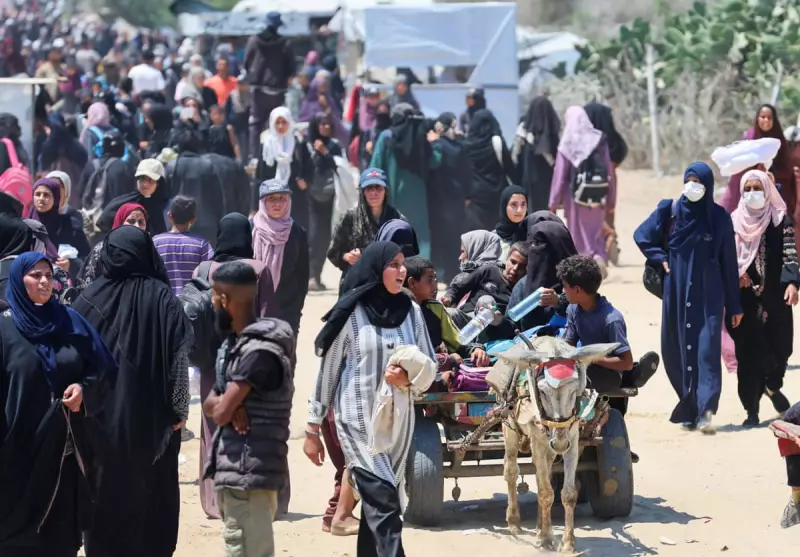
UAE to Finance First Planned Community in Southern Gaza with Biometric Entry System
The United Arab Emirates has announced plans to fund what is being described as Gaza's first planned community on the devastated outskirts of Rafah, located in the southern Gaza Strip. This ambitious reconstruction project represents the UAE's inaugural investment in post-war rebuilding efforts within the Israeli-controlled portion of Gaza, marking a significant development in the region's recovery process.
Biometric Requirements for Basic Services
According to planning documents and sources familiar with recent discussions at the US-led Civil Military Coordination Center in Israel, Palestinian residents seeking access to this new community will need to submit to biometric data collection and thorough security vetting. In exchange, they will gain access to fundamental services that have been largely destroyed during the conflict, including education facilities, healthcare provisions, and reliable running water systems.
The wealthy Gulf state has already contributed more than $1.8 billion in humanitarian assistance to Gaza since October 2023, establishing itself as the territory's largest humanitarian donor according to UAE state media. This new planned community initiative represents a strategic shift from emergency aid to structured reconstruction efforts.

Security Measures and Community Design
Blueprints for the Emirati-backed project, detailed in an unclassified slide deck obtained by media outlets, describe the community as a "case study" development. Planners have incorporated several measures designed to prevent Hamas influence, including the introduction of electronic shekel wallets intended to "mitigate the diversion of goods and funds to Hamas financial channels."
The educational curriculum will be supplied by the UAE rather than following Hamas-based materials, while residents will be permitted to "enter and exit the neighborhood freely, subject to security checks to prevent the introduction of weapons and hostile elements." The plans do not specify which authorities will conduct these security checks at community entry and exit points.
Reconstruction Challenges and Political Context
Rebuilding Gaza presents monumental challenges, with United Nations estimates suggesting costs could reach at least $70 billion. UN experts believe reconstruction could take up to 80 years given the extensive destruction, with three-quarters of Gaza's roads, water pipes, and buildings damaged or destroyed by Israeli bombardment during the two-year conflict that killed more than 70,000 Palestinians.
The planned community will be constructed atop rubble from this devastating war, with land-clearing efforts already underway according to Israel Defense Forces representatives. An IDF spokesperson clarified that while Israel will clear infrastructure including tunnels and booby-trapped houses, they will not participate in building or operating the Emirati compound.
Broader Reconstruction Framework
This initiative falls under the broader framework established by Donald Trump's brokered peace agreement, which divided Gaza into Israeli-controlled "green zones" and Hamas-governed "red zones." Initial reconstruction efforts are focused exclusively on the Israeli-held portions of the territory.
The newly mandated Board of Peace, endorsed by Trump at the World Economic Forum in Davos, now oversees Gaza reconstruction efforts. Their ambitious plans envision eight residential areas spanning Gaza, including two development blocks called Rafah 1 and Rafah 2, with the first city referred to as "New Rafah" in planning documents.
Controversy and Criticism
Daniel Levy, a former Israeli peace negotiator, expressed skepticism about whether the Emirati-backed compound would actually be constructed, suggesting that the plans primarily serve Israel's political objectives regardless of implementation. "Without one brick being laid, it gives a further layer of permission to Israel clearing the area, and displacing or killing Palestinians in the process," Levy commented.

Human rights experts have raised concerns about the biometric surveillance aspects of the plan. Matt Mahmoudi of Amnesty International warned that such measures could "expand biometric surveillance in Gaza" and reinforce what he described as "apartheid and the oppression of Palestinians by perpetuating a coercive environment intended to force Palestinians out of areas of strategic interest to Israeli authorities."
Implementation Timeline and Legal Considerations
A project timeline indicates that site planning began with a "land deed" review in late October and will require four to six months of preparations before construction commences. The deed review represents a crucial legal consideration, as Palestinian landowners with proven claims to the site could potentially accuse funders of forcible displacement—a war crime under international law.
Palestinians approved for entry to the community will use Palestinian ID numbers issued by the Palestinian Authority in coordination with Israel's COGAT agency to join the community registry. Those living in Hamas-controlled "red zones" would need to cross Israeli checkpoints into "green zones" before undergoing security vetting and biometric documentation processes.
The United Arab Emirates has not publicly commented on its decision to endorse the Board of Peace or its plans to fund this reconstruction project, leaving many questions unanswered about the long-term implications of this ambitious initiative in one of the world's most contested territories.