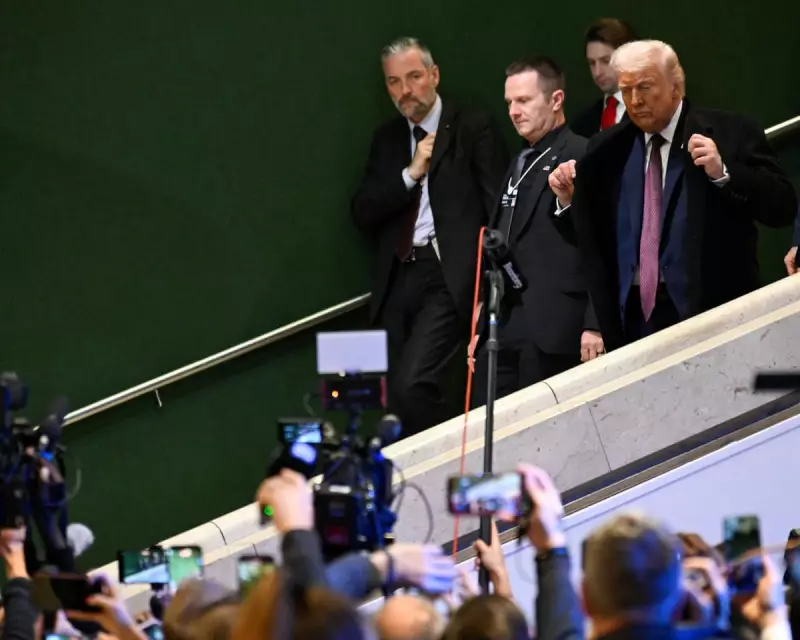
Trump's Davos Dominance: A Week of Geopolitical Turbulence and Dissent
The 56th World Economic Forum in Davos, Switzerland, was dramatically overshadowed by the presence of former US President Donald Trump, whose smash-and-grab politics and voracious geopolitical ambitions dominated the agenda. What is typically a gathering focused on global economic challenges and cooperation became a stage for intensifying great power rivalry, with Trump's threat to impose tariffs on European nations if they opposed his bid to seize Greenland setting a confrontational tone.
The Voices of Resistance
Dissenting voices were scarce but notable. Canadian Prime Minister Mark Carney emerged as a rallying figure, warning delegates that "if we're not at the table, we're on the menu." He condemned Trump's approach as a system of economic coercion and urged middle powers to band together to avoid being crushed, receiving a standing ovation for his efforts.
European Commission President Ursula von der Leyen echoed this sentiment, arguing that nostalgia for the old order was futile and calling for a new, independent Europe through strengthened trading relationships and integrated markets. French President Emmanuel Macron, speaking while sporting aviator shades due to an eye condition, declared it was "not a time for new imperialism or new colonialism," emphasising respect over bullying.

The Trump Circus Arrives
From the moment Trump agreed to attend, the forum's focus pivoted sharply. US companies secured prime locations along the Promenade, converting shops into lavish showrooms, while a church was transformed into USA House with sponsorships reportedly reaching up to $1 million. Security was unprecedented, with armed police patrolling streets and heavy weaponry installed at helipads.
When Trump delivered his rambling, invective-filled speech, the congress hall was packed to capacity, with attendees scrambling for seats and police ejecting those without. His remarks, which included racist descriptions of Somalian people as "low-IQ," were met with only muted dismay, highlighting the palpable fear of retaliation among the elite.
Populist Alliances and Corporate Caution
Trump found allies among fellow populists. Argentina's President Javier Milei praised the US as a beacon for the West, while Brexit architect Nigel Farage celebrated the shift in Davos discourse away from climate change and diversity initiatives toward his brand of politics. Farage argued that Brexit and Trump's initial win were not fleeting rages but signs of a major political transformation.
Corporate leaders largely avoided public criticism. JP Morgan CEO Jamie Dimon cautiously admitted the US had become a less reliable ally and expressed discomfort with some immigration raids, only for Trump to sue the bank and Dimon personally for $5 billion shortly after. Tech titans like Tim Cook and Jensen Huang joined Trump's entourage, but fears of economic crossfire kept them from speaking out, even as Europe considered retaliatory measures.
Ukraine Sidelined and European Dithering
The war in Ukraine risked being marginalised until President Volodymyr Zelenskyy's impassioned speech accused European leaders of being in "Greenland mode"—passively waiting for rescue. He lamented that little had changed since his previous Davos appeal for European self-defence, underscoring how Trump's threats and domestic crises had diverted attention.
European unity proved fragile, as seen when the European Parliament referred the EU-Mercosur trade deal to the court of justice, potentially delaying it for years—a blow to von der Leyen's Davos promotion of the agreement. Leaders like Macron faced domestic turmoil, while Keir Starmer avoided the forum amid political challenges at home.
A Forum Transformed
In the end, quiet diplomacy and market forces may have averted Trump's most aggressive moves, but Davos was irrevocably transformed. The circus atmosphere consumed all oxygen, pushing critical issues like the climate crisis, corruption, and Ukraine down the agenda. As Transparency International's François Valerian noted, discussions shifted from poverty and hunger to "negotiations under threat, intimidation, war." This year's gathering felt less like a mission to improve the world and more like a testament to Trump's disruptive dominance on the global stage.