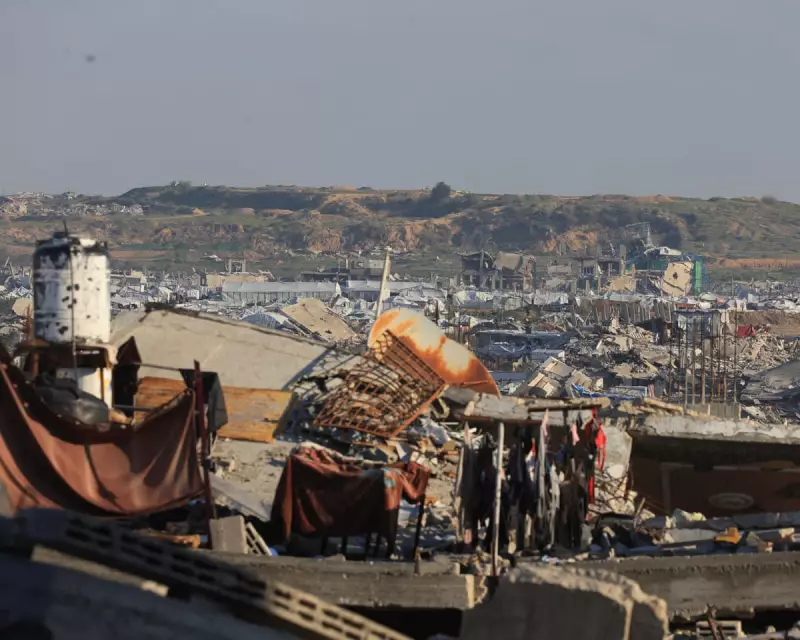
Trump Administration Unveils Ambitious Blueprint for Gaza's Future
Amid the fanfare surrounding Donald Trump's "board of peace" launch in Davos, his administration has presented a detailed and ambitious plan for Gaza's short- and long-term future. The blueprint, revealed on Thursday, outlines a vision for a unified Palestinian-run Gaza, marking a significant departure from proposals that would partition the territory between Hamas and Israeli-controlled areas.
A Rejection of Extremist Aims
The plan represents a clear rebuff to the objectives of Israeli extremists, including some within the governing coalition, who have advocated for the deportation of Gaza's population and the establishment of Israeli settlements in their place. Instead, it envisages a Gaza administered by Palestinians, with the newly formed National Committee for the Administration of Gaza (NCAG) tasked with overseeing a transition period.
The blueprint's success hinges on several critical factors: the determination of Trump and his peace board to implement it despite potential Israeli objections, and the creation of an effective mechanism within Gaza to oversee the disarmament of Hamas. This disarmament process is seen as a prerequisite for further Israeli military withdrawals from the territory, which currently occupies more than half of Gaza.

Immediate Goals and Long-Term Vision
The plan sets out achievable promises for the next 100 days, including the restoration of basic infrastructure such as water, sewage, and electrical systems, alongside hospitals and bakeries. A significant increase in the flow of goods entering Gaza is also planned. A key immediate test will be the opening of the Rafah crossing between Gaza and Egypt next week, the first time since Israeli troops seized control in May 2024.
Jared Kushner, Trump's son-in-law, presented a slideshow in Davos depicting a futuristic vision for Gaza, complete with gleaming apartment blocks, office towers, industrial parks, and even an airport. However, this vision treats the territory as a blank slate, overlooking the property rights of generations of Palestinians, and includes a buffer zone along the Israeli border.
The Role of the NCAG and Disarmament
The NCAG, a panel of Palestinian non-partisan technocrats, is central to the plan's implementation. Its chair, Chief Commissioner Ali Shaath, addressed world leaders in Davos via video link from Cairo, promising to rebuild Gaza into a centre for freedom, opportunity, and peace. Shaath, a former deputy transport minister in the Palestinian Authority, emphasised the mission to restore order, rebuild institutions, and ensure "one authority, one law, and one weapon."
This principle means that all weapon possession in Gaza would be authorised solely by the NCAG. Hamas has reportedly agreed in principle to hand over heavy weapons like rockets and artillery to a Palestinian administration and is said to be prepared to accept the NCAG's authority. To test this, Shaath and the NCAG would need to enter Gaza with a Palestinian police force trained in Jordan and Egypt.
Challenges and Political Hurdles
The plan notably makes no mention of the International Stabilisation Force (ISF), a key component of Trump's earlier peace proposals. Creating the ISF has been problematic, with potential troop contributors reluctant to confront Hamas over weaponry, and Israel rejecting Turkish or Qatari forces.
Instead, the blueprint focuses on the new Palestinian police force, with heavy weapons to be "decommissioned immediately" and personal arms registered and phased out as police capability grows. The end goal is a situation where only NCAG-sanctioned personnel carry weapons.
Political opposition remains substantial. Benjamin Netanyahu's cabinet is due to discuss the Rafah crossing opening, with some coalition members opposing it until the remains of Israeli hostage Ran Gvili are returned. Far-right elements are strongly against establishing a Palestinian interim government, preferring to empty and annex the territory.

A Glimmer of Hope for Gaza's Population
For Gaza's residents, many still living in tents under regular Israeli fire, a potentially encouraging aspect of the Davos presentation is that Trump's prestige appears tied to the ceasefire he brokered last year. This connection may provide the impetus needed to overcome the significant hurdles to a free and peaceful Gaza, harnessing the president's self-esteem to drive progress.
The plan does not explicitly state that a future Gaza would be part of a sovereign Palestinian state, but it does not rule out a unified Palestine. It is unlikely the NCAG could recruit credible Palestinian members if it did. The Israeli army's withdrawal would occur progressively based on agreed standards, though details remain vague, raising questions about compliance.