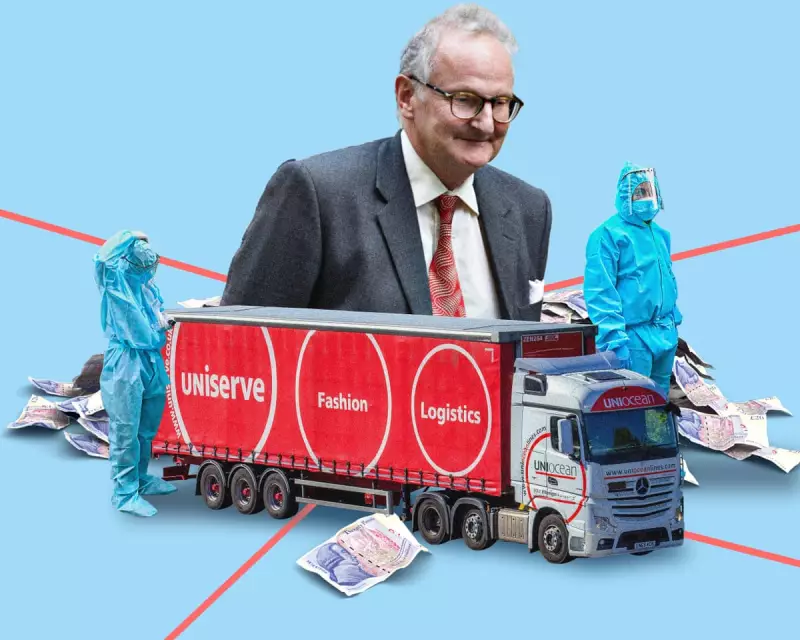
A landmark High Court judgment against PPE Medpro has cast fresh light on the UK government's pandemic procurement, revealing astonishing details about another company that secured contracts worth £1.4bn - Uniserve, which happens to share its premises with a Conservative MP's constituency office.
The £1.4bn Pandemic Windfall
When Mrs Justice Cockerill delivered her ruling against PPE Medpro - the company connected to Conservative peer Michelle Mone - for supplying unusable protective equipment, her 87-page judgment also exposed serious questions about Uniserve's role in the procurement saga. While PPE Medpro was ordered to repay £122m for faulty gowns, Uniserve's involvement in the same supply chain raised broader concerns about government spending controls.
Uniserve, an established logistics company based in Upminster on the London-Essex border, became instrumental in the government's frantic efforts to source PPE from China during the early pandemic. The Department of Health and Social Care (DHSC) paid the company £1.4bn across multiple Covid contracts, dwarfing the deals awarded to PPE Medpro.

Failed Inspections and Political Connections
Justice Cockerill's judgment revealed that Uniserve was responsible for inspecting the PPE Medpro gowns in China before shipment. Her findings indicated 'a degree of doubt' about whether proper inspections ever occurred, and whatever process was followed failed to identify that the gowns lacked proper sterile certification.
The crucial failure meant the DHSC paid PPE Medpro the full £122m when the gowns were approved for shipping, only for them to be rejected upon arrival in England after public health official Zarah Naeem spotted the invalid labelling. Had Uniserve conducted proper inspections in China, the shipment might never have left and taxpayers might not be facing the current struggle to recover funds from the now-insolvent PPE Medpro.
Uniserve's founder Iain Liddell disputes the judge's interpretation, claiming through lawyers that quality control inspections weren't required in the freight contract until late August 2020. If correct, this points to an even more alarming procurement issue: massive government spending without basic quality checks.
The VIP Lane and Political Links
How Uniserve came to secure such enormous contracts has been subject to scrutiny since the company's remarkable accumulation of government work began. The DHSC later revealed that Conservative peer Theodore Agnew introduced Uniserve to the controversial VIP lane for politically connected companies.
Remarkably, when questioned at the Covid inquiry in March, Agnew appeared unfamiliar with the company that received £1.4bn of public money, stating 'I don't even know what Uniserve is' when asked about his connection to Liddell.
More intriguing is the connection to Conservative MP Julia Lopez, whose constituency office is located on Uniserve's premises - effectively making Liddell her landlord. In 2018, Lopez had enthusiastically promoted Uniserve on social media, posing with Liddell in hi-vis jackets and describing the company as 'the UK's number one independent logistics and global trade management provider'.
Both Liddell and the Cabinet Office initially denied any contact with Lopez regarding the contracts. However, Liddell's lawyers later revealed he emailed the MP on 2 April 2020 - just as Uniserve was being steered into the VIP lane - to complain about delays in PPE supply proposals that he felt 'may cost lives'.
Civil service evidence shows that around the same time, an email chain within the Cabinet Office referenced Uniserve and asked about checking with 'Lord Agnew's private office', while another senior civil servant noted concerns that Uniserve was a 'VIP opportunity' not being processed quickly enough.
Billions in Questionable Spending
The consequences of the rushed procurement are staggering. Procurement consultant Chris Smith of Transparency International's UK Anti-Corruption Coalition calculated that the DHSC paid £9.35bn for PPE in the first four months before proper inspections began. The department later reported paying £3.3bn for PPE that was unusable in the NHS.

For Uniserve specifically, £178.5m worth of PPE it supplied was later deemed 'do not supply' by the government, though Liddell maintains this equipment passed quality standards.
The pandemic contracts transformed Uniserve's finances. Company accounts show revenues almost tripled to £562m in the 15 months to June 2020, with pre-tax profits increasing sevenfold to £46m. In the subsequent 18 months to December 2021, turnover doubled again to £1.4bn with profits reaching £144m.
In a statement, Liddell defended his company's role: 'Our engagement with the DHSC was based on our longstanding expertise in international logistics... Contracts were awarded on the basis of proven performance and capability to deliver, not on the basis of political connection.'
However, the evidence emerging from court judgments and the Covid inquiry paints a more complex picture of how companies with political connections secured billions in public money during a national emergency, leaving taxpayers to deal with the consequences years later.