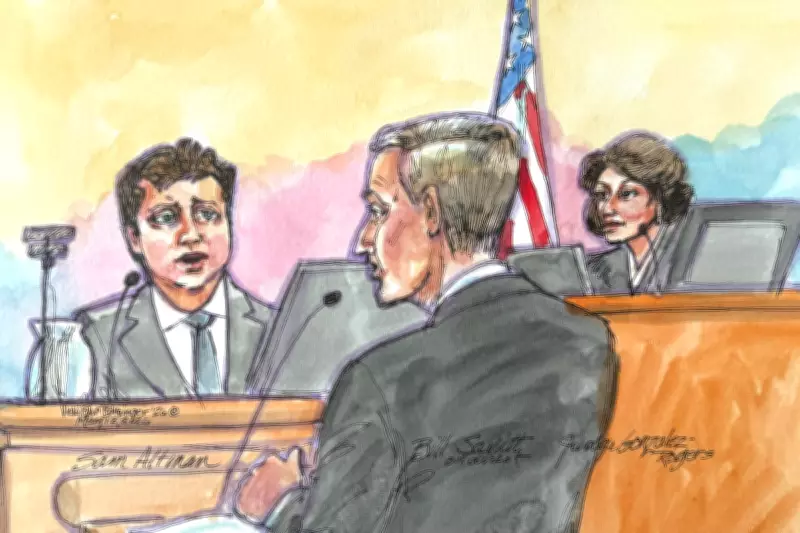
OpenAI CEO Sam Altman took the stand on Tuesday to defend himself and his company against a lawsuit filed by Elon Musk. Altman is expected to be one of the final witnesses in the trial, which has pitted two of the tech industry's most influential figures against each other in a dramatic courtroom showdown.
The Core of the Dispute
Musk has accused Altman and OpenAI of violating the AI firm's founding agreement by restructuring it into a for-profit enterprise. He alleges that Altman essentially tricked him into co-founding the company and providing tens of millions in financial backing. Musk also claims that Altman unjustly enriched himself in the process and is seeking the CEO's removal from OpenAI, the redistribution of $134 billion to the firm's non-profit, and the reversal of its for-profit conversion.
OpenAI and Altman have rejected all of Musk's claims, arguing that he is motivated by jealousy after a failed attempt to take over the AI firm in 2018 and his subsequent departure from the board. They contend that Musk was always aware of plans to create a for-profit structure and that OpenAI's non-profit still oversees the for-profit business.
Altman's Testimony
Altman's testimony is one of the marquee moments of the three-week-long trial, which has featured some of the biggest names in Silicon Valley, including Musk and Microsoft's CEO. The outcome is crucial for OpenAI, which is seeking to go public at around a $1 trillion valuation later this year. In the bitter feud between Musk and Altman, the reputational stakes are winner-takes-all.
When Altman took the stand just before 9 a.m. local time in the Oakland, California federal courthouse, he began by recapping his career in tech before addressing some of Musk's allegations directly.
“You, as you know, have been accused of stealing a charity,” OpenAI's lawyer asked Altman. “What is your response to that?”
“It feels difficult to even wrap my head around that framing,” Altman responded. “We created the largest or one of the largest charities in the world.”
“What would you say to the suggestion that OpenAI was Mr. Musk's startup?” OpenAI's lawyer asked.
“I would not agree with that characterization at all,” Altman replied.
Altman claimed that in 2017 there were discussions at OpenAI about creating a for-profit structure, but they fell through due to disagreements over ownership. Musk wanted to be CEO of the organization, Altman said. The CEO also alleged that when Musk was asked what would happen to control of the company if he died, the centibillionaire suggested it could go to his children.
“Mr. Musk felt very strongly that if we were going to form a for-profit, he needed total control over it initially,” Altman said, adding that Musk's request made him “extremely uncomfortable.”
Altman's testimony portrayed Musk as an erratic, sometimes vindictive leader while at OpenAI. He claimed that Musk had “demotivated some of our key researchers” through aggressive demands and management techniques such as ranking employees. Altman also stated that Musk was later offered a chance to invest in OpenAI's for-profit entity but turned it down because he refused to invest in companies he did not control on principle.
At one point in his opening testimony, Altman took a dig at Musk's accusation that he had “stolen a charity.”
“This whole ‘you can't steal a charity.’ I agree you can't steal it. Mr. Musk did try to kill it, I guess twice,” Altman said.
Portraying Altman as Deceptive
Altman's character and leadership of OpenAI have been a core focus of the trial, with Musk's lawyers attempting to portray him as deceptive and self-serving. Several former OpenAI executives, including those involved in briefly ousting Altman in 2023, have testified that he was untrustworthy and had a pattern of lying. Mira Murati, OpenAI's former chief technical officer, accused him of “creating chaos.”
Musk's attorney, Steven Molo, began a combative cross-examination of Altman with questions about whether he ever misled former colleagues or investors, asking if he was a “completely trustworthy” person.
“You've repeatedly been called deceptive and a liar by people with whom you've done business, right?” Molo asked.
“I have heard people say that,” Altman replied.
Molo read out a list of statements from former OpenAI executives and coworkers who suggested that Altman fed them falsehoods or misrepresented himself. Molo also tried to portray Altman as the one bent on control, rather than Musk.
“You had a fixation on this concept of being CEO, didn't you?” Molo asked.
“I don't agree with that characterization,” Altman replied.
Molo pressed Altman on his connections to other companies, suggesting potential conflicts of interest, and questioned his dual role on the board of OpenAI's non-profit and as its CEO. At one point, Molo asked Altman if he would ever fire himself.
Altman largely responded with short, yes-or-no answers and occasional claims that he did not recall exact details or disputed the characterization of events. The cross-examination was punctuated with frequent objections from OpenAI's attorney, especially when Molo brought up accusations of Altman being dishonest.
Broader Context
The trial is the culmination of several tumultuous weeks for Altman, who was the target of a molotov cocktail attack at his San Francisco home and was the subject of an unflattering, widely circulated New Yorker profile mentioned in court. Musk has also faced embarrassment, with details about his romantic relationship with former OpenAI board member Shivon Zilis becoming public, and OpenAI president Greg Brockman describing Musk throwing a tantrum during a meeting shortly before leaving the company.
The trial is set to hold closing arguments on Thursday, followed by the nine-person jury deliberating whether Altman, Brockman, and OpenAI will be held liable.