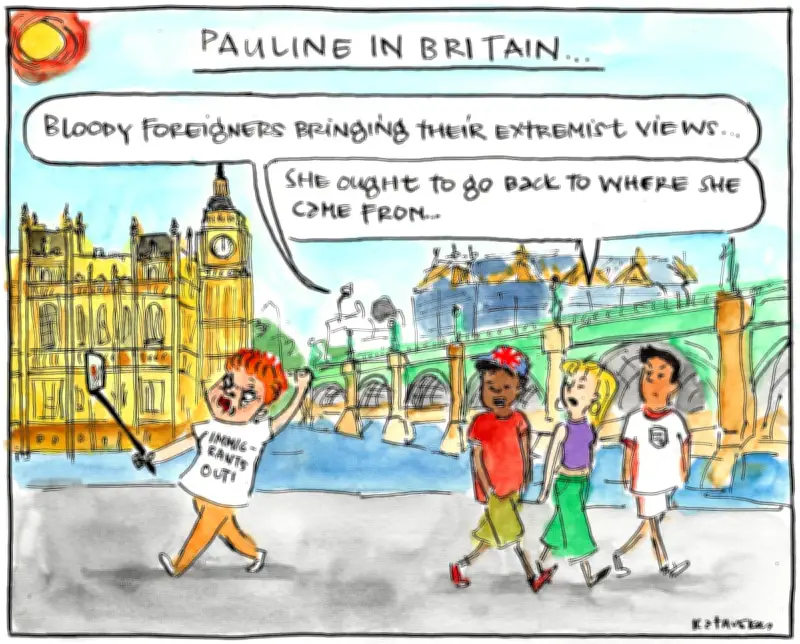
Pauline Hanson, the controversial Australian politician known for her anti-immigration and anti-Muslim rhetoric, has faced a storm of protests and condemnation during her visit to the United Kingdom. Local communities and political figures have expressed outrage, accusing her of spreading division and hate.
Protests Erupt Across the UK
In multiple cities, including London and Manchester, demonstrators have gathered to voice their opposition to Hanson's presence. Signs reading 'No to Hate' and 'Welcome to Multicultural Britain' were prominent. According to a spokesperson for the protest organizers, 'We will not stand by while someone who promotes racism and xenophobia visits our country.'
The protests have been largely peaceful, but tensions have flared in some areas. Police have increased patrols to ensure public safety. One protester said, 'Her views are dangerous, and we need to show that Britain rejects this kind of politics.'

Political Reactions
UK politicians from across the spectrum have also condemned Hanson's visit. Labour MP David Lammy called her 'a divisive figure whose ideology has no place in our society.' A spokesperson for the Home Office stated, 'While we uphold free speech, we do not endorse or welcome individuals who promote hatred.'
Hanson's visit was reportedly organized by a small far-right group, which has been criticized by mainstream political parties. The group's leader defended the invitation, claiming Hanson 'speaks the truth about immigration.' However, this view is widely rejected by the British public, according to recent polls.
Impact on UK-Australia Relations
The visit has also raised questions about its impact on diplomatic relations between the UK and Australia. An Australian government spokesperson said, 'Ms. Hanson is a private citizen and does not represent the views of the Australian government.' Nonetheless, the incident has sparked debates about the influence of far-right ideologies in both countries.
Local community leaders have called for dialogue and education to counter hate speech. 'We must engage in constructive conversations to promote understanding and tolerance,' said a community organizer in London.