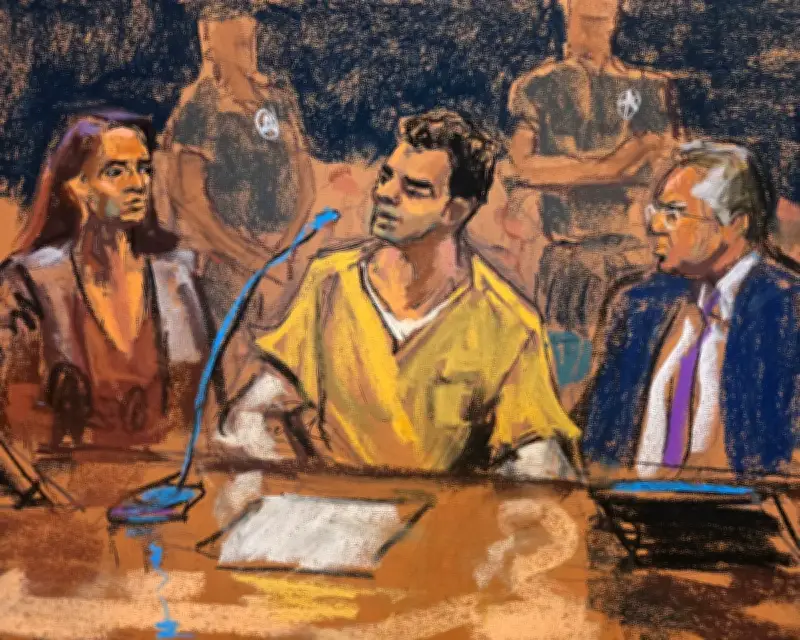
After Luigi Mangione admitted in Manhattan federal court that he killed UnitedHealthcare CEO Brian Thompson, most experts believe that the state murder case against him is highly unlikely to proceed – though some still see a slim possibility that it may yet happen.
Mangione, who pleaded guilty on 14 August to two federal stalking counts, was scheduled for a New York state trial on 8 September for murder and weapons charges in the December 2024 killing. In the wake of Mangione’s surprise plea, legal experts said New York’s state-level double jeopardy law – which means someone cannot be tried twice for the same crime – could derail his local prosecution.
Defense motion to dismiss and trial postponement
Mangione’s defense team, seizing on this law, quickly filed a motion to dismiss his state case. Judge Gregory Carro, who is overseeing the state case, decided on Monday to postpone Mangione’s trial, scheduling a proceeding for 10 December and giving both sides deadlines to file their legal arguments about dismissal.
It was a remarkable turnaround for a case that had been eagerly anticipated in the wake of Thompson’s killing on the streets of Manhattan in 2024. It had also become a flashpoint in a discourse about Americans’ struggles with the for-profit US healthcare industry, and launched Mangione himself to near folk-hero status among a hard core of supporters.
Potential sentencing and legal strategy
Now Mangione’s possible punishment in the wake of his plea potentially lifts the veil on his lawyers’ legal gambit, but points to risks associated with this strategy. Prosecutors disclosed in court that a sentencing range under federal guidelines would span from 292 to 365 months, though they vowed to seek a life sentence. And, there remain potential legal avenues for the survival of Mangione’s state case albeit very small, experts said.
Mark Chutkow, a former federal prosecutor who now practices white-collar defense at the firm Dykema, said: “At this point, it seems like his goal is to try to get out of prison sometime in his 50s, but even that path is narrowing as we speak.”
“He’s trying to do the best with the hand that he has, and it’s a difficult hand,” he added.
The defense might be betting that a federal judge would be more lenient about sentencing than Carro, who could impose a maximum 25 years-to-life sentence if Mangione were convicted in state court. The legal community has described Carro as “fairly tough on crime, fairly sympathetic to victims”, Chutkow said – so Mangione’s defense might have factored this track record into estimating a possible state sentence versus federal one.
Federal vs. state prison considerations
Joseph McNally, a former federal prosecutor who now directs emerging litigation at McNicholas & McNicholas, said he expects Mangione will receive a life sentence – or something close. Even though this would be a possible outcome in a state trial, Mangione’s defense would still see resolving this case federally as more desirable.
“Serving out long-term imprisonment, including life imprisonment, it’s typically better and safer for an inmate to be in federal prison than state prison,” McNally said. Although federal prison is no “country club”, with Mangione facing the strictest of prisons, “if you ask somebody: would you rather serve your time in state custody or federal custody? An inmate would say that they’d rather serve their sentence in federal custody.”
Jeffrey Greco, a former prosecutor who now helms defense firm Greco Neyland, said: “At the end of the day, there is a very good chance Mangione is still doing life in prison. The only difference: is he doing it in a federal lockup, or is it a state facility upstate?”
Though legal experts generally believe Mangione’s state case is all but done, prosecutors are likely poised to explore nuances in the law to argue that it should persist. The Manhattan district attorney’s office certainly says it is going to continue fighting the case, remarking in a post-plea statement: “While federal sentencing is pending, we are prepared to litigate the defense motions. The Manhattan DA’s office remains committed to seeking justice for Mr Thompson and his family.”
Double jeopardy exceptions and prosecution arguments
Jeremy Saland, a defense attorney who worked as a prosecutor in the Manhattan district attorney’s office, explained that state and federal authorities are typically allowed to pursue parallel cases. New York has its own double jeopardy law, however, stipulating that a person cannot be prosecuted for the same thing in state court if it stems from “the same underlying criminal transaction”.
“But, there are some exceptions,” Saland said. Are the elements of the crime different? What harm is the legislature trying to protect against with state laws? “If they’re different and there’s different elements, then is there a window to say you know what, this would be the exception to the double jeopardy,” Saland said. “We understand and we know that he pleaded guilty to a stalking charge, and we also know that in the state case, he’s facing a ‘murder two’ charge.”
Saland said he believes that the Manhattan district attorney’s office will focus on the distinction between the elements of these crimes and intended harm. “You have one that is an intentional murder, meaning: ‘I intentionally sought to kill you. This was my purpose and goal.’ And that would be the state. Whereas on the federal level, it’s different. You’re stalking someone and as a result, that causes death, but it was not your intent, as per the statute, to murder that person.”
“It could put them in fear of their life for sure, but that’s very different. You may have killed that person for sure,” he continued, noting that while Mangione admitted to killing Thompson, “he did not say, nor was it required by the statute, that he intentionally killed Brian Thompson.”
Maurice Johnson, a former prosecutor with the Manhattan district attorney and federal prosecutor in south Florida, now a partner at Lewis Brisbois Bisgaard & Smith, voiced similar sentiments about a possible prosecution strategy. “I think what the prosecution is going to argue is: your honor, this defendant pled guilty to stalking in the federal system. We are charging him with second-degree murder and other charges.” He said of state prosecutors’ potential argument: “These are separate elements so technically, these are not the same offense. It may be stalking there, but it’s murder here.”
Johnson believes that Mangione will likely be able to avoid state charges. While Mangione admitted to killing Thompson, this admission overlaps with the state murder charge, in his view. In Chutkow’s view, the Manhattan DA’s office has already been laying the groundwork to make this argument, pointing to a July letter filed amid rumors of plea talks. In that letter, Manhattan state prosecutors said any guilty pleas “must account for the seriousness of defendant’s offenses, the loss of an innocent life, the impact of those crimes on the victim’s family, and the other state interests that are implicated, including the sanctity of life principle that underpins the state homicide charges”.
“I do think that the state does have a pretty good argument here, but this is relatively untested,” Chutkow said, noting that there is not an abundance of state appeals court decisions that would readily settle this issue. “There hasn’t been a lot of case law, and so I think the Mangione team is, in essence, throwing up a Hail Mary to see if they can’t land that touchdown by getting the state prosecution barred.”