
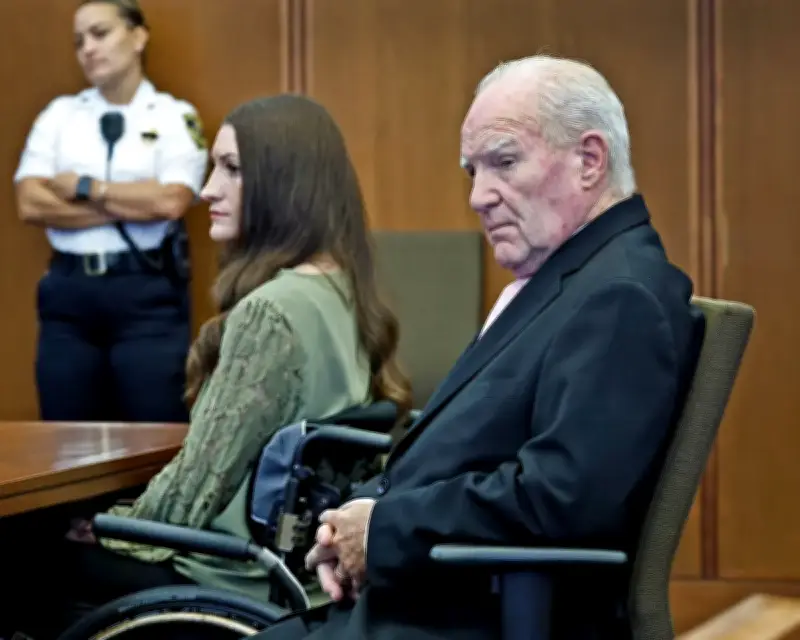
The jury in the Lindsay Clancy trial began a seventh day of deliberations on Friday, following a day in which the jury's foreperson informed the judge that a single juror would not follow the court's instructions regarding reasonable doubt. This extraordinary disclosure, delivered as a note to the judge, has provided the clearest indication yet of the obstacle preventing a verdict on whether the Massachusetts mother is criminally responsible for the deaths of her three children.
Jury deadlock and the note that changed the proceedings
The trial, which has drawn intense public interest for over a month, has deeply divided opinion on whether Clancy should be punished for the killings and has cast a spotlight on maternal mental health issues after childbirth. For the second time, the jury told Judge William Sullivan that it could not agree on a verdict. On Thursday, Sullivan questioned each juror individually in private before rereading his instructions, emphasizing that proof beyond a reasonable doubt does not mean proof beyond all possible doubt. He reminded the jurors that the burden of proof rests with the prosecution before sending them back to continue deliberations.
The jury resumed work on Friday, but only after the judge rejected a request from Clancy's attorney to individually question the juror who was the subject of the note about reasonable doubt instructions. “Reading that note carefully and strictly,” Sullivan said, “that note does not indicate this is a person who refuses to follow the law.”
Defense request to dismiss juror denied
Clancy's lawyer, Kevin Reddington, had asked Sullivan on Thursday to dismiss the juror, arguing the person had refused to follow the judge's instructions. Prosecutors objected, and Sullivan declined to remove the juror. “I don't feel it is proper for me to side with one side or the other of the deliberations,” the judge said on Thursday. “I don't feel it's appropriate for me to say, 'I agree with one juror or the 11.' I have asked if they are able to follow my instructions. They swore earlier that they could.”
In a notable moment, and for the first time in the trial, Clancy was brought to join a sidebar conversation with the judge. Clancy, who is paralyzed from the waist down after a suicide attempt, uses a wheelchair, which Reddington pushed to the front of the courtroom. “She has a right to know what's going on,” he later told reporters.
Clancy's actions and the legal arguments
Clancy, a 36-year-old former labor and delivery nurse, does not deny strangling her children in the basement of their home in 2023 before attempting to take her own life. Her attorney argues that postpartum psychosis led to her actions, while prosecutors maintain she knew what she was doing when she killed Cora, Dawson, and Callan Clancy, ages five, three, and eight months. The prosecution contends she deliberately sent her then-husband on errands to get him out of the house and has questioned the seriousness of her suicide attempt.
If the jury cannot ultimately agree on a verdict, the judge could declare a mistrial. In that case, prosecutors would have to decide whether to retry Clancy, drop the charges, or negotiate a plea deal with her lawyer. If the jury decides Clancy was criminally responsible, it could convict her of murder or manslaughter. If acquitted, a judge could still order her confined to a mental health facility if an evaluation determines she poses a danger to the public. In the US, the national maternal mental health hotline is 1-833-852-6262. In the UK, the Pandas foundation offers support via WhatsApp on 07903 508334. In Australia, the national maternal and perinatal mental health hotline is 1300 726 306.




